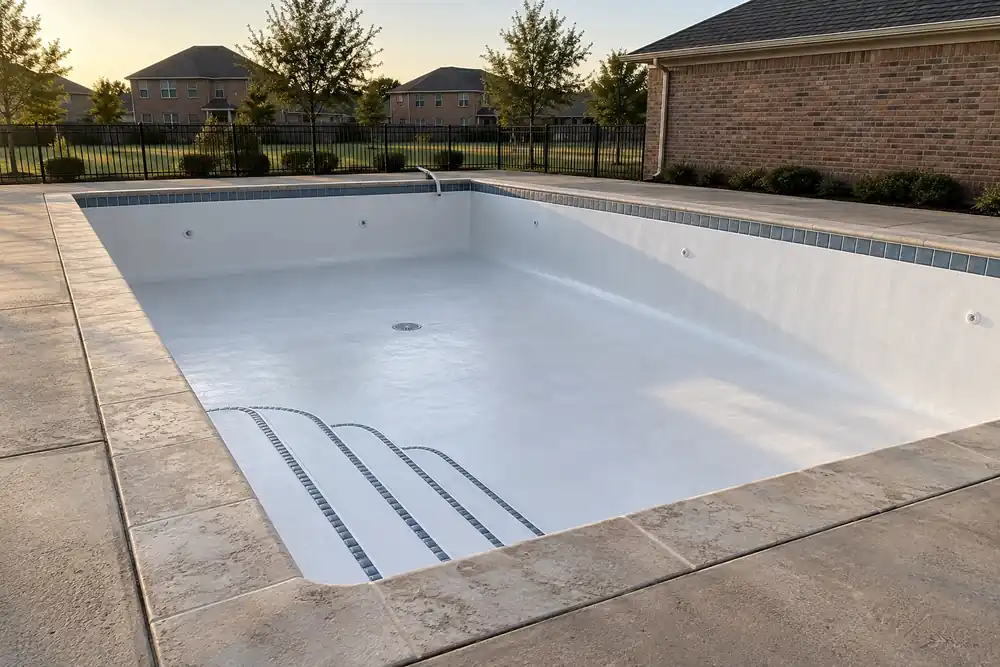
Pool Deck Resurfacing in Flower Mound, TX
Flower Mound Pool Resurfacing handles pool deck resurfacing in Flower Mound, Texas: cleaning and stripping the old concrete, filling cracks, keeping the joints open, and laying a new acrylic spray-texture coating or cement-based overlay. SUNDEK, one coating maker, describes its acrylic system as about as thick as two stacked quarters, just under a quarter inch, and uses it to feather uneven spots up to 2 inches deep.
Request a free estimate, any time. We'll talk through the coating, the cracks and joints in your deck, and a stretch of dry weather for the work.
Call or request a free estimate any time, 24/7
No charge · answered 24/7
Get free estimates
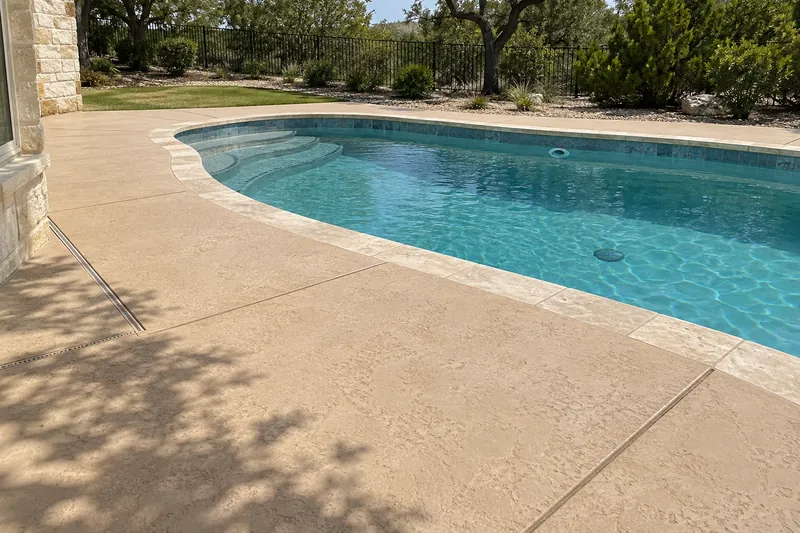
Pool deck coating and resurfacing options
Acrylic spray-texture (knockdown) coatings
A knockdown coating is sprayed onto the concrete and then knocked down with the edge of a trowel, leaving a slip-resistant texture that is comfortable underfoot; once it dries, SUNDEK sprays two acrylic finish coats for the color and the protection. SUNDEK builds its system in 4 to 8 layers, depending on the surface and the pattern, and a typical installation takes about 2 to 8 clear, dry days.
Cement-based overlays and resurfacers
Sider-Crete's Sider-Deck is a cement-based, polymer-modified texture sprayed from a hand-held hopper gun and knocked down with a stainless steel trowel; the texture covers 70 to 80 percent of the concrete, and an acrylic, silicone-enhanced sealer gives the final color. QUIKRETE's Re-Cap Concrete Resurfacer is a thinner fix, a polymer-modified portland cement that restores worn or scaled concrete, spread from a feather edge of 1/16 inch up to 1/2 inch.
Roll-on and polymer systems
Tuff Coat is a single-component, water-based non-skid coating that cross-links urethanes, acrylics and co-polymers with recycled rubber granules and dries 30 to 35 mils thick. Mortex's Systex is a three-step polymer deck system that the maker says resists oil and grease stains better than plain concrete and stands up to high heat.
Cool deck, stamped concrete and stone
Kool Deck, the cement topping Mortex invented in 1962, is its own job, covered under cool deck repair and resurfacing. Stamping presses a pattern into wet concrete or into a special coating, and where the old slab is replaced rather than coated, the new deck can be poured as stamped concrete pool decks or laid as travertine and paver pool decks.
Flower Mound Pool Resurfacing will talk through which surface suits your deck and the way you use it.
Call or request a free estimate any time, 24/7.
(469) 526-3886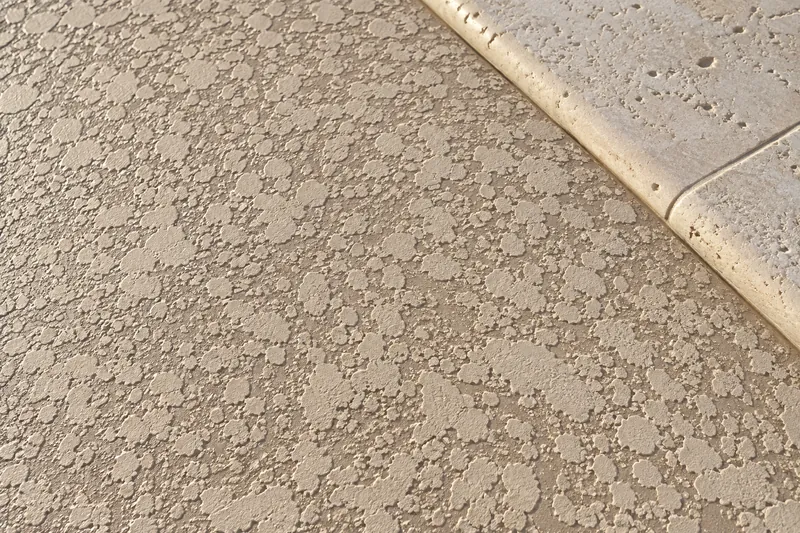
Preparing an old pool deck for a new surface
Cleaning and stripping
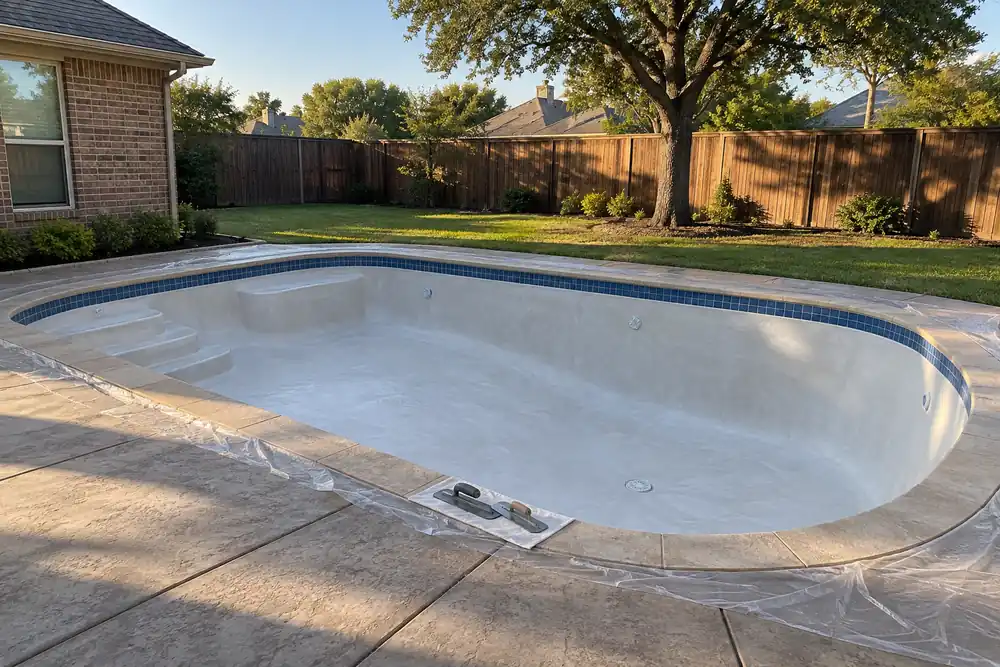
The makers start from clean, sound concrete. SUNDEK power-washes at high pressure and removes dirt, grease, oil and curing compounds, and its coating can't go over paint, so painted concrete is stripped back to the original surface. QUIKRETE calls a 2500 PSI wash essential to the bond and applies its resurfacer only to bare concrete, never painted or sealed, while Sider-Crete takes off old paint and loose material by water blasting, sandblasting or wire brushing and lays a thin plastic tarp on the pool water, taped at the edges, so nothing falls in.
Cracks and joints
SUNDEK fills most cracks with urethane before coating and leaves hairline and shrinkage cracks alone; a treated crack may come back, usually as a hairline largely hidden in the texture. QUIKRETE is blunter: reflective cracking can't be completely prevented, especially where a slab lacks enough control joints or has settled, and old cracks can reappear when the base concrete moves. Both keep the existing control and expansion joints open, and SUNDEK replaces worn-out expansion joints. Before any topping, Mortex has the major cracks and structural damage in a deck fixed well in advance, and that part is pool deck repair work.
Slope, puddles and drainage
SUNDEK's specification calls for drainage of at least 1/4 inch per linear foot and says a coating doesn't guarantee a drainage fix, though a low spot can sometimes be moved, or made wider and shallower so the sun dries it sooner, if the installer is told beforehand. The 2021 International Swimming Pool and Spa Code caps the slope of a non-wood pool deck at 1/2 inch per foot and allows no more than 1/8 inch of standing water 20 minutes after water stops being added.
Flower Mound Pool Resurfacing will talk through the cracks, hollow spots and puddles on your deck before a coating is chosen.
Call or request a free estimate any time, 24/7.
(469) 526-3886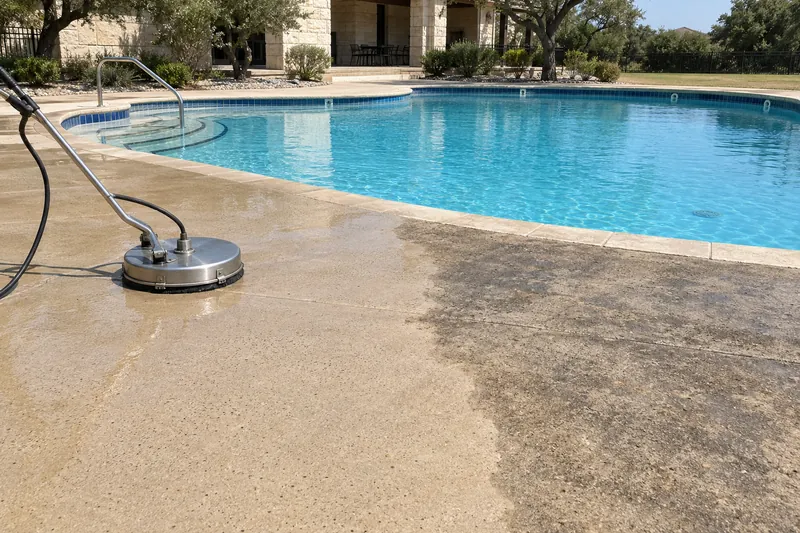
How a pool deck coating goes on
SUNDEK's specification for its spray-texture system sets the order:
Primer and base coat
A primer is sprayed or rolled on, then a base coat at least 1/8 inch thick blends the surface and is left to dry.
Texture
A stipple coat goes on through a smaller spray tip, then a splatter coat is knocked down with a flexible pool trowel.
Joints and repairs caulked
Joints and repairs are caulked at this stage, before the color goes on.
Two finish coats
Two finish coats go on by roller or airless sprayer, each drying completely before the next.
Protection
The deck is kept free of moisture, freezing and foot traffic for 24 hours, and vehicles wait 72 hours.
Sider-Crete's timing for its cement texture runs the same way: the sealer goes on 24 to 48 hours after the texture, three days at most, in two thin coats at least 2 to 4 hours apart, the second at right angles to the first. Light foot traffic waits 24 hours, use stays light for 48, and patio furniture, hard-soled shoes and heavy use wait at least a week. Sider-Crete always recommends a knockdown texture for the most slip resistance and doesn't present its system as slip-proof.
Flower Mound Pool Resurfacing will talk through the coats and the drying days for your deck.
Call or request a free estimate any time, 24/7.
(469) 526-3886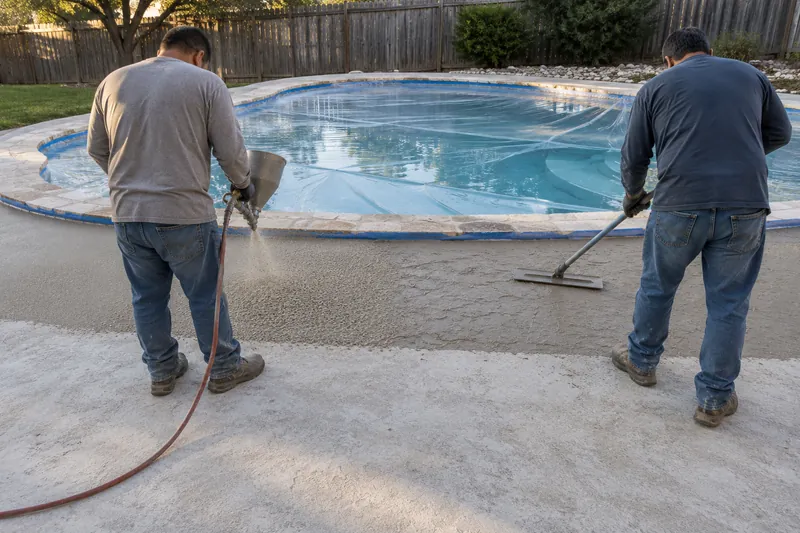
Pool decks in Flower Mound: clay, weather and permits
Clay under the slab
Soil maps put about a third of Flower Mound's land, 33.9 percent, on soils that NRCS rates Very limited for homes with shrink-swell as a full-weight reason, among them Navo and Wilson clay loams, whose linear extensibility reaches 7.5 percent. The Birome and Aubrey soils of the town's largest map unit are rated Very limited for concrete driveways and sidewalks too, mainly because they are too acid, and High for concrete corrosion. Denton County's 1980 soil survey explains the force involved: clays rich in montmorillonite swell in wet spells and shrink and crack in dry ones, pressing hard enough to crack walls and foundations unless they are specially reinforced, and sometimes even then. That base movement is what QUIKRETE says a new surface can't fully hide.
Heat, rain and freezes
NOAA's 1991–2020 normals for Grapevine Dam average 104.3 days a year at 90°F or hotter. QUIKRETE applies its resurfacer only with the air and concrete between 50°F and 90°F, Tuff Coat paints between 9 a.m. and 4 p.m. at 40°F to 90°F so dew can't spoil the coat, and Sider-Crete warns that hot concrete can make its material set too quickly. Rain matters as much: SUNDEK doesn't coat exterior surfaces in wet weather, and Grapevine Dam's wettest months are May, with 4.73 inches, and October, with 4.46. The same station averages 44.3 nights a year at or below freezing, and Sider-Crete keeps air and surface at 45°F or above through application and drying and never coats frozen concrete.
Code and permits
If an overlay raises the deck, the 2021 code still limits the height difference between the pool deck and an adjoining sidewalk to 1/4 inch and the open gap between them, joint material included, to 3/4 inch. Permits are less clear-cut. The Town of Flower Mound's residential permit guidelines name two cases: any wood deck needs a permit, while concrete flatwork goes without one so long as it isn't structural, isn't joined to the driveway or the house's foundation, and stays clear of the public right-of-way. Coating a slab that is already there isn't mentioned, so check with the Town's Building Inspections before the coating goes on.
Oak Point, one of the towns we serve, has its own page on pool deck resurfacing in Oak Point. Flower Mound Pool Resurfacing will talk through the soil, the season and the permit question for your deck.
Call or request a free estimate any time, 24/7.
(469) 526-3886Pool deck resurfacing costs around Dallas–Fort Worth
- Basic acrylic coating, per sq ft (DFW, 2026)
- $3–$6
- Decorative overlay or concrete coating, per sq ft (DFW, 2026)
- $6–$12
- Stamped or custom-texture overlay, per sq ft (DFW, 2026)
- $10–$20
- Quality decorative coating, 500 sq ft deck (DFW, 2026)
- $3,000–$6,000
- Replacing the concrete, same 500 sq ft (DFW, 2026)
- $8,000–$15,000
Published averages and other companies’ ranges, not our prices. A real price needs a look at the deck.
Dallas averages for 2026 put pool deck resurfacing at $3,000 a job. National figures from 2025 put resurfacing at $3 to $12 a square foot, $1,500 to $10,800 for decks of 500 to 900 square feet, and sealing at $1 to $3 a square foot.
Call or request a free estimate any time, 24/7.
(469) 526-3886Pool deck resurfacing questions and answers
What is the average cost of resurfacing a pool deck?
Around Dallas, the 2026 average for resurfacing a pool deck is $3,000, and typical Dallas–Fort Worth figures for the same year run $3 to $6 a square foot for a basic acrylic coating and $6 to $12 for a decorative overlay. Flower Mound Pool Resurfacing measures the deck before pricing it.
What are the best options for resurfacing a concrete pool deck?
The makers' systems fall into three groups: acrylic spray-texture coatings such as SUNDEK's, cement-based overlays such as Sider-Deck and QUIKRETE's Re-Cap, and roll-on coatings such as Tuff Coat, with Kool Deck as a cement topping of its own. Whichever is chosen, the old paint has to come off first and the control and expansion joints stay open.
Is painting a pool deck a good idea?
The coating makers are wary of it. SUNDEK's coating and QUIKRETE's resurfacer both need bare concrete, so old paint comes off first, and Tuff Coat sands and primes old paint only when it is in good condition. On a cool deck, Mortex says its own Systex Deck Paint gives no cooling and leaves the painted area hotter and slicker, and W. R. Meadows says its DECK-O-SEAL joint sealant can't be painted, because paint less flexible than the sealant may crack and fail.
How long does pool decking last?
Typical Dallas–Fort Worth figures for 2026 give acrylic coatings 3 to 5 years in the local climate, quality decorative overlays 10 to 20 years with routine maintenance and stamped concrete overlays 15 to 25 years. Another Dallas figure for 2026 puts a resurfaced deck at 8 to 15 years, depending on the material and the installation.
How long before you can walk on a resurfaced pool deck?
It depends on the system. SUNDEK's specification protects a new coating from moisture, freezing and foot traffic for its first 24 hours, and from vehicles for 72. Sider-Crete's cement texture waits on its sealer, which needs 24 hours of drying before light foot traffic; the deck then takes only light use for 48 hours, and furniture, hard-soled shoes and heavy use stay off it for at least a week.
Get a free pool deck resurfacing estimate
Flower Mound Pool Resurfacing answers calls and estimate requests 24/7. Tell us about the surface of the deck now, any cracks or low spots, and the finish you have in mind.