Pool Tile Repair and Replacement in Flower Mound, TX
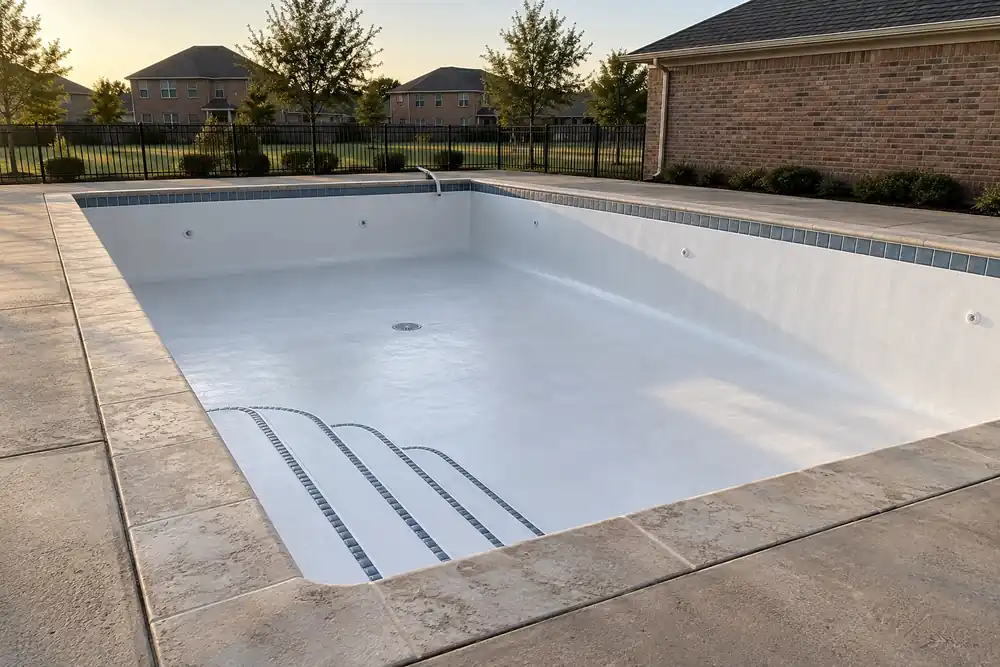
Flower Mound Pool Resurfacing handles pool tile repair and replacement in Flower Mound, Texas: cutting out cracked or loose waterline tile, regrouting failed joints, setting new porcelain, stone or glass tile, and resealing the joint under the coping. The National Plasterers Council's glossary calls the tile line the perimeter tile, simply the water line tile, and tile goes there because it cleans of deposits fairly easily and holds up both in and out of the water, unlike plaster, quartz and pebble finishes, which must stay under water. For the tile itself, LATICRETE's pool guide sets water absorption limits: under 0.5 percent for impervious tile and under 3.0 percent for vitreous, the only two kinds it allows.
Request a free estimate, any time. We'll talk through which tiles have let go, what made them fail, and whether a repair or a new tile line suits your pool.
Call or request a free estimate any time, 24/7
No charge · answered 24/7
Get free estimates
Pool tile types and setting materials
Porcelain, ceramic, stone and glass
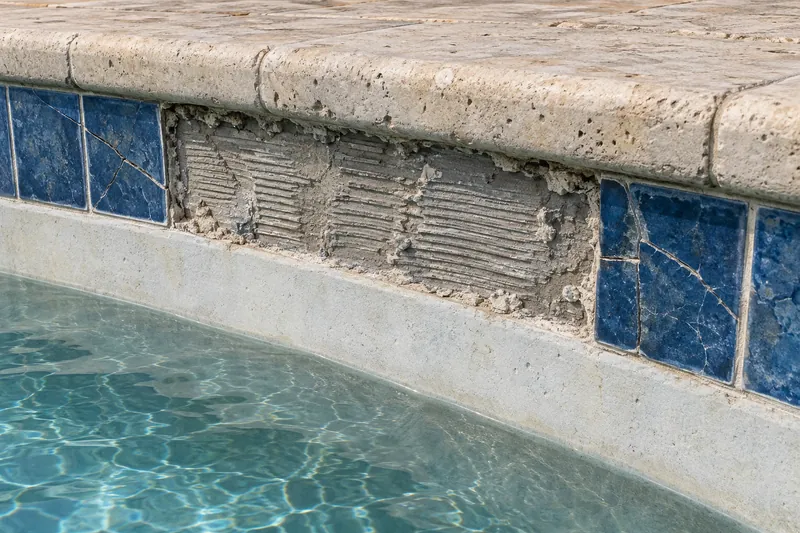
LATICRETE's pool guide allows only impervious tile, under 0.5 percent water absorption, or vitreous tile, under 3.0 percent, because tile that absorbs more than 3 percent may permanently expand from moisture. For mosaics it recommends paper face-mounted sheets and urges caution with sheets held by PVC dots or adhesive mesh, whose bond can be very low once soaked in pool water; the glass maker Interstyle requires face-mounted or dot-mounted glass under water, so the two makers differ on dot mounting. Glass also chips and cracks more readily than porcelain, so keeping spare tiles for later repairs is the usual advice. A pool tiled all over, not just at the waterline, is covered under glass tile pool finishes.
Thin-set, grout and the standards
The 2021 International Swimming Pool and Spa Code points to ANSI A108, A118 and A136.1, the American National Standards for installing tile and for tile-setting materials, for tile in pool and spa shells. MAPEI's pool specification, published with Daltile, follows the Tile Council of North America's method P602: a cement bond coat to ANSI A118.4 or better, epoxy grout to ANSI A118.3 or cement grout to ANSI A118.6 or better, and a flexible sealant meeting ASTM C920. LATICRETE's epoxy grouts contain no portland cement and aren't affected by pool water treatment, and it says cement grouts break down in submerged work more often than a good epoxy grout.
Glass needs more care. Interstyle makes back-buttering mandatory so water can't collect in voids behind the tile, LATICRETE asks for at least 95 percent mortar coverage after the tile is beaten in, and Oceanside Glass & Tile lists bright-white thin-sets because the setting material and flattened trowel marks decide how translucent glass looks. Grout sand is disputed: Oceanside says its tile takes sanded cement grout without scratching, while LATICRETE and Interstyle say sand may scratch glass and point to unsanded or epoxy grout.
Flower Mound Pool Resurfacing will talk through the tile, the thin-set and the grout that suit your pool.
Call or request a free estimate any time, 24/7.
(469) 526-3886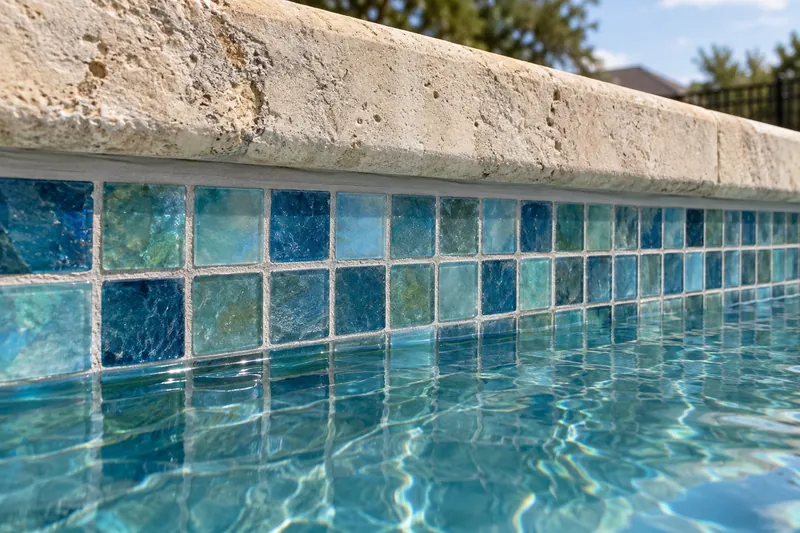
Why pool tile cracks, comes loose and stains
Grout and water chemistry
LATICRETE lists six reasons cement grout loses strength in pools: poor water chemistry, filling the pool too soon, no allowance for movement, the wrong grout, poor surface preparation and poor installation. Water that runs high in pH leaves mineral deposits on tile and grout, mostly at the waterline, and deposits that form behind a tile can push it loose; water that runs low in pH etches cement until the grout turns rough or crumbles and the mortar under the tile starts to fail. Iron and copper from the source water also drop out at normal pool pH and can stain tile, grout and fittings. Waterline scale on its own is a cleaning job, covered under pool tile cleaning and calcium removal.
Movement at the top of the wall
A horizontal crack running along the tile line usually comes from movement: the deck pushing on the coping where no flexible joint is working, or the leveling mortar on top of the bond beam letting go. Oceanside Glass & Tile therefore requires a flexible sealant rated for submerged use, not grout, between the tile and anything that restrains it, such as the coping or deck, at inside corners and over joints in the shell, with movement joints in the field at most every 8 feet for glass tile and every 12 feet for porcelain or ceramic, under the Tile Council of North America's method EJ171. LATICRETE adds that the joints allow for long-term moisture expansion and for shrinkage when the pool is emptied, and Interstyle fills them with 100 percent silicone meeting ASTM C920, never hard grout, because glass moves a lot with temperature. When the cap above has shifted too, pool coping repair deals with it before the tile is reset.
Flower Mound Pool Resurfacing will talk through the cause before any tile is replaced.
Call or request a free estimate any time, 24/7.
(469) 526-3886How pool tile is repaired or replaced
Cutting out cracked or loose tile
Each cracked or loose tile is cut out around its edges with an angle grinder or circular saw fitted with a dust attachment, the old thin-set is ground off down to the concrete, and the new tile goes back in a submersion-rated adhesive, with care not to damage any waterproofing membrane underneath. LATICRETE wants the shell free of dirt, dust, curing compounds, sealers and any residue that could act as a bond breaker, with no standing water, and doesn't recommend acid-cleaning it when other methods will do, since poorly rinsed acid can leave chlorides that weaken the bond.
Regrouting the tile line
To regrout, LATICRETE removes the old grout with a medium- to high-pressure washer, or saw-cuts the joints with diamond blades, down to sound grout or bedding mortar, then vacuums, rinses and lets the joints dry completely. For cracked grout at the waterline alone, the usual repair lowers the water below the tile line, clears the loose grout with a grout saw or an oscillating tool, presses in new grout and lets it set before the water goes back up.
New tile over old
New tile can go over existing pool tile with a suitable thin-set, LATICRETE says, but only when the pool is in good condition and the old tile is well bonded: the old tile is scrubbed and rinsed, loose or damaged pieces are fixed, a thin skim coat goes on, and the new tile is beaten into fresh mortar.
Cure time and the refill
LATICRETE's minimum cure before refilling is 14 days at 70°F for latex-fortified cement grout and 10 days at 70°F for epoxy grout, and Oceanside asks for at least 21 days for its submerged tile unless the thin-set and grout maker says otherwise. No acid-based cleaner touches LATICRETE grout before the fill, and the water then goes in at about 2 feet per 24 hours, the same rate LATICRETE uses for draining, so pressure from behind can't pop tile or mortar loose.
Pebble Technology International notes that a remodel usually does the pool finish and the waterline tile at the same time, which is where pool remodeling comes in. Flower Mound Pool Resurfacing will talk through a spot repair, a regrout or a new tile line.
Call or request a free estimate any time, 24/7.
(469) 526-3886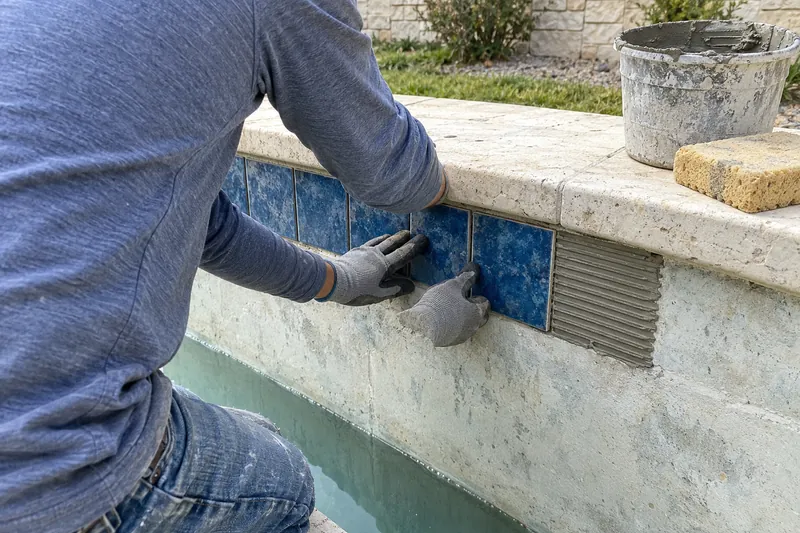
Tiling in Flower Mound's heat and freezes
Tile makers set a working window. MAPEI keeps the surface and air between 50°F and 95°F while tiling and for at least 7 days after, and Oceanside puts the ideal range for most thin-sets and grouts at 50°F to 90°F and shields outdoor tile from direct sun, heat, wind and rain while it cures. NOAA's 1991–2020 normals for Grapevine Dam put the normal high at 95.3°F in July and 95.7°F in August, just above MAPEI's ceiling, so shading the work, as Oceanside asks, is part of a summer job. LATICRETE also says not to refill a tiled pool when cold water would hit a shell heated by days of sun, and its maintenance guide keeps the fill water within 10°F of the shell.
Winter brings the opposite risk. At the same station NOAA gives a 50 percent chance of the last spring freeze coming by March 14 and the first autumn freeze by November 17, and LATICRETE's low-absorption rule doubles as its guard against freeze/thaw damage in exterior pools in cold climates. Before any of it, Flower Mound's amendments to the 2024 International Swimming Pool and Spa Code ask anyone planning to alter or repair a pool to apply to the code official, so check with the Town's Building Inspections whether a tile job needs a permit.
Homeowners in Corinth will find the same work under pool tile repair in Corinth. Flower Mound Pool Resurfacing will talk through timing, shade and the permit question when your tile is measured.
Call or request a free estimate any time, 24/7.
(469) 526-3886Pool tile repair and replacement costs around Dallas–Fort Worth
- Targeted waterline repair, per linear ft (DFW, 2026)
- $15–$30
- Full waterline, 80–120 linear ft (DFW, 2026)
- $1,200–$3,600
- Full retile, most home pools (DFW, 2026)
- $3,000–$8,000
- Ceramic tile replacement, average (Dallas, 2026)
- $3,000
- Glass tile replacement, average (Dallas, 2026)
- $3,500
Published averages and other companies’ ranges, not our prices. A real price needs a look at the pool.
Installed tile alone runs, per square foot, $5 to $25 for porcelain, $15 to $40 for natural stone and $10 to $50 for glass mosaic in typical Dallas–Fort Worth figures for 2026, and fixing a bad old installation or a damaged surface underneath can add $500 to $2,000. National figures from 2025 put regrouting at about $3 a square foot. The same Dallas–Fort Worth figures say tile and coping usually wear out around the same age, after 15 to 20 years of sun, water and chemicals.
Call or request a free estimate any time, 24/7.
(469) 526-3886Pool tile repair questions and answers
How can I repair a cracked pool tile?
Replace it rather than fill it. LATICRETE's repair sheet cuts around the cracked tile with a grinder or saw, grinds the old thin-set off to bare concrete and sets a new tile in a submersion-rated adhesive. It also says to work out first why the tile cracked, since movement, water chemistry or a poor bond will crack the new one too. Flower Mound Pool Resurfacing prices a tile repair after seeing the pool.
Can you replace pool tile without draining the pool?
It depends on where the tile is. For grout at the waterline, the usual repair lowers the water only below the tile line; for new tile, LATICRETE wants the area clean and free of standing water before anything is set. If a tiled pool does have to be emptied, LATICRETE drains and refills it at about 2 feet per 24 hours, and notes that keeping a pool full protects the tile bond from water pressure in the ground behind the shell.
How much does it cost to repair pool tiles?
Typical Dallas–Fort Worth figures for 2026 put targeted waterline tile repair at $15 to $30 a linear foot, depending on the tile and how much prep the surface needs, and national figures from 2025 put tile repair at $25 to $30 a square foot including labor.
How much does it cost to replace pool tile?
Around Dallas–Fort Worth in 2026, replacing a whole waterline of about 80 to 120 linear feet usually runs $1,200 to $3,600, and retiling most home pools $3,000 to $8,000, with bigger pools, complex shapes, spas and water features costing more.
What is the best product to reattach pool tiles?
The makers name a class of material rather than one product. LATICRETE asks for mortar suited to continuous submersion, with latex-fortified mortars for adhesion and flexibility and epoxy adhesives where chemical attack is the worry, and for glass Oceanside calls for a thin-set meeting ANSI A118.4, ANSI A118.15 or ISO C2.
Get a free pool tile repair estimate
Flower Mound Pool Resurfacing answers calls and estimate requests 24/7. Tell us which tiles have cracked or come loose, the kind of tile, and the coping above it.