Pool Plaster Repair in Flower Mound, TX
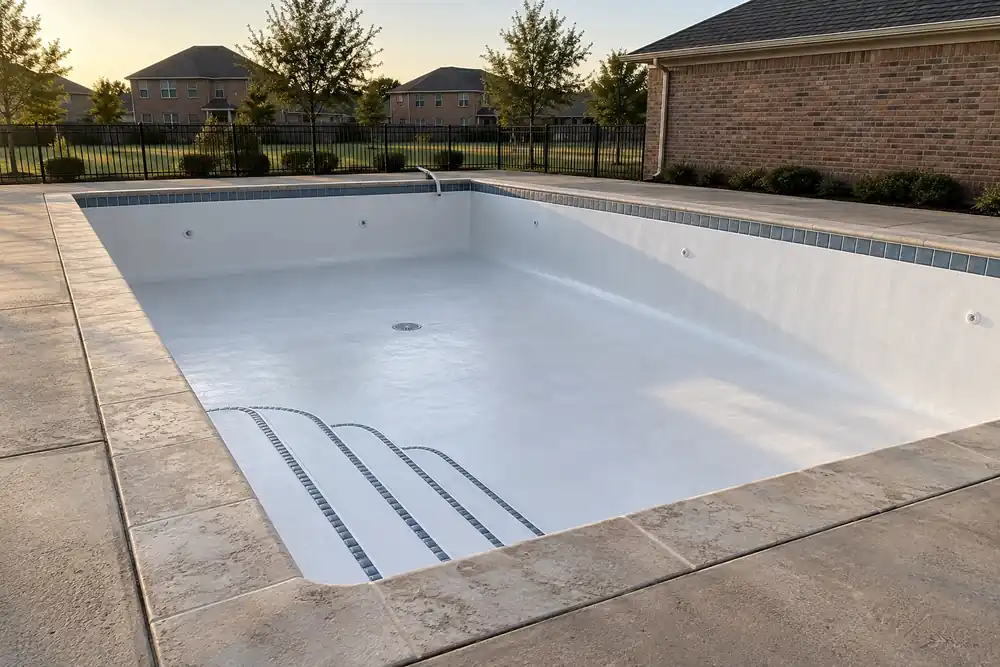
Flower Mound Pool Resurfacing handles pool plaster repair in Flower Mound, Texas: sounding out hollow and delaminated spots, cutting out and patching loose plaster, sealing small cracks, and treating scale and metal stains. The National Plasterers Council says resurfacing becomes necessary when cracks and deterioration of the finish can no longer be patched or repaired, or when the pool's appearance is no longer acceptable. Small cracks in a concrete or gunite pool cost $100 to $200 to repair by national figures from 2025.
Request a free estimate, any time. We'll talk through what has gone wrong with the plaster, what caused it, and whether a patch will hold.
Call or request a free estimate any time, 24/7
No charge · answered 24/7
Get free estimates
Pool plaster problems and how to tell them apart
Delamination and hollow spots
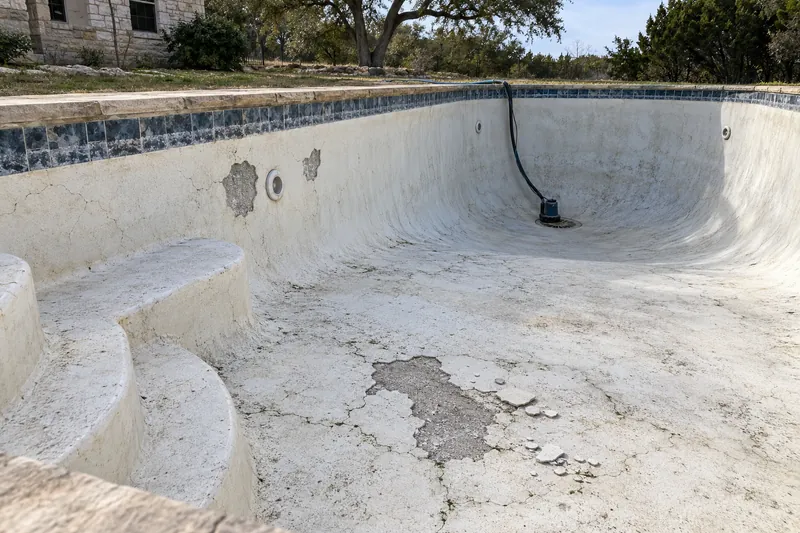
Delamination is a bond failure, not just a cosmetic issue, says Universal White Cement, a white cement maker: the finish is separating from the shell or bond coat, and sooner or later that turns into pop-offs, hollow areas and bigger tear-outs. The signs it lists are raised, blister-like or volcano-shaped spots; patches near lights, returns, tile lines, steps and benches; and circular or spider cracks around one patch rather than a straight crack through the shell. The National Plasterers Council keeps two terms apart: delamination is a material parting from itself or from its substrate, and debonding is one material parting from another. A straight crack running through the shell is a structural problem, covered under pool crack repair.
Spalling, etching, scale and nodules
Universal White Cement also sorts out the look-alikes. Spalling is the top cream layer breaking away from chemistry or freeze-thaw while the plaster under it stays bonded; etched plaster feels soft, chalky or pitted, which the Council describes as material removed from within the surface; scale is mineral buildup on top; and calcium nodules are small volcano-like mounds that weep calcium and may or may not sit over a true void.
Stains and faded color
The Council says scale shows as a white or light film that can dull or completely mask a finish's color, while copper and manganese stain blue, green or black and iron stains red, orange or black. Aggressive water can leach pigment from a colored finish up to 1/8 inch deep, first as faded, blotchy areas and eventually as white ones, and that color loss is irreversible.
Flower Mound Pool Resurfacing will talk through what the plaster is showing before any repair is chosen.
Call or request a free estimate any time, 24/7.
(469) 526-3886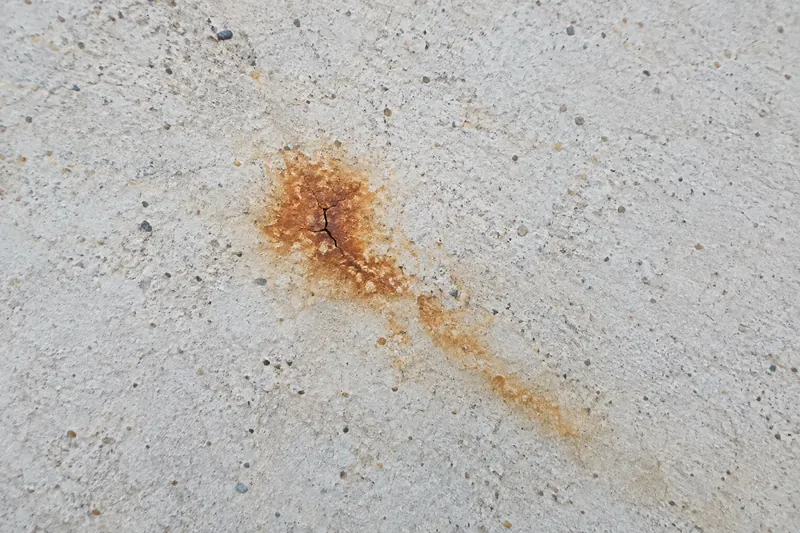
What makes pool plaster fail
Bond problems and back pressure
Universal White Cement calls delamination usually a process problem, not a cement problem: dust, paint, loose old plaster, algae or scale left on the shell; a bond coat that was the wrong product, thin or contaminated; cold joints where work stopped and restarted; over-troweling; and thin layers stacked over a marginal old finish. Water pressing from outside the pool can do it too. The National Plasterers Council warns that water collecting against the back of the shell, from rain, irrigation or a leaking irrigation pipe, can build enough pressure to debond a bond coat or interior finish.
Water chemistry
The Council's etching bulletin ties low calcium hardness to dissolved calcium compounds and discoloration, low pH to general dissolving, high cyanuric acid to leaching and pigment fade, and direct contact with salt, stabilizer, granular chlorine or shock to discoloration. Filling a pool with soft water leaches calcium from the top of a new finish, with damage that ranges from severe discoloration to a weaker cement binder and a shorter service life.
The age of the finish
Age changes what a problem means. Delamination in a new or young finish points to more serious trouble underneath than the same problem in an old finish working toward the end of its life, Universal White Cement says.
Flower Mound Pool Resurfacing will talk through the cause, so a repair isn't undone by the same problem.
Call or request a free estimate any time, 24/7.
(469) 526-3886How pool plaster is repaired
Sounding the surface
Universal White Cement's simplest and most reliable field test is listening. The plaster is tapped in a grid with the plastic handle of a screwdriver, a rubber mallet or a hard plastic tool: well-bonded plaster answers crisp and tight, while delaminated plaster sounds dull, hollow or drum-like. The test works with the pool full or drained, though a drained pool gives the clearest result.
Patch or replaster
The same maker sorts what the tapping finds into three tiers. A few small, isolated hollow spots can sometimes be chipped out and patched, especially when the rest of the surface is in good condition; hollow areas that spread or form a pattern point to a bond problem across the pool; and widespread separation calls for a full replaster, the work covered under pool replastering. Areas actively popping off with sharp edges, or dropping debris into the system, come first.
Cutting out and patching
To patch a small hole in a shotcrete shell before plastering, the American Shotcrete Association pressure-washes at 3,000 psi or more to remove dirt and laitance, hand-patches with a nonshrink hydraulic cement of at least 4,000 psi 28-day strength, and roughens the patch so it takes the plaster. Some repairs can be made with the water in: SGM's Dynamite Pool Patch, a quick-setting specialty cement, goes into a crack or hole that has been cleaned and chiseled into a V-shaped channel, is held under pressure for at least five minutes when it is stopping a leak, and is kept damp for fifteen minutes so it doesn't crack. Warm water speeds the set, so SGM mixes only what can be used in three to five minutes.
Voids behind loose plaster can be pathways for water, Universal White Cement adds, and water that a patch can't hold back is a job for pool leak repair. Flower Mound Pool Resurfacing will talk through a patch, an underwater repair or a full replaster for your pool.
Call or request a free estimate any time, 24/7.
(469) 526-3886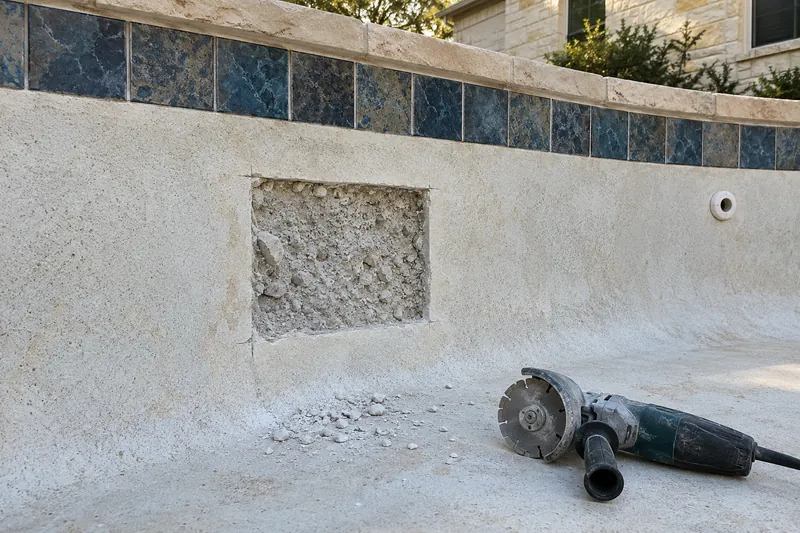
Removing scale and stains from pool plaster
Chelating or sequestering chemicals can counter metal stains and scale, the Council says, but once started they have to be used continuously, because new fill water keeps bringing in metals and minerals. For abnormal discoloration the Council developed torching: the pool is drained completely and lightly acid washed, then the plaster is heated with a propane torch slowly over a number of days, so the heat and carbon dioxide turn calcium hydroxide into calcium carbonate and wick the moisture out. Flat plaster and white quartz are the best candidates; colored finishes take more steps, pebble needs a very delicate touch, glass-bead surfaces can't be torched safely, and the homeowner stays away from the pool while the work goes on.
A drain and acid wash has a cost too. Universal White Cement says frequent drain-and-acid washes may make a pool look whiter for a while but strip years off the plaster, and that metal brushes, razor scrapers and aggressive scrub pads gouge it and create weak spots. When a one-time clean is the right call, it is covered under pool drain and acid wash.
Flower Mound Pool Resurfacing will talk through which stains can come out and which can't.
Call or request a free estimate any time, 24/7.
(469) 526-3886Flower Mound water, rain and freezes on plaster
All of Flower Mound's water is surface water from lakes and rivers, bought from the Upper Trinity Regional Water District and Dallas Water Utilities. UTRWD says its plants test about 168 samples a day for parameters including alkalinity, hardness and pH, and the Town provides its monthly test results on request, since the annual report doesn't print those secondary constituents. Calcium hardness and pH are the same readings the Council's etching bulletin ties to dissolving and discoloration.
Outside the shell, NOAA's 1991–2020 normals for Grapevine Dam give 38.89 inches of rain a year, wettest in May and October: the seasonal water the Council says can build back pressure behind a pool. The same station averages 44.3 nights a year at or below freezing, and freeze-thaw is one of the two causes Universal White Cement gives for spalling. Flower Mound's amended pool code also asks anyone who means to alter or repair a pool to apply to the code official first, so call the Town's Building Inspections before a plaster repair begins.
Denton pool owners will find the same work under pool plaster repair in Denton.
Call or request a free estimate any time, 24/7.
(469) 526-3886Pool plaster repair costs around Dallas–Fort Worth
- Pool repairs of every kind, average (Dallas, 2026)
- $250–$1,200
- Surface repairs before resurfacing (national, 2025)
- $200–$1,200+
- Small cracks, concrete or gunite pool (national, 2025)
- $100–$200
- Large or spiderweb cracks, bulges or divots (national, 2025)
- $700–$1,000
- Full white replaster, 15,000–25,000 gallons (DFW, 2026)
- $4,000–$7,000
Published averages and other companies’ ranges, not our prices. A real price needs a look at the pool.
The Dallas average covers pool repairs of every kind, from liner replacements to tile resurfacing, so the national figures give the plaster ranges; what a surface repair costs depends on its extent and on the size and type of pool.
Call or request a free estimate any time, 24/7.
(469) 526-3886Pool plaster repair questions and answers
Can pool plaster be patched?
Yes, when the damage is small and local. Universal White Cement says a few small, isolated hollow spots can sometimes be chipped out and patched, and the National Plasterers Council treats resurfacing as the answer once the finish can no longer be patched or repaired. Flower Mound Pool Resurfacing will talk through a patch or a replaster after seeing the pool.
How to repair cracks in pool plaster?
It depends on the crack. The National Plasterers Council calls cracks that form while a finish is being applied, or within twenty-four hours after it sets, shrinkage cracks, which differ from a crack in the structural shell. The American Shotcrete Association says certain shrinkage cracks may simply be plugged or patched, while cracks from structural movement need an in-depth investigation of cause and remedy first.
How do I know if my pool plaster is delaminating?
Look first, then listen. Universal White Cement's warning signs are spots that look puffed up, from blisters to volcano-shaped mounds or domes; trouble gathered around lights, returns, tile lines, steps and benches; and circular or spider cracks focused on one patch instead of a straight crack across the shell. Tapping settles it, because a dull, hollow or drum-like note marks plaster that has let go. The same maker reads delamination in a young finish as a sign of deeper trouble than in an old one, and puts spots popping off with sharp edges first in line for repair.
What is the average cost of pool plaster repair in Texas?
Dallas figures for 2026 average $250 to $1,200 for necessary pool repairs, a range that spans every kind of repair rather than plaster alone. For the finish itself, national figures from 2025 run $100 to $200 for small cracks in a concrete or gunite pool and $700 to $1,000 for large or spiderweb cracks, bulges or divots, and put surface repairs ahead of a resurfacing at $200 to $1,200 or more. A full white replaster is a bigger job: $4,000 to $7,000 for a pool of 15,000 to 25,000 gallons in typical Dallas–Fort Worth figures for 2026.
Can stains be removed from pool plaster?
Some can and some can't. Metal stains and scale respond to chelating or sequestering chemicals used continuously, and the Council's torching process treats abnormal discoloration in a drained pool. Pigment leached from a colored finish doesn't come back, though, and SGM says permanent staining that cleaning or chemical treatment can't remove may justify refinishing even when the finish is still sound.
Get a free pool plaster repair estimate
Flower Mound Pool Resurfacing answers calls and estimate requests 24/7. Tell us where the plaster is hollow, cracked or stained, and how old the finish is.