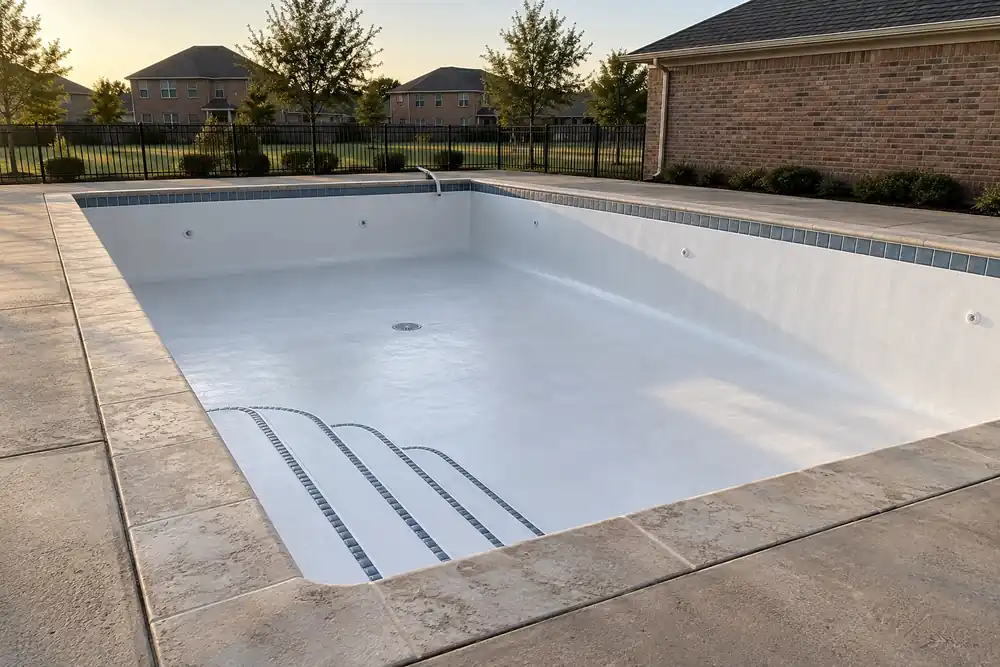
Travertine and Paver Pool Decks in Flower Mound, TX
Flower Mound Pool Resurfacing installs travertine pool decks and concrete paver decks in Flower Mound, Texas: compacting the base, screeding the sand bed, laying and cutting the stone, restraining the edges, and sealing the joint at the coping. The Natural Stone Institute lists travertine among the natural stones that make good paving, and notes that a stone's surface can be finished for slip resistance. Typical Texas figures for 2026 put a 600-square-foot travertine deck at $7,200 to $15,000 installed.
Request a free estimate, any time. We'll talk through the stone or paver, the base and the drainage.
Call or request a free estimate any time, 24/7
No charge · answered 24/7
Get free estimates
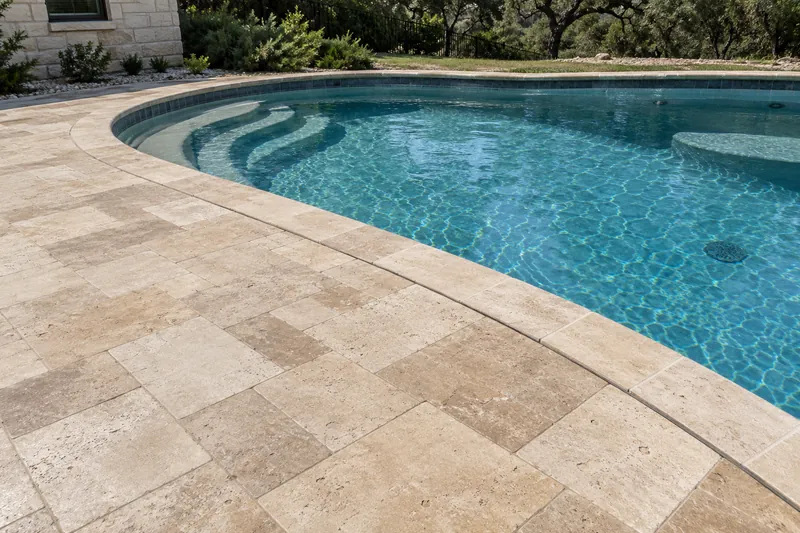
Travertine and paver choices for a pool deck
Travertine and other calcareous stone
Travertine belongs with limestone and marble among the calcareous stones, the Natural Stone Institute explains: made mainly of calcium carbonate and commonly used indoors or outdoors where conditions are relatively controlled, while siliceous stones such as granite, quartzite and sandstone are generally harder and stand up better to abrasion and chemicals. Relatively few limestone varieties have a proven record in outdoor paving, the Institute adds, particularly where freezing and thawing come into play.
Choosing and filling the stone
Travertine varies more than any other natural stone, even within one quarry, so the Institute tells buyers to ask for a range of samples before installation and, on an order of several pallets, to mix pieces from all of them. Its holes come from gases trapped as the stone formed; today they are much more often filled during fabrication, with a cement or resin filler, than left open, and holes that break through later can be filled in place.
Concrete pavers
The Interlocking Concrete Pavement Institute says high slip resistance and rapid drainage make concrete pavers a desirable surface around pools, and because pavers are modular, a settled spot can be repaired by lifting and re-laying the same pavers. For one poured surface with the look of stone or brick, see stamped concrete pool decks; an existing concrete deck that is staying can be coated, as covered under pool deck resurfacing.
Flower Mound Pool Resurfacing will talk through which stone or paver suits your pool and yard.
Call or request a free estimate any time, 24/7.
(469) 526-3886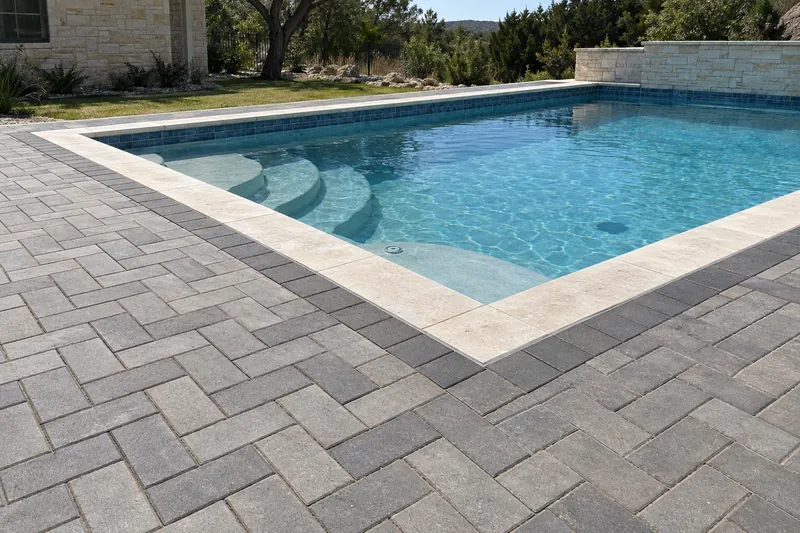
How a travertine or paver pool deck is laid
Unilock's installation guide for a paver patio runs in this order, after a check with the local municipality or homeowners' association about any permits or rules:
Excavate and compact
The area is marked out and dug, and loose subsoil is compacted.
Build the base
Gravel goes down in 3-inch layers, each compacted with at least 3 passes.
Screed the bedding course
The bedding course is screeded flat, and nobody walks on it afterward.
Lay, cut and restrain
The pavers are laid and cut, and the edges are restrained with plastic, metal or a cement wedge.
Compact, sand and seal
The pavers are compacted with 3 passes, jointing sand goes in, and the surface is sealed if wanted.
The Interlocking Concrete Pavement Institute describes the same build-up: an edge restraint, pavers with sand-filled joints, a bedding sand layer of nominal 1 inch, and a compacted aggregate or stabilized base over compacted soil. It calls edge restraints essential, because they keep the system interlocked, and around pools it typically uses a concrete base at least 4 inches thick where the backfill soil or aggregate base can't be adequately compacted. Natural stone can also be mortar-set where stability matters, the Natural Stone Institute notes.
Flower Mound Pool Resurfacing will talk through the base and the setting method for your deck.
Call or request a free estimate any time, 24/7.
(469) 526-3886Drainage, slope and the joint at the coping
Slope and drainage
The 2021 International Swimming Pool and Spa Code sets a minimum drainage slope of 1/8 inch per foot for travertine or brick-set pavers at a residential pool, and 3/8 inch per foot at a public pool, unless another drainage method keeps water from pooling. ICPI slopes paver surfaces and bases toward drains whose holes or slots sit at the level of the bedding sand, covered with geotextile so the sand doesn't wash out, and sets finished pavers 1/8 to 1/4 inch above their edges to allow for minor settlement.
At the coping
At the pool's edge, ICPI places a urethane or neoprene sealant over backer rod between the last course of pavers and the coping, which keeps water out of that joint while the pool wall and the paving move separately, and it recommends sealing the pavers and their joints to keep the sand in place. The stone or brick cap itself is covered under pool coping repair and replacement.
Slip resistance
Slip resistance depends on a surface's texture and porosity, any treatment on it, and the water and dust it meets, the Natural Stone Institute notes. Where a deck surface is tested, the 2024 International Swimming Pool and Spa Code, which the Town adopted, looks for a wet dynamic coefficient of friction of 0.42 under ANSI A326.3, or a pendulum rating of P4.
Call or request a free estimate any time, 24/7.
(469) 526-3886Ground, freezes and permits in Flower Mound
The 1980 Denton County soil survey dug its typical example of Navo clay loam, the town's second-largest soil and rated Very limited for homes because of shrink-swell, 0.4 mile north of the Flower Mound city offices; its typical Gasil fine sandy loam, rated Not limited, came from near the intersection of FM 1171 and FM 2499. Even a durable stone can have problems when drainage, movement or the ground beneath isn't properly handled, the Natural Stone Institute warns. Freezes count too, since travertine is a kind of limestone: NOAA's 1991–2020 normals for Grapevine Dam average 44.3 nights a year at or below 32°F.
For stone, the Town's residential permit guidelines give no direct answer. They require a permit before any wood deck is built and exempt concrete flatwork that is non-structural, separate from the driveway and the house foundation, and outside the public right-of-way, but they never mention travertine or pavers, so ask Building Inspections before work starts. The Town doesn't enforce HOA rules or deed restrictions, so a homeowners' association's own approval is a separate step.
In Argyle, one of the towns we serve, the largest soils mapped inside the town are Callisburg and Gasil fine sandy loams, with linear extensibility of 4.5 and 1.8 percent; its own page covers travertine pool decks in Argyle. Flower Mound Pool Resurfacing will talk through your yard's ground and the permit question when the deck is measured.
Call or request a free estimate any time, 24/7.
(469) 526-3886Travertine and paver pool deck costs
- Travertine pool deck, installed, per sq ft (Texas, 2026)
- $12–$25
- Travertine materials only, per sq ft (Texas, 2026)
- $3–$7
- Travertine pool deck, 600 sq ft (Texas, 2026)
- $7,200–$15,000
- Travertine patio, 300–600 sq ft (DFW, 2026)
- $5,000–$15,000
- Travertine pool deck, installed, per sq ft (national, 2026)
- $13–$30
Published averages and other companies’ ranges, not our prices. A real price needs a look at the site.
Typical Texas figures for 2026 add $2 to $8 a square foot for site preparation, depending on conditions, and national figures for 2026 add $500 to $1,500 for drainage grading and $1 to $3 a square foot for sealing.
Call or request a free estimate any time, 24/7.
(469) 526-3886Travertine pool deck questions and answers
How much does a travertine pool deck cost?
Typical Texas figures for 2026 put an installed travertine pool deck at $12 to $25 a square foot, and national averages for 2026 run $13 to $30. Flower Mound Pool Resurfacing measures the deck area and looks at the ground before pricing it.
Is travertine a good choice for a pool deck?
The Natural Stone Institute counts it among the natural stones that are good options for paving. It also says long sun exposure and thermal expansion in hot climates can affect color and movement joints, and that acids can dull or etch it.
How do you lay travertine pavers around a pool?
On a compacted base. Unilock's guide compacts the subsoil, builds a gravel base in compacted layers and screeds a bedding course before the pavers are laid, cut, edged, compacted and sanded, and ICPI adds a sealant over backer rod where the pavers meet the coping.
What cleaner is safe for travertine?
Mild, non-acidic cleaners, the Natural Stone Institute says, because calcium carbonate is sensitive to acids, and products containing lemon, vinegar or other acids may dull or etch it. Around an outdoor pool, it advises flushing with clear water and using a mild bleach solution for algae or moss, and it cautions that high spray-nozzle pressure and stiff brushes can knock out filler and grout.
Should a travertine pool deck be sealed?
It is common practice, though not always needed. The Natural Stone Institute says the products sold as stone sealers are really impregnators that act as a repellent, making stone more stain resistant, not stain proof, and that many stones don't require them. ICPI recommends sealing paver joints to keep the sand in place, and national figures for 2026 put sealing travertine at $1 to $3 a square foot.
Get a free travertine pool deck estimate
Flower Mound Pool Resurfacing answers calls and estimate requests 24/7. Tell us the size of the deck, the stone or paver you have in mind, and what is there now.