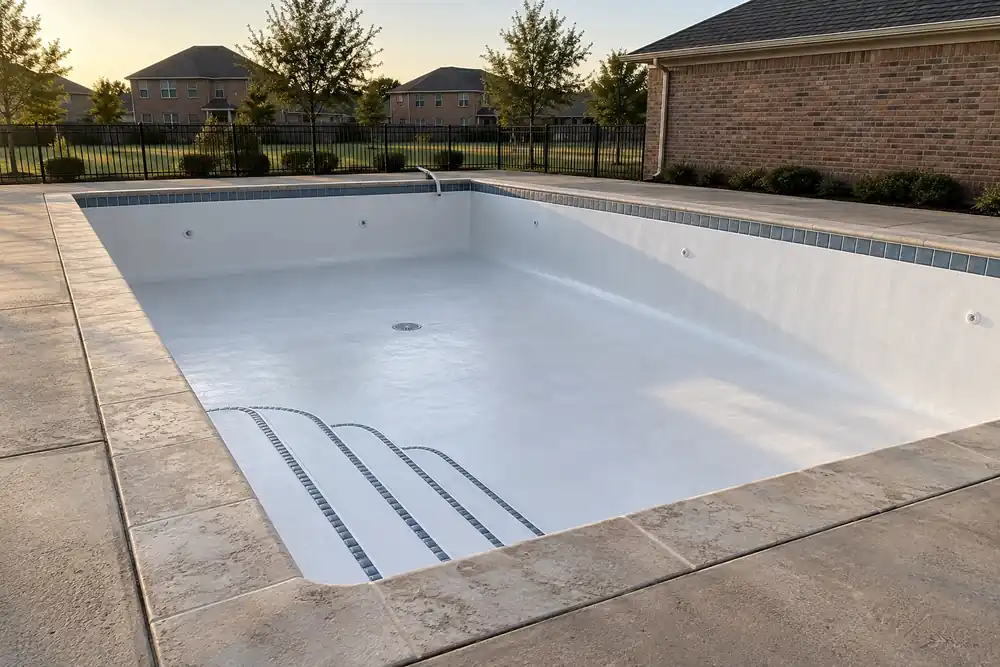
Pool Resurfacing Questions and Answers for Flower Mound, TX
Flower Mound Pool Resurfacing answers the questions people ask about pool resurfacing in Flower Mound, Texas: what a new finish costs and how long it lasts, how the work is done, remodels, tile, decks, and the Town's permit rules.
Every figure here is a published one, from the National Plasterers Council, a finish maker, the Town of Flower Mound, or a typical Dallas–Fort Worth, Texas or national price with its year. None of the prices are ours. A firm price needs a look at the pool itself, and every estimate is free.
Call or request a free estimate any time, 24/7
Pool resurfacing cost questions
What is the average cost to resurface a pool?
National figures for 2026 put it at $6,000 to $15,000, with about $11,000 typical for a standard pool of 1,000 square feet and a benchmark of $6.55 to $7.81 a square foot as of May 2026. Texas figures from 2025 share the same top and start lower, at $5,000 to $15,000. Prices move with the finish and with the area of the walls and floor, which is what contractors measure.
How much does it cost to resurface a concrete pool?
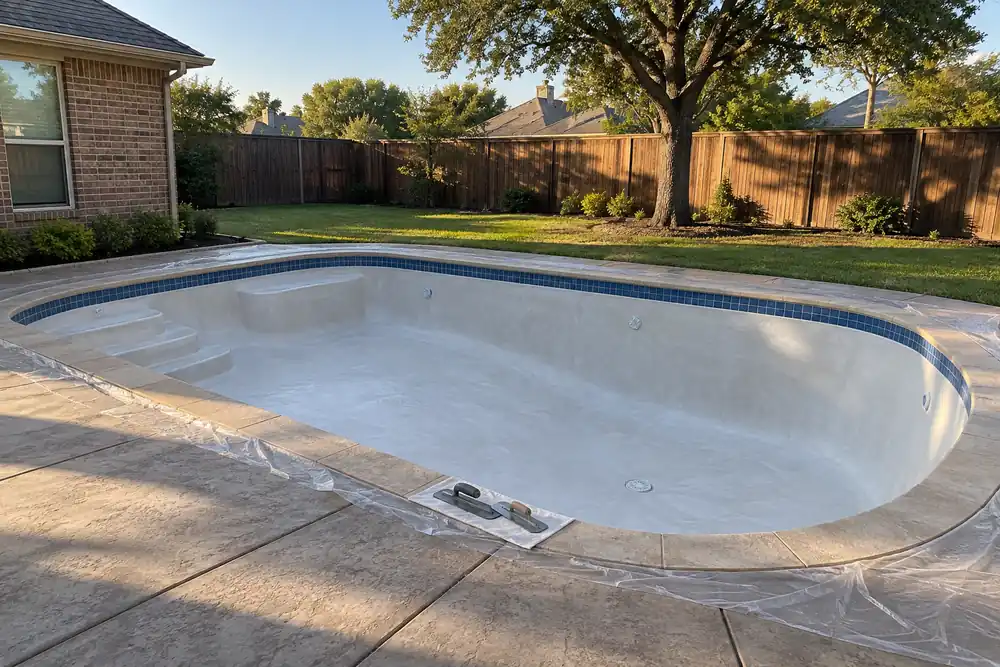
Dallas figures for 2026 work it out by area, at about $6,702 for each 1,000 square feet of surface, which brings a 2,000-square-foot pool to $13,403. National ranges from 2025 by material run $4,000 to $10,000 for plaster, $6,500 to $13,000 for aggregate and $20,000 to $30,000 for tile. Plaster sits at the bottom of that list; for white and colored plaster on concrete shells, see pool replastering.
How much to replaster a 10,000 gallon pool?
Gallons don't set the price; the surface does. Contractors measure the interior, walls plus floor, rather than the water, and national averages for September 2026 start replastering at $6.72 to $8.02 a square foot. In Dallas–Fort Worth, 2026 figures give standard white plaster a range of $4,000 to $7,000 for the typical pool, which they size at 15,000 to 25,000 gallons. A 10,000-gallon pool is smaller than the pools behind that range, so its own measured surface decides where it lands.
For a free estimate measured on your own pool, ask Flower Mound Pool Resurfacing.
Call or request a free estimate any time, 24/7.
(469) 526-3886Pool finish questions: plaster, quartz, pebble and tile
What is a plaster pool?
It is a concrete pool whose shell is finished with pool plaster, often called marcite. The National Plasterers Council's recipe for white plaster is white cement, water and white marble aggregate, hard-troweled smooth, and it calls white plaster the cheapest pool finish product on the market. The Council also calls plaster a relatively soft finish that water chemistry affects more than newer products, so its look changes over the years, from slight shading to staining or etching in bad cases.
What are pool quartz finishes?
They are cement finishes built on quartz, a silicate mineral the National Plasterers Council ranks among the hardest in nature and one that won't react with pool chemicals; colored quartz is often added as an accent. SGM, the maker of Diamond Brite, says quartz stays completely insoluble even in strong acid, unlike marble, and that modifying the cement with polymers makes it harder and helps it bond. The Council lists quartz as an affordable, 10 to 15 year surface that can be troweled smooth or exposed for texture. Our quartz pool finish page covers the blends and colors.
What is a pebble pool finish?
Pebble finishes mix small pebbles, glass and other materials into cement, and the National Plasterers Council says the surface is made by hard troweling, compacting the aggregate and then exposing it. The Council rates pebble a textured, upgraded-cost finish with a 12 to 18 year surface life, and ranks it as the most durable surface on offer because river pebble is chemically inert; a rougher feel and a higher price are the trade-offs. Around Dallas–Fort Worth, 2026 figures put pebble finishes like Pebble Tec and Pebble Sheen at $8,000 to $15,000 or more. The textures and colors are on our pebble pool finish page.
Is tiling a pool a good idea?
An all-tile interior sits at the top on both price and life: national figures for 2026 put tile resurfacing at $20,000 to $50,000 or more and say tile outlasts every other finish. It also asks more of the installer. LATICRETE, which makes tile-setting materials, says submerged glass tile is typically pricier and takes more installation skill, and it wants movement joints at 8 to 12 foot spacing both ways in a tiled pool. Glass tiles also chip and crack more readily than porcelain, so keeping spares for later repairs is wise.
Does a darker pool finish make the water warmer?
The finish makers say so. SGM says light finishes keep pool water cooler while darker ones absorb and hold heat, and Premix-Marbletite says darker colors tend to hold warmth and lighter pools stay cooler. Light and shade change the look as well: NPT, the StoneScapes maker, says water shaded by tall trees or buildings reads darker, and SGM says the shallow water over a sun shelf, a beach entry or steps reads much lighter than the deep end.
Ask Flower Mound Pool Resurfacing which finish suits your pool, your budget and the shade around it.
Call or request a free estimate any time, 24/7.
(469) 526-3886When to resurface a pool, and how long a finish lasts
How often should a pool be replastered?
The sources disagree, so it helps to see them side by side. The National Plasterers Council's finish comparison gives white plaster 5 to 8 years of surface life, yet the Council's FAQ page says plaster can reach 20 years when it is cared for properly. Universal White Cement, which makes white cement, puts routine service at 15 to 20 years when the materials, the application and the water care are all sound. For Dallas–Fort Worth, 2026 figures say most plaster needs a new surface every 8 to 15 years.
How do you know if a pool needs to be resurfaced?
Go by the surface, not the calendar. Universal White Cement says plaster is at the end of its life when it feels rough and pitted underfoot with aggregate showing over large areas, when etching or soft areas are widespread, when large sections sound hollow or have let go, or when deep stains stop responding to treatment; mild mottling and light roughening on steps and benches it counts as normal aging. SGM adds aggregate loss that leaves a pebble or quartz finish uneven, a big rise in the cleaning and chemicals the pool needs, and any delamination or bubbling, which it says means the finish has failed.
Does the Texas sun fade a pool finish?
Less than most people expect. The National Plasterers Council says sun and UV are not the main cause of faded color; it comes down to three things, what the finish is made of, how it was applied and the water chemistry, and most cases start with a start-up or ongoing chemistry done poorly. Heat still matters to the surface: SGM finds that hot, sunny climates wear plaster out faster, and at Grapevine Dam the 1991–2020 normals include 104.3 days a year reaching 90°F or more. Colored plaster can also lighten over time, which the Council doesn't treat as a defect.
Call or request a free estimate any time, 24/7.
(469) 526-3886How a pool is resurfaced, from drain-down to start-up
Can you resurface a pool yourself?
The trade's own guidance points the other way. In the National Plasterers Council's words, resurfacing calls for expert plasterers with years behind them: the finish is a cement mix designed only for pools, and it goes on and is finished in a single application, troweled free hand. SGM's manual gives a sense of the choreography. Crews coat the deep-end bowl first because it sets last, work the walls from shade to sun, and finish the whole pool at 3/8 to 1/2 inch. For fiberglass pools, River Pools says only authorized professionals should even drain the pool.
Should you drain and refill your pool?
Only with a reason. By the EPA's reckoning, draining every 3 to 7 years is enough for a well-kept pool, mainly to lower total dissolved solids, and the National Plasterers Council warns that every drain-down puts the finish at risk. Groundwater adds a second risk: River Pools explains that water in the ground pushes up on a shell, so a pool without enough water in it can bulge, crack or even float, and Pentair's main drains can take a hydrostatic relief valve to let that pressure into the pool. The EPA also asks owners to look up local discharge rules before draining, so check with the Town of Flower Mound on how drained water must be handled at your address.
What is a bond coat?
It is a thin coat that ties new plaster to the old surface. CL Industries describes its PermaKote as a polymer-modified cement coating that works as both bonding agent and scratch coat and removes the need for heavy prep such as sandblasting and stripping. SGM sells Bond Kote as a kit of liquid resin in a 5-gallon pail plus two 65-pound bags of dry mix, enough for about 500 square feet; it is rolled on, rolled again a minute later to stipple it, and cured six hours at minimum and 24 for best results, with plastering inside fourteen days. Premix-Marbletite calls a bond coat absolutely mandatory on every renovation, while Pebble Technology International describes stripping the old surface off first.
How often should a new pool finish be brushed?
At least twice a day to start. The National Plasterers Council's start-up calls for brushing the whole pool thoroughly twice daily to lift the plaster dust, with no wheeled vacuums or wheeled cleaners until after 28 days, and by day 7 the last dust comes out with a brush vacuum. NPT says to brush from the top of the walls down, starting at the shallow end and finishing at the deep end. Once the dust is gone and a good cleaning system runs, the Pool & Hot Tub Alliance says brushing can drop to once a week and as needed.
Flower Mound Pool Resurfacing can walk you through the prep, the fill and the start-up before the drain-down.
Call or request a free estimate any time, 24/7.
(469) 526-3886Pool remodeling and renovation questions
Can I get an inground pool for $30,000?
Not a new one, going by published figures: typical Dallas–Fort Worth prices for 2026 start a new pool for a typical home at $60,000 and run to $150,000 or more. For an existing pool, $30,000 reaches a long way. The same 2026 figures sort most area remodels into three bands: tile and coping at $5,000 to $12,000; tile, coping and a new surface at $10,000 to $25,000; and a full remodel with stonework, fire features or a kitchen at $25,000 to $80,000 or more.
Is remodeling a pool worth it?
Against starting over, the published prices are lopsided. Typical Dallas–Fort Worth figures from 2025 put resurfacing alone at $8,000 to $24,000 and a comprehensive remodel, with a new surface, tile and coping, equipment, a spa and automation, at $35,000 to $75,000, while full replacement runs $80,000 to $175,000 or more. Pebble Technology International says projects usually begin with a problem: leaks, cracks, mottling, mildew or algae, walls that sound hollow, or pebbles and tiles coming loose; and it notes a remodel usually does the finish and the waterline tile at once. Our pool remodeling page sets out what can change.
What are some ideas for renovating my pool?
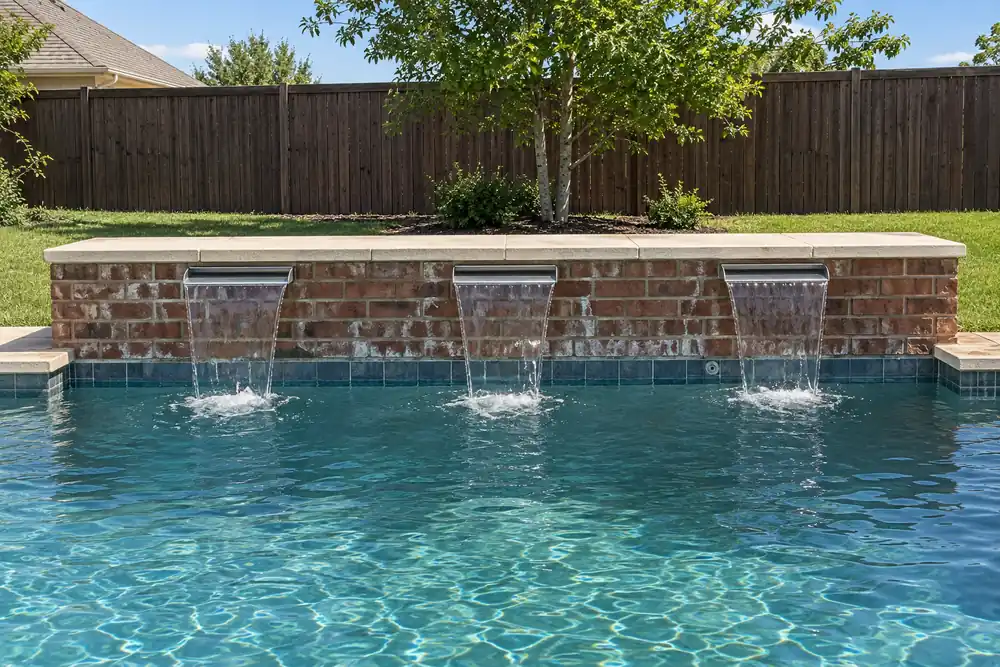
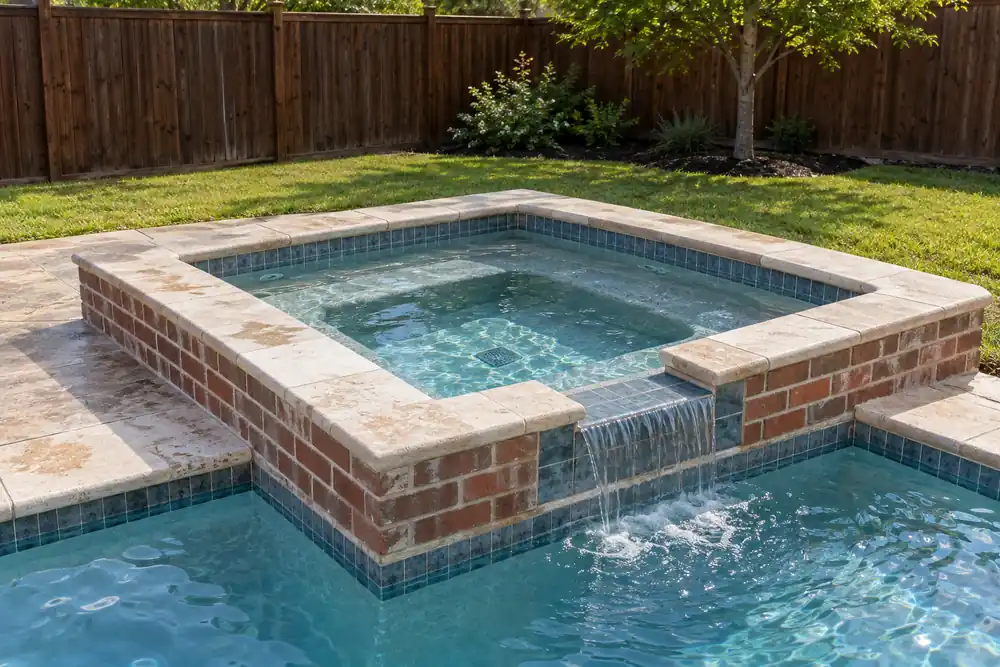
The usual ones, with typical area prices: an in-ground spa added beside the existing pool, which Dallas–Fort Worth figures from 2025 price at $18,000 to $35,000; a basic waterfall or scupper at $1,000 to $5,000 by 2026 figures; a deep end made shallow, which Dallas figures for 2026 put at $4,000 to $7,000; and new tile and coping, the light-remodel band at $5,000 to $12,000. The spa figures carry advice that fits the rest: time the work with a resurfacing and the pool is emptied just once.
Can you redesign an existing pool?
Yes, within limits. The American Shotcrete Association says new shotcrete bonds well to an old shell once the old surface is roughened, cleaned and left damp but not dripping, the state it calls saturated surface-dry, and it advises against bonding agents at that joint because they can stop the bond. The International Swimming Pool and Spa Code holds the altered part to the requirements for new work but doesn't require the untouched parts of the pool to be brought up to today's code. National figures for 2025 say to expect $15,000 or more to change a pool's size or shape, and Dallas figures for 2026 show $60,000 for reshaping a concrete pool.
Is a tanning ledge worth it?
That depends on how the pool gets used. The CDC's Model Aquatic Health Code describes these underwater shelves as either a widened top step or a broad area of their own, built mainly for lounging in chairs or on contoured couches in very shallow water. Ledge Lounger, which makes in-pool furniture, puts most ledges at 6 to 9 inches of water, and Pentair's bubblers go in water from 2 to 12 inches deep. For adding one to a pool already in the ground, 2026 Dallas–Fort Worth figures give $2,000 to $10,000, and the same source points out that a retrofit means draining, digging next to the shell, new concrete and a new finish over the whole interior.
Ask Flower Mound Pool Resurfacing which of these changes can share one drain-down.
Call or request a free estimate any time, 24/7.
(469) 526-3886Pool tile, mastic and leak repair questions
Is it difficult to retile a pool?
It is exacting work with written standards. MAPEI's pool tile specification, built on the Tile Council of North America's P602 method, sets minimum materials such as an ANSI A118.4 cement bond coat, ANSI A118.3 epoxy grout and an ASTM C920 flexible sealant, and LATICRETE says only mortars rated for continuous submersion belong under pool tile. Before the refill, LATICRETE wants latex-fortified cement grout cured 14 days at 70°F, or epoxy grout 10 days, and the water then rising at about 2 feet a day. In Dallas–Fort Worth, 2026 figures put retiling most home pools at $3,000 to $8,000, and our pool tile repair page covers smaller jobs.
How much do swimming pool tiles cost?
Per installed square foot, typical Dallas–Fort Worth prices for 2026 are $5 to $25 for porcelain, $10 to $50 for glass mosaic and $15 to $40 for natural stone. Where an old installation was done badly or the surface under it is damaged, putting that right can add $500 to $2,000. In Dallas, 2026 averages are $3,000 to replace ceramic tile and $3,500 for glass tile.
Why do pool tiles crack or come loose?
Movement and water chemistry come up again and again. When the flexible joint between deck and coping stops working, the deck's movement as it expands and contracts with the seasons often pushes coping and tile loose and leaves horizontal cracks along the waterline tile. LATICRETE says water kept too high in pH leaves mineral deposits that can form behind tile and push it off, while water kept too low etches grout and the mortar beneath. Its list of reasons cement grout fails in pools also includes filling too soon, the wrong grout and poor surface preparation.
What is mastic on a pool?
Mastic is the flexible sealant between the pool deck and the coping. The joint it fills is really an isolation joint, there so the deck can move without shoving the pool; with poured or precast coping it is normally a foam backer rod topped with flexible mastic. W. R. Meadows makes DECK-O-SEAL, a pourable polysulfide for pool decks that can stretch or squeeze by 25 percent once it cures, placed at a 2:1 width-to-depth ratio. That flexibility matters on Flower Mound's heaviest clays, where NRCS rates linear extensibility, its measure of swelling, at 12.2 percent for Heiden clay and 13.0 percent for Branyon; a Houston engineer's guidelines for pools in expansive soil likewise put isolation joints between coping and flatwork.
Is there something you can put in a pool to find a leak?
A bucket. For the EPA's evaporation test, pick a day with no rain or strong wind and turn off the pool's systems, auto-fill included. Fill a bucket of 2.5 to 5 gallons to within about an inch of its rim and stand it on a step with two-thirds or more of it submerged, then mark both water levels, in the bucket and in the pool, and look again 24 hours later. A pool that dropped more than the bucket may have a leak. The EPA also treats a loss of over 2 inches a week, or over 3 inches where the climate is hot and dry, as a likely leak, along with wet spots near the pool or air bubbles in the return line.
Call or request a free estimate any time, 24/7.
(469) 526-3886Pool deck resurfacing and cool deck questions
What is the best material for a pool deck in Texas?
The sources weigh heat, grip and care rather than naming one winner. Mortex says its Kool Deck topping brings the surface temperature of concrete down significantly, though its darker colors run warmer and paint over it makes the surface hotter and slicker. Travertine is a calcium-carbonate stone, and the Natural Stone Institute warns that acids such as vinegar can etch it and that long sun in hot climates can affect its color and joints. The Interlocking Concrete Pavement Institute rates concrete pavers highly around pools for slip resistance and fast drainage, and a settled spot can be lifted and relaid. For coatings over the concrete you have, see pool deck resurfacing.
How much does it cost to redo a pool deck?
That turns on whether the concrete stays. Keeping the slab and coating it costs, per square foot in typical Dallas–Fort Worth prices for 2026, $3 to $6 for basic acrylic, $6 to $12 for a decorative overlay or concrete coating, and $10 to $20 for a stamped or custom-texture overlay. Replacing the deck costs more: national figures for 2026 put removing the old surface at $2 to $6 a square foot before $6 to $18 or more to install the new one.
What is the difference between Kool deck and cool deck?
Kool Deck is a brand. Mortex owns the trademark and says it invented the Keystone Kool Deck topping in 1962: a cement topping splashed on from a dash brush, never sprayed, 1/8 inch thick, and troweled so about 40 percent of the surface is smooth and 60 percent void. Other textured deck coatings go down differently; a spray-texture or knockdown coating, for one, is sprayed on, flattened with a trowel's edge and finished with two coats of acrylic for color.
How long should a cool deck last?
Published figures give ranges for deck coatings rather than for Kool Deck by name. In the Dallas–Fort Worth climate, 2026 figures put acrylic coatings at 3 to 5 years and quality decorative overlays at 10 to 20 years if maintained routinely, and national figures for 2026 give spray-texture overlays 10 to 15 years, with most systems resealed every 2 to 3 years. Mortex rates its Protect-A-Deck water repellent for Kool Deck at 5 to 10 years of repellency.
For a free estimate on a deck coating, cool deck or pavers, ask Flower Mound Pool Resurfacing.
Call or request a free estimate any time, 24/7.
(469) 526-3886Fiberglass pool refinishing and pool painting questions
Can a fiberglass pool be resurfaced?
Yes, though not by re-gelcoating the whole pool. River Pools, which builds fiberglass pools, says gelcoat is a factory product: it takes a long time to dry, has to cure at a steady temperature and needs precision that can't be matched outdoors, so it suits small repairs rather than a whole pool in the ground. Its standard recommendation is a coating such as ecoFINISH, a polyethylene powder sprayed onto tacky epoxy and set with heat, which dries fast enough to refill the same day; paint makers that allow fiberglass specify epoxy. National 2026 figures for resurfacing or recoating a fiberglass pool run $6,000 to $15,000.
How often do you have to resurface a fiberglass pool?
Rarely, by the makers' accounts. River Pools says most fiberglass pools will never need it, and that a pool commonly reaches 20 or 30 years of age before refinishing comes up, unless water chemistry or cleaning has been neglected. ecoFINISH, which sells a refinishing coating, sees first wear much sooner, after 10 to 15 years in regular use. The signs to watch for are a chalky, discolored or rough surface as the gelcoat breaks down.
How much does it cost to paint an inground pool?
In national figures for 2025, painting a pool costs $1 to $2 per square foot, with epoxy the most common paint, and 2024 figures put painting the bottom of a pool at $1,400 to $2,500, using up to 10 gallons, before any draining or repairs. Insl-x, a Benjamin Moore brand, gives a worked example: a pool 30 feet by 10 feet with an average depth of 5 feet has about 730 square feet to paint. Paint is the short-lived option: Olympic rates epoxy coatings at 5 to 8 years and acrylic enamel at 2 to 3.
Can I paint my pool myself?
Paint makers publish their steps, and in North Texas the weather is the hard part. Insl-x wants the paint applied between 50°F and 85°F and kept out of direct sun, doing the east wall while it is shaded in the morning and the west wall late in the afternoon, then a wait of 7 days or more after the final coat before the pool is filled; NOAA's normals put Grapevine Dam's July high at 95.3°F. Ramuc names poor surface preparation as the number one cause of blistering, and Insl-x warns that scraping or sanding old pool paint may release lead dust, calling for a NIOSH-approved respirator and HEPA cleanup.
Call or request a free estimate any time, 24/7.
(469) 526-3886Commercial pool, HOA and permit questions in Flower Mound
Does a commercial pool have to close for resurfacing?
Yes. Under Texas rules a public pool must close once its water falls below the working range of its skimmers or gutters, and during a renovation, users and anyone else unauthorized must be kept from entering the pool yard, with a closed sign on the entry gates. Flower Mound then adds a step before reopening: if a permitted public pool has been shut 30 days or more, it needs a fresh pre-opening inspection. These rules cover apartment, HOA, hotel and club pools, not backyard pools, and our commercial pool resurfacing page covers the finish and safety rules for them.
Does HOA have to approve a pool?
Across much of Flower Mound, yes. Of the 439 residential subdivision records in the Town's map data, 306 carry HOA requirements, and those subdivisions hold 69.7% of the lots. In Wellington of Flower Mound, adding a pool needs the Architectural Control Committee's approval, a Town permit doesn't count as that approval, and the committee may take up to 30 days but averages about 5 to 10. Bridlewood's homeowners association wants a signed modification request, with photos, a plot map marked with the change and any Town permit the work needs, before a home's exterior is physically or structurally changed.
Do I need a permit to remodel a pool in Flower Mound?
A remodel does. Flower Mound's amended pool code makes anyone who builds, enlarges, alters, repairs, moves or demolishes a pool or spa apply for a permit first. From October 1, 2026, the Town charges $430 to permit an in-ground pool and $250 either for a spa or for a residential remodel that adds no square footage, plus a $120 plan review that is applied to the permit fee once approved. Replastering is the narrow exception: the International Swimming Pool and Spa Code in its 2024 edition, which the Town adopted as its pool code, says no permit is required to replaster or resurface an existing pool or spa. Either way, call the Town's Building Inspections office to confirm before any work starts.
Do pool contractors need to be licensed in Texas?
For the electrical and plumbing work, yes. Texas requires anyone doing non-exempt electrical work to be licensed and to work through a licensed electrical contractor, and its Plumbing License Law counts piping that circulates or recirculates water as plumbing. Flower Mound's code requires pool electrical work by a licensed electrician and plumbing by a licensed plumber, both licensed by the State and registered with the Town, and anyone applying for a Town permit for pool work has to register with the Town as a contractor, a year at a time. The industries the Texas Department of Licensing and Regulation lists include electricians but no program for pool builders, plasterers or remodelers.
Ask Flower Mound Pool Resurfacing about the Town permit, HOA approval and, for shared pools, the state's rules.
Call or request a free estimate any time, 24/7.
(469) 526-3886Free estimates for pool finishes, remodels and repairs
Flower Mound Pool Resurfacing takes calls and estimate requests around the clock. Send your question with a few details about the pool, and the estimate is free.