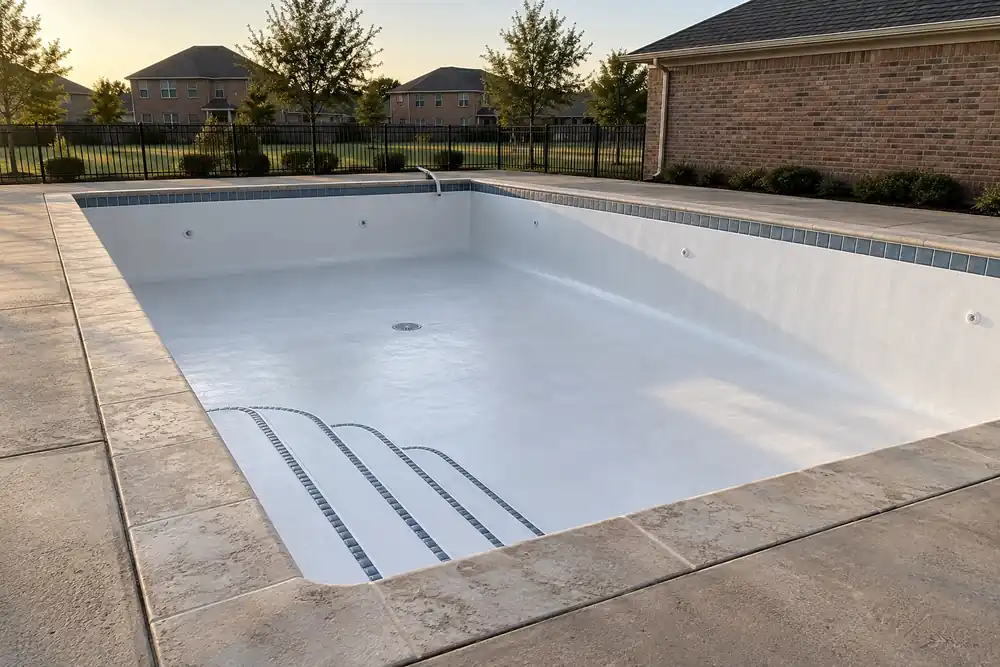
Pool Replastering in Flower Mound, TX
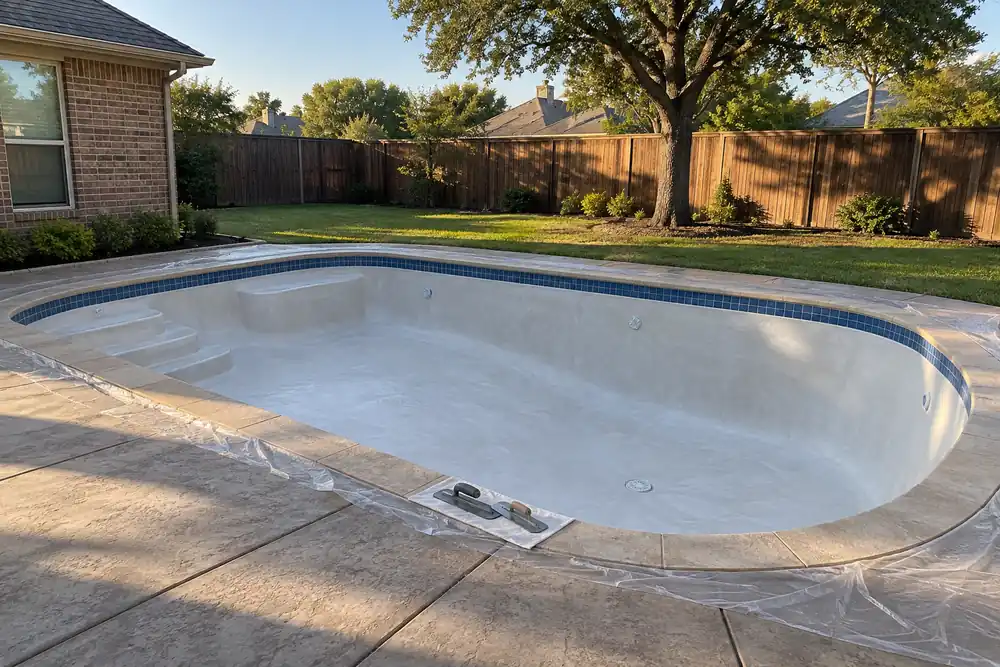
Flower Mound Pool Resurfacing handles pool replastering in Flower Mound, Texas: white plaster, also called marcite, and colored plaster, troweled over a bond coat on sound old plaster or onto a shell stripped of its old surface. The National Plasterers Council describes standard white plaster as the economical option, hard-troweled to a smooth finish, and rates it a 5 to 8 year surface.
Request a free estimate, any time. We'll talk through white or colored plaster, what the old plaster needs before the new coat goes on, and the 28 days of start-up after the fill.
Call or request a free estimate any time, 24/7
No charge · answered 24/7
Get free estimates
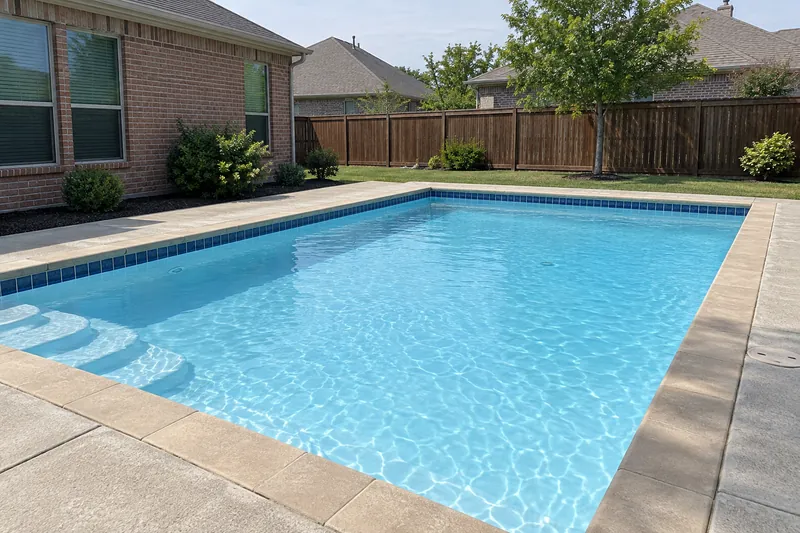
White plaster and colored plaster
White plaster (marcite)
White plaster is a simple mix of white cement, white marble aggregate and water, and underwater it gives a brilliant, clean, light blue look that is very smooth to the touch, the National Plasterers Council says. It also calls it a relatively soft finish, more affected by water chemistry than newer products, that will change in appearance over its life, from slight shading or scaling to, in extreme cases, staining, etching, cracking or delamination. Pool plaster uses white cement, which typically carries 0.4% or less iron oxide against 2.6% in gray cement, according to the Council's bulletin with the Portland Cement Association.
Colored plaster
Colored plaster accentuates everything normal in white plaster: mottling can be more pronounced, and pigment streaks, uneven color and checking show more. The Council counts none of it as a product defect and says the color may fade or lighten over time; sun and UV aren't the main cause, it adds, so much as the finish materials, the application and the water chemistry. Premix-Marbletite suggests setting a color sample in 6 inches of water to preview the result, and notes that darker colors hold warmth while lighter pools stay cooler.
Admixtures, and stepping up to aggregate
Pozzolan admixtures tie up calcium hydroxide, plaster's weakest element, and have been shown to reduce etching, cracking and mottling, though the Council says they aren't fool-proof. For a harder surface, quartz pool finishes are far more resistant to changing water chemistry than plain plaster, and pebble pool finishes are the most durable surface the Council knows; the guide to pool finishes compared sets them side by side.
For a free estimate on white or colored plaster, ask Flower Mound Pool Resurfacing.
Call or request a free estimate any time, 24/7.
(469) 526-3886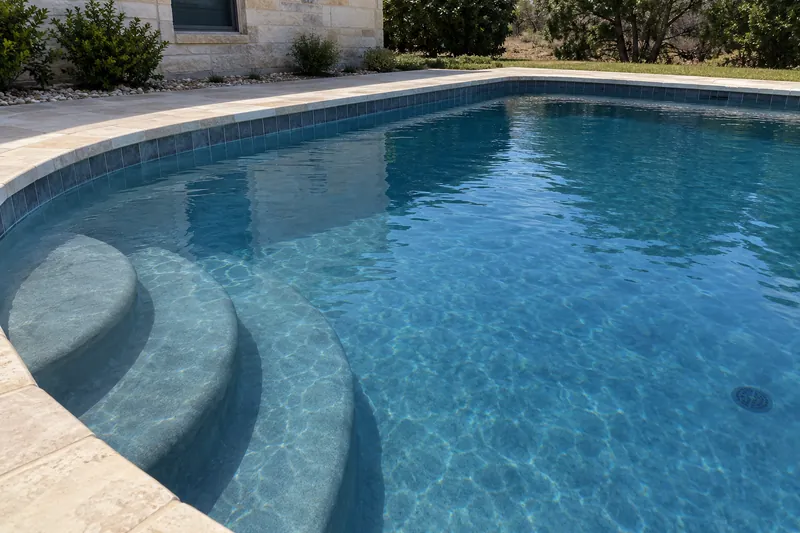
Bond coat or chip-out: getting the old plaster ready
Sounding for hollow plaster
SGM's installation manual calls for sounding out every hollow and delaminated area before resurfacing, sawing 3 inches outside each spot and filling the holes with patching cement. Where only a few isolated spots have let go, pool plaster repair may be enough; Universal White Cement says spreading or patterned hollow areas point to a bond problem that patching may only delay.
Bond coats over sound plaster
A bond coat is a resin-and-cement layer that grips the new plaster. SGM's Bond Kote, one 5-gallon pail of liquid resin and two 65-lb bags of dry mix covering about 500 square feet, is rolled on and stippled, and SGM's product page puts its minimum cure at six hours, with 24 hours giving the best results. Premix-Marbletite calls its Bond-Tite bond coat absolutely mandatory on all pool renovations, and CL Industries says its PermaKote removes the need for heavy preparation such as sandblasting and stripping.
Stripping to the shell
Pebble Technology International's remodel process strips the existing surface off instead. Either way, SGM's prep removes loose material by scraping, pressure washing or sandblasting, kills algae with a chlorine wash because leftover algae causes discoloration and delamination, and etches the shell with muriatic acid. Where old plaster is sound and only needs its stains cleared, a pool drain and acid wash dissolves surface material instead, one of the three meanings the Council gives the term.
Thickness at tile and fittings
The Council sets a finish's average thickness at 3/8 to 3/4 inch and says the finish can't level an uneven shell beyond that. SGM undercuts the old plaster at all tile and fittings, 2 inches back and 3/8 inch deep, so the new coat doesn't feather out to nothing, and keeps the inlets plugged until the pool is full so drips don't stain the new surface.
Flower Mound Pool Resurfacing will talk through whether your old plaster can take a bond coat or needs to come off.
Call or request a free estimate any time, 24/7.
(469) 526-3886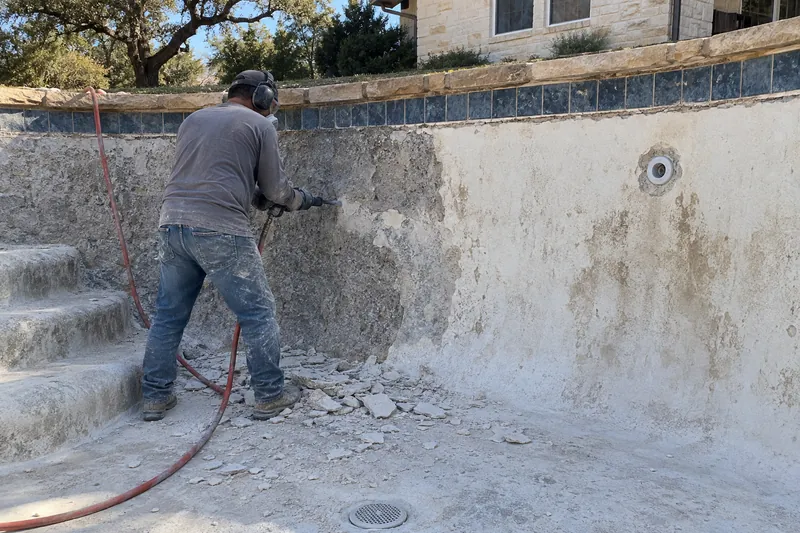
Plaster day, the fill and the 28-day start-up
One application
The Council stresses that a pool finish is placed and finished in one single application, which takes experienced plasterers. SGM's order is a scratch coat on the deep-end bowl first, then the walls from the shady side toward the sunny side, then a finish coat over the whole pool, 3/8 to 1/2 inch thick, on a shell that is cool and damp but not dripping wet.
Filling without stopping
Traditional hard-troweled white plaster should be filled as soon as possible after final set. Once started, the fill runs without interruption to the middle of the skimmer, with a clean cloth tied to the hose at the deepest point; a stop can leave a discolored bowl ring at that level. NPT says a fill can take 18 to 36 hours, so the hose is turned down overnight rather than off.
The first 28 days
The Council's start-up card treats the first 28 days as the time a new finish is most open to staining, scaling and discoloration. On day 1, alkalinity goes to 80–100 ppm and pH to 7.2–7.6; the pool is brushed at least twice a day; the pumps and filter run continuously for seven days, 72 hours at minimum; no chlorine goes in for 48 hours; salt-water pools get no salt for 30 days; and wheeled cleaners wait until after day 28. The Council accepts that other start-ups give similar results, and says proprietary finishes follow their maker's instructions.
To plan the fill and start-up for your pool, ask Flower Mound Pool Resurfacing.
Call or request a free estimate any time, 24/7.
(469) 526-3886
Flower Mound water, weather and permits for a replaster
Testing the Town's water before the fill
Flower Mound buys its water from the Upper Trinity Regional Water District and Dallas Water Utilities and disinfects it with chloramine. Its 2025 water quality report leaves out calcium hardness and the other secondary constituents, offering monthly results on request instead. The Council calls testing fill water for pH, alkalinity, calcium hardness and metals no longer optional, and warns that water low in pH, calcium or alkalinity can etch a finish while water high in them can scale it.
The water stage at refill time
As of October 2026 the Town is under its Long-Term Water Conservation Plan rather than one of its emergency stages, and it says its restrictions could change. If Stage 1 is declared, refilling an existing pool after maintenance counts as outside water use and follows the watering schedule; under Stage 2, a pool may be filled only between 6 p.m. and 10 a.m. A new plaster finish needs its fill to run without stopping, so check the Town's current stage before the pool is drained.
Heat, wind and the season
NOAA's 1991–2020 normals for Grapevine Dam average 22.1 days a year at 100°F or hotter, 11.2 of them in August. The Council's hot-weather bulletin finds no standard limiting the air temperature for plastering and calls wind the dominant cause of shrinkage cracking, so its precautions run to pre-wetting the shell, starting earlier in the morning, adding plasterers and tenting the pool. More on timing is in the guide on when to resurface a pool in North Texas.
Permits for replastering
The 2024 International Swimming Pool and Spa Code, which Flower Mound adopted by Ordinance No. 31-25, says a permit is not required for replastering or resurfacing an existing pool or spa. The Town's amended code still requires permits to alter or repair a pool, and its fee schedule names no fee for replastering, so confirm with the Town's Building Inspections before work starts. Plumbing and electrical work is permitted separately.
The same plaster, prep and start-up apply across the towns we serve, including pool replastering in Carrollton. Flower Mound Pool Resurfacing will talk through the water test, the Town's current stage and the permit question before your pool is drained.
Call or request a free estimate any time, 24/7.
(469) 526-3886What pool replastering costs around Dallas–Fort Worth
- White plaster, 15,000–25,000-gallon pool (DFW, 2026)
- $4,000–$7,000
- Colored or tinted plaster (DFW, 2026)
- $5,000–$8,000
- Basic plaster resurfacing (national, 2026)
- $5,000–$10,000
- Extra prep: chip-out and repairs (Texas, 2026)
- $1,000–$3,000 added
Published averages and other companies’ ranges, not our prices. A real price needs a look at the pool.
Size drives the price: Dallas figures for 2026 put replastering at $5,671 per 1,000 square feet of pool surface. Refill water bills at the Town's monthly usage blocks; from October 1, 2026, Ordinance No. 33-26 charges $5.62 per 1,000 gallons from 2,000 to 10,000 gallons in a month, $7.60 up to 15,000 and $8.65 up to 50,000. Totals for other finishes and remodels are in the guide to pool resurfacing cost in Flower Mound.
Call or request a free estimate any time, 24/7.
(469) 526-3886Pool replastering questions and answers
How much does it usually cost to replaster a pool?
Typical Dallas–Fort Worth figures for 2026 put standard white plaster at $5,000 to $7,500 for a typical home pool, and Dallas figures for the same year put plaster at about $4 a square foot. Flower Mound Pool Resurfacing prices each job after a look at the pool's size, its old surface and the prep it needs.
How long does a pool replaster last?
The National Plasterers Council's finish comparison rates standard white plaster a 5 to 8 year surface, while its FAQ page says pool plaster can last up to 20 years with proper care. Universal White Cement, a white cement maker, rests plaster life on three legs: materials, application and the water environment.
Can you plaster over old plaster in a pool?
Yes, over a bond coat on sound plaster. SGM, CL Industries and Premix-Marbletite all make bond coats for putting new plaster over an existing finish, once hollow and loose plaster has been removed. The limit the sources set is thickness: the Council caps a finish's average at 3/4 inch.
Is resurfacing a pool the same as replastering?
Replastering is one kind of resurfacing. The National Plasterers Council's resurfacing page lists four finish types, white plaster, quartz, polished and pebble, and the 2024 International Swimming Pool and Spa Code names replastering and resurfacing side by side in its permit exemption.
Can I replaster a pool myself?
The Council says resurfacing takes expert plasterers with years of experience, because the special cement mix is placed and finished in one single application, and Pebble Technology International sells its finishes only to trained builders and installers. In Flower Mound, a homeowner doing code-regulated work personally at their own residence is exempt from the Town's contractor registration fee.
Get a free pool replastering estimate
Flower Mound Pool Resurfacing answers calls and estimate requests 24/7. Tell us about the pool, its plaster now and the color you have in mind.