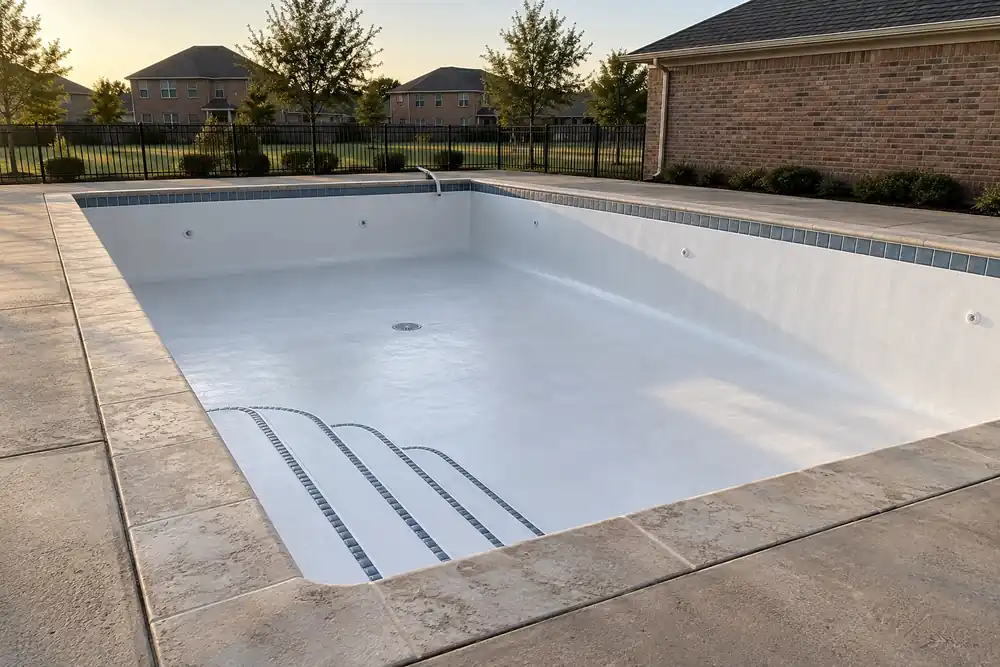
When to Resurface a Pool in North Texas: Season, Heat and Timing
Flower Mound Pool Resurfacing looks at when to resurface a pool in Flower Mound, Texas: how to tell a finish is worn out, and how North Texas heat, wind, freezes and rain shape the day the new one goes on.
No industry body or finish maker we found names a best month. They set weather limits instead, and this guide sets those limits beside NOAA's 1991–2020 normals for the Grapevine Dam station, about 6.9 miles from the center of town, and for DFW Airport.
Call or request a free estimate any time, 24/7
Signs a pool finish needs resurfacing
Wear you can see and feel
Pebble Technology International names rough or pitted surfaces, discoloration and cracks as signs that any finish needs replacing. SGM adds that roughening beyond normal wear points to a finish near the end of its life, that loss of aggregate in a pebble or quartz finish becomes a concern once it leaves the surface uneven or exposes what's underneath, and that permanent stains or faded color can justify refinishing even while the finish is still sound.
Cracks, spalling and delamination
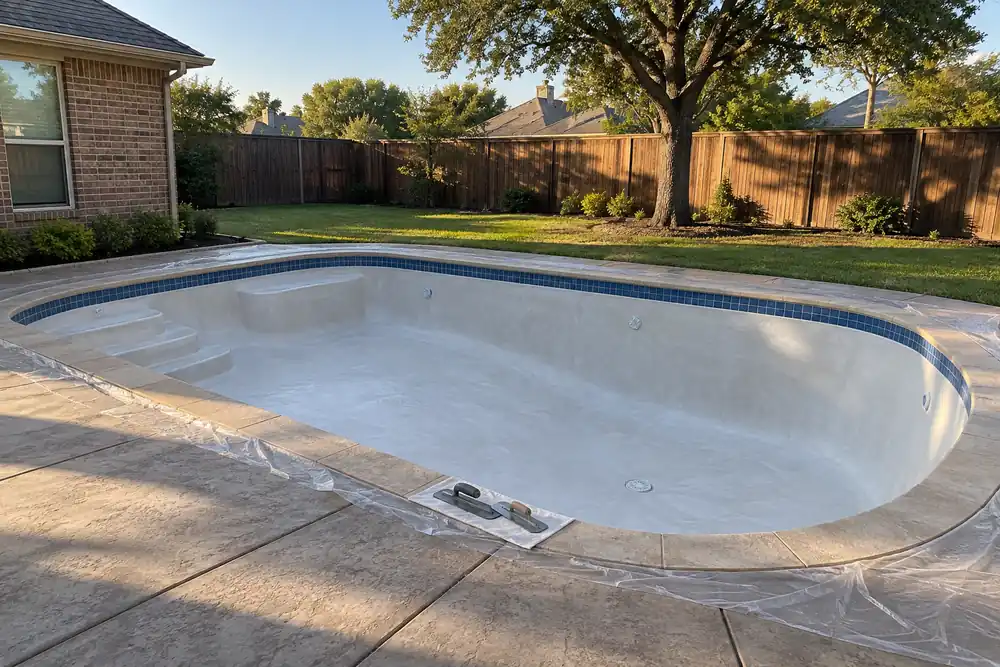
Cracking or spalling needs attention right away, SGM says, and usually points to a problem in the shell that has to be fixed during refinishing; delamination or bubbling means the finish has failed. Its maintenance guide tells owners to call an installer on seeing widespread etching, persistent dark mottling, calcium nodules or any sign of the finish pulling away from the shell. A worn plaster surface is what pool replastering replaces.
Rising cleaning and chemical needs
A big rise in cleaning and chemical needs, or water chemistry that gets harder to manage, can signal a finish nearing replacement, SGM says. Pebble Technology International puts any pool's schedule down to its use, its maintenance and its surroundings.
Call or request a free estimate any time, 24/7.
(469) 526-3886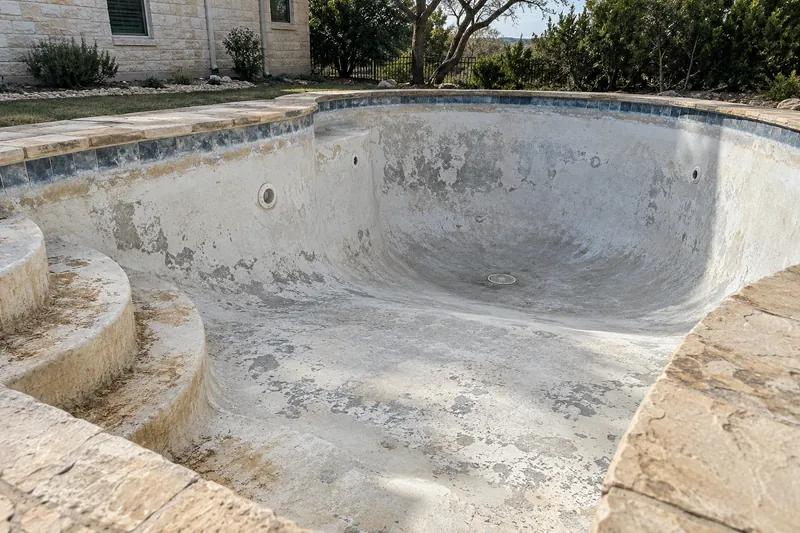
How often pools are resurfaced
The National Plasterers Council's ratings run 5 to 8 years for white plaster, 10 to 15 for quartz and 12 to 18 for pebble. Typical Dallas–Fort Worth figures for 2026 run longer, saying most plaster in the area needs resurfacing every 8 to 15 years, depending on water chemistry, maintenance and the type of surface.
Tile and coping keep their own clock. Typical Dallas–Fort Worth figures for 2026 give the two 15 to 20 years in the sun, the water and the chemicals before both wear out, and put most retiles on pools aged 15 to 25. Pebble Technology International says a remodel usually renews the finish and the waterline tile together. When both are due, a pool remodel handles them in one drain-down.
Call or request a free estimate any time, 24/7.
(469) 526-3886Summer heat and wind on plastering day
Hot days
At Grapevine Dam, a normal year brings 22.1 days of 100°F or more: 7.7 in July and 11.2 in August. The National Plasterers Council says heat alone may not call for any change to normal application; precautions come in when conditions can affect placing and finishing, and they vary by region. Hot, dry or windy weather, the Council says, shortens the set time, dries the surface faster, raises the chance of cold joints and can color the finish unevenly between sun and shade.
Wind
Wind speed is the dominant factor in the Council's analysis of shrinkage cracking. A 100°F day with little or no wind doesn't reach the water loss that causes shrinkage cracking, but sustained wind above 5 mph does, and even a mild 75°F day can pass it with sustained winds of 12 to 13 mph.
Hot-weather plastering precautions
The Council's hot-weather list includes light-colored pump hoses or white tarps over the hoses and materials, cold water or ice in the mix, a slower-setting cement, a pozzolan and set retarders used as their makers recommend. SGM keeps the materials and surfaces for its Bond Kote bond coat between 50°F and 100°F for 24 hours before and after it goes on, and says not to apply it in rain or extremely high humidity.
Call or request a free estimate any time, 24/7.
(469) 526-3886Winter freezes and a new pool finish
Cold limits for the finish
NPT quotes the American Concrete Institute: for every 10°F drop in concrete temperature, setting time grows by about a third, so a mix that sets in six hours at 70°F wouldn't set for 11 hours at 50°F. NOAA's normals for DFW Airport count 29.2 nights a year at or below freezing, with the last spring freeze by March 8 and the first autumn freeze by November 24 in half of all years; Grapevine Dam, closer to town, averages 44.3 such nights.
Freeze-thaw at the waterline
Water insulates: the National Plasterers Council says a finish fully underwater isn't subject to freezing and thawing, and even a few inches of standing water typically keep it above freezing, generally around 39°F, when the air is below freezing. The weak spot is the band just above the waterline, where water held in the finish's pores can expand and contract by about 9% with each freeze-thaw cycle. Damage starts as a white bloom above the waterline, then a rough surface and lost aggregate, and finally thin layers that crack, lift or peel. Steps, benches and sun ledges in that band are most at risk, so the Council recommends keeping at least 4 inches of water over them. Rain shifts the water level and puts new areas of finish in the band. Mild winters may leave no visible damage, severe ones make it inevitable, and the Council doesn't count freeze-thaw damage as a material or workmanship defect.
Call or request a free estimate any time, 24/7.
(469) 526-3886Rain, water rules and the refill
Keeping rain off a new finish
Grapevine Dam's normal precipitation is 38.89 inches a year, and a volunteer gauge inside the town, Flower Mound 2.3 NE, logs 39.17. The National Plasterers Council says no other water, such as sprinklers or rain runoff, should touch a new finish before the pool is full, to prevent streaks or spots, and Designer Concrete Coatings, an Australian finish maker, says a fresh surface must be protected from rain until it reaches hard set.
The Town's water stage
The Town was operating under its Long-Term Water Conservation Plan when this guide was written in October 2026, and says its restrictions could change with drought or water storage and pumping conditions. A stage can be triggered by demand (Stage 1 when average daily use reaches 90 percent of the available supply for two days in a row), by equipment failures, or by restrictions from a wholesale supplier. Under Stage 1, the Town's code treats refilling an existing pool after maintenance as outside water use, limited to the watering schedule: two set days a week by address, from midnight to 10 a.m. and from 6 p.m. to midnight. Because the fill on a new finish should run without stopping once it starts, ask the Town how a refill is handled before the pool is drained if a stage is in force.
Call or request a free estimate any time, 24/7.
(469) 526-3886Pool resurfacing timing questions
How do I know if my pool needs resurfacing?
The National Plasterers Council's test is whether cracks and wear can still be patched or repaired, and whether you still accept how the pool looks. Makers add specific signs: a rough or pitted surface, stains that cleaning won't lift, faded color, aggregate coming loose, and any delamination, where the finish separates from the shell.
How often should pools be resurfaced?
National figures for 2025 say every 7 to 15 years, depending on the finish: plaster lasts 7 to 12 years on average, and aggregate and pebble finishes 15 years or more. On the National Plasterers Council's ratings, plaster sits at the short end and pebble at the long end.
Can a pool be resurfaced in winter?
Yes, inside the makers' cold limits. Pebble Technology International won't accept a cold-weather install unless the day's average temperature tops 40°F and the shell is unfrozen, and NPT wants a new finish protected from freezing for 48 hours so it can reach at least 500 psi. Days that never climb above freezing are rare at Grapevine Dam, at 1.8 a year.
Plan your pool resurfacing with a free estimate
Requests are answered 24/7. Describe the finish as it looks today and when you would like the work done.