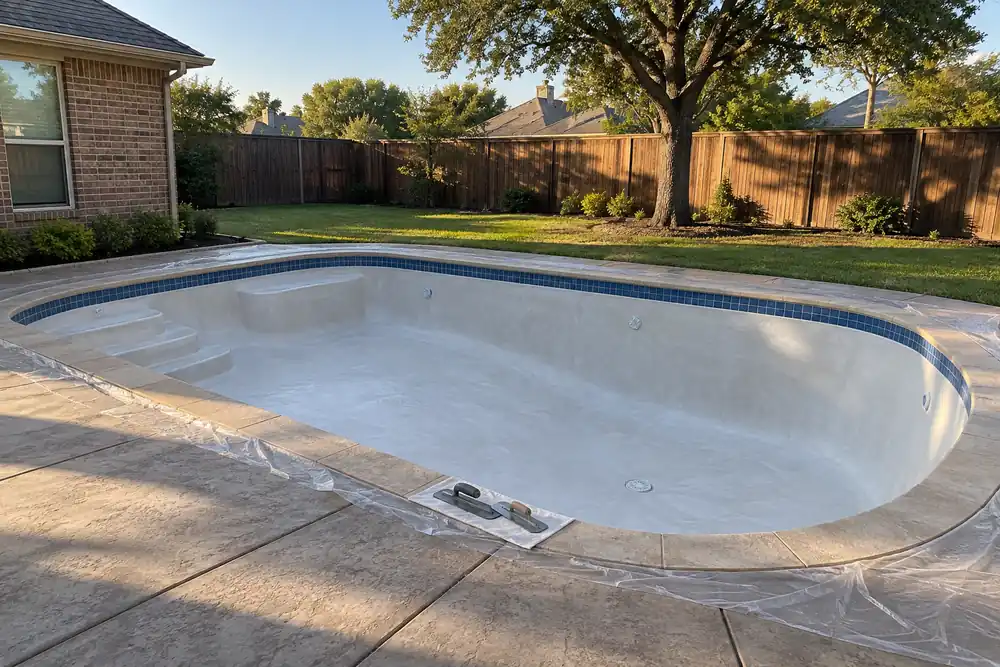
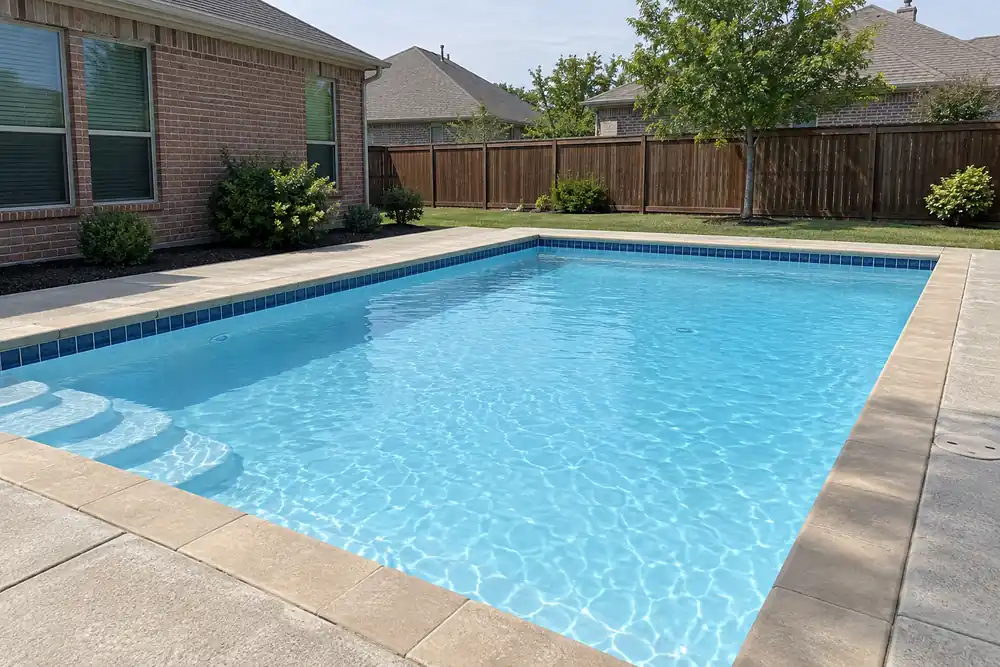
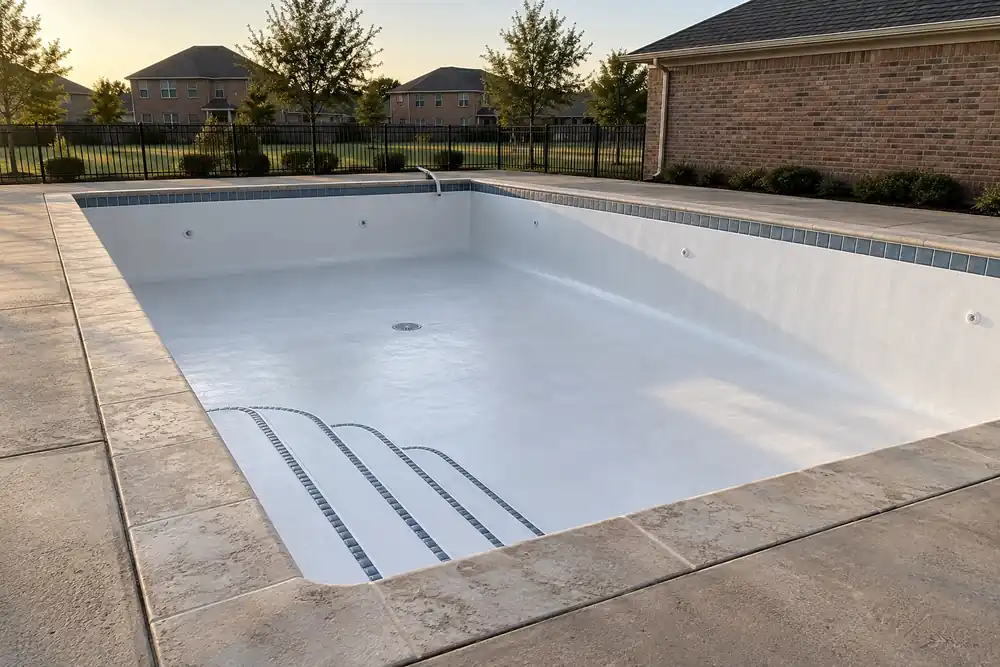
Pool Replastering in Carrollton, Texas
Flower Mound Pool Resurfacing handles pool replastering in Carrollton, Texas, for home pools as well as apartment, club and other commercial pools; 29,587 of the city's housing units, about 54.4%, went up before 1990, by the Census Bureau's 2020–2024 survey estimates.
Carrollton sits on Interstate 35E fourteen miles north of downtown Dallas and spreads across Denton, Dallas and Collin counties, with the A.W. Perry Homestead Museum, the Elm Fork Nature Preserve, Indian Creek Golf Club and the Rosemeade Rainforest among its City facilities. Ask for a free estimate whenever it suits you, and we'll talk through the old plaster, the prep it needs and the City's rules before the pool is drained.
Call or request a free estimate any time, 24/7
No charge · answered 24/7
Get free estimates
Carrollton's 1970s and 1980s housing
No decade built more of Carrollton than the 1980s, with 15,462 housing units, about 28.4% of the city's 54,365 in the survey. Another 14,125 units predate 1980, so 29,587 predate 1990, and the median year built is 1988, give or take two years. Later decades added less: 8,604 units in the 1990s, 7,706 in 2000–2009 and 8,468 since 2010, of them 973 in 2020 or later.
The Handbook of Texas traces that boom. Carrollton had 1,610 people in 1950 and 13,855 by 1970, then grew 193 percent to 40,595 by 1980, when almost three-quarters of its year-round housing units had been built during the 1970s. It reached 82,169 in 1990 and 109,576 in 2000. The 2020 Census counted 133,434 residents, and the estimate for July 1, 2025 is 134,562: 83,033 in Denton County, 50,838 in Dallas County and 691 in Collin County.
Apartments beside detached houses
About 58.3% of the units, 31,669, are single-family detached houses, and 15,554, about 28.6%, are in buildings of five or more units, 5,327 of them in buildings of 50 or more. Owners occupy 30,442 of the 51,995 occupied homes, about 58.5%, and 21,553 are rented. Carrollton's owner-occupied homes have a median value of $381,000; the median household income is $101,396.
Flower Mound Pool Resurfacing replasters backyard pools as well as apartment, club and other commercial pools across Carrollton.
Call or request a free estimate any time, 24/7.
(469) 526-3886The 2024 pool code and the City's permit rules
Carrollton has adopted the 2024 editions of the International Building, Residential and Swimming Pool and Spa codes, with local amendments; the 2021 codes, under Ordinance 4044, were the previous cycle. The 2024 model text adds a sentence to the permit section: "A permit shall not be required for replastering or resurfacing of an existing pool or spa." We haven't read the City's amendments, and its swimming pool page speaks only of new pools, so confirm with Building Inspection before the pool is drained, and don't stretch that sentence to tile, coping, decks, plumbing or electrical work.
What the City's pool page does say: any new pool or spa deeper than 24 inches needs a permit, though a self-contained portable spa with a locking cover does not; a pool barrier is required around every pool, and it may include alarms on doors from the house, with an affidavit accepted in place of the alarm inspection; and a pool contractor must be registered with the City. The building fee page, as archived on June 11, 2026, listed a pool or spa permit at $200, paving at $125 and a residential remodel at $125, so check the live schedule before you apply. Electrical repairs to a pool light are a separate matter: under Texas law, non-exempt electrical work must be done by a licensed electrician working through a licensed electrical contractor.
Apartment pools and the color of the new plaster
Texas classes apartment, condominium, hotel, property owners association, club and school pools as Class C public pools. For public pools the state follows the 2021 International Swimming Pool and Spa Code, under which interior finishes must reach a Munsell color value of at least 6.5, while the 2024 edition that Carrollton adopted raises that minimum to 8.0. Local health authorities may set public-pool standards equal to or stricter than the state's, so ask the City which minimum applies before choosing a colored plaster for an apartment or club pool. The color rule leaves out waterline tile, step and bench edge markings, competition lane markings and pools shallower than 24 inches.
Call or request a free estimate any time, 24/7.
(469) 526-3886How long plaster lasts and how it cures
Published lifespans
Published figures vary. Typical Dallas–Fort Worth figures for 2026 put the usual interval for resurfacing plaster in the area at 8 to 15 years, with water chemistry, upkeep and surface type making the difference, and national figures for 2025 give plaster 7 to 12 years on average. Universal White Cement, a white cement maker, says white cement plaster made with good materials, applied soundly and kept in decent water should routinely give 15 to 20 years of service.
Curing under water
Plaster cures best submerged. The National Plasterers Council calls it ponding: filling the pool as soon as possible after final set lets the cement keep hydrating without losing moisture fast, which greatly reduces shrinkage cracking. The Council's figures have roughly 70 percent of the cement's hydration done within 7 days and roughly 85 percent within 28, with the remainder continuing for years.
Judging the new surface
A hard-troweled plaster finish should feel no rougher than very fine 220-grit sandpaper, like an eggshell, though the Council wants steps, benches and walk-out areas left less smooth so feet don't slip. Its advice is to look at new plaster once the pool is full and the water clean and balanced, on a cloudy day or in morning or afternoon light, not with the sun straight overhead, in wind or under the pool lights at night, which all make flaws look worse. Normal mottling, a uniform shaded or cloudy look, is no defect in the Council's view and usually fades with time.
The 2025 plastering standard
On April 14, 2025, the Pool & Hot Tub Alliance, the International Code Council and the National Plasterers Council published the revised ANSI/PHTA/NPC/ICC-12 2025 plastering standard, covering the cementitious finish of public and residential pools and spas. The Council also notes that limestone cement, which entered pool plastering in late 2011 to early 2012, now holds an estimated 40% of the market, and that because limestone doesn't bind with pigment, colors made with it may look somewhat muted.
Call or request a free estimate any time, 24/7.
(469) 526-3886Houston Black clay, Trinity soils and the rain gauge
The USDA soil survey maps 77 units on land inside Carrollton, drawn from both the Denton and the Dallas County surveys. Houston Black-Urban land complex leads at about 9.6% of the mapped land, then Branyon clay at 7.7% and Trinity-Urban land complex, occasionally flooded, at 7.6%; grouped by main soil, Houston Black covers about 18.0%, Trinity 14.5% and Branyon 11.5%. Houston Black's highest linear extensibility runs from 12 to 17 percent across its units, and NRCS puts the main soil of units covering about 81.9% of the mapped land in its Very limited class for houses, shrink-swell among its reasons.
Wet ground can reach plaster from the outside. The National Plasterers Council warns that water building up against the back of a pool shell, from seasonal rain or a leaking irrigation line, can create enough back pressure to debond a bond coat or the finish itself, and it notes that a pool holds water through its shell and interior finish working together. NOAA's Carrollton station records a 1991–2020 normal of 39.84 inches of precipitation a year, though on only 10 years of data and with no temperature figures.
Dallas water and the City's watering rules
Carrollton buys its water from Dallas Water Utilities, whose supply comes from seven surface sources, by the City's 2025 report: the Elm Fork of the Trinity River and lakes Fork, Grapevine, Lewisville, Ray Hubbard, Ray Roberts and Tawakoni. When we read the City's rules on October 6, 2026, Carrollton was not under mandatory drought restrictions, and from April 1 to October 31 it allows no watering between 10 a.m. and 6 p.m. Mandatory restrictions may begin if total reservoir storage drops below 65 percent of capacity, since the City follows the conservation strategies of Dallas Water Utilities, its supplier.
The National Plasterers Council wants a new finish filled continuously, as fast as possible, once the hose goes in, and it calls for the fill water to be tested for pH, total alkalinity, calcium hardness and metals and the results recorded. The City's page didn't say how its stage rules would treat a pool fill, so check the current stage with Carrollton before the pool is drained.
Call or request a free estimate any time, 24/7.
(469) 526-3886Trinity Mills, the Cotton Belt and the Metrocrest
The site lay inside the Peters colony grant, and William and Mary Larner, the first settlers, arrived in 1842. The A. W. Perry family followed two years later and claimed its headright in the Trinity Mills area, where Perry ran a mill with Wade H. Witt, and the town was most likely named for Carrollton, Illinois, the hometown of many early settlers. When the Cotton Belt line crossed the Katy there in 1888, Carrollton became a shipping center for livestock, grain, cotton and cottonseed, and by the late 1940s it was a "grain and gravel" town with a dairy industry and a brick plant that furnished brick for Dallas.
The city incorporated in 1913 and elected W. F. Vinson its first mayor. It belongs to the Metrocrest, four northwest Dallas County cities, with Addison, Coppell and Farmers Branch, served by a single chamber of commerce, and as late as 1983 a working cattle ranch still operated inside its limits. The A.W. Perry Homestead Museum and the Elm Fork Nature Center are among the City's facilities today.
Replastering beside plaster repair, tile and new finishes
A replaster is often the moment for other work. Along with the new plaster, Flower Mound Pool Resurfacing handles plaster patches, quartz and pebble finishes, waterline tile, coping, and drain and acid wash. Nearby, see pool remodeling in Coppell and cool deck repair in Hebron.
Typical Dallas–Fort Worth figures from 2025 put standard white plaster at $4 to $5 a square foot and complete marcite replastering projects at $6,000 to $8,000 on average, and in national 2026 figures commercial replasters cost roughly $6.50 to $8.00 per square foot, counted over the pool's interior surface. Those are published averages, not our prices.
Call or request a free estimate any time, 24/7.
(469) 526-3886Steps in a Carrollton replaster
Measure walls and floor
Replastering is priced on the pool’s interior surface, walls plus floor, rather than on the water surface or the gallons it holds.
Ask Building Inspection
Check the City’s amendments against the 2024 code’s replastering sentence, and use a pool contractor registered with the City.
Keep the barrier closed
The City requires a pool barrier around every pool, so it stays shut while the work goes on.
Prepare the old surface
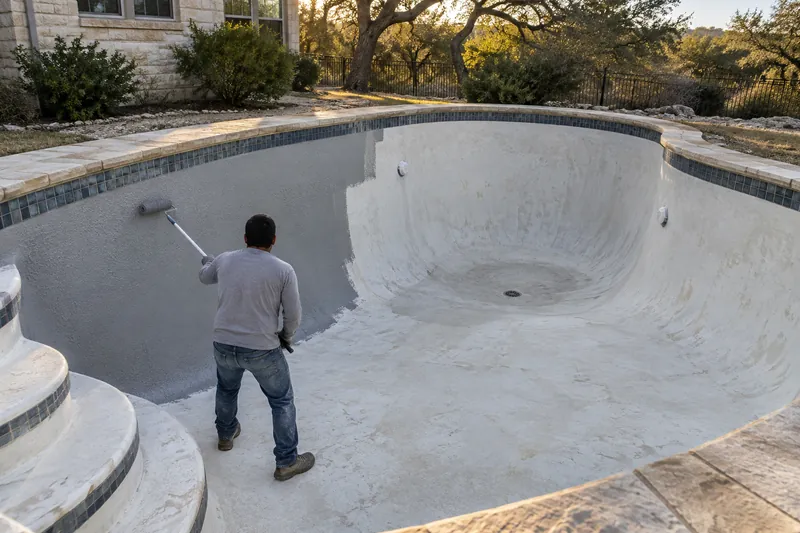
Hollow plaster is cut out, and the shell is either bonded over or stripped so the new coat grips.
Plaster, then fill at once
The pool is filled as soon as possible after final set and without a stop, so the new plaster cures under water.
Start up and judge the finish
The water is balanced through the first weeks of start-up, and the surface is judged full, in morning or afternoon light.
Call or request a free estimate any time, 24/7.
(469) 526-3886Pool replastering questions
What does it cost to replaster a 10,000-gallon pool?
Price follows the pool's surface area more than its volume. National figures for 2026 put replastering at $4 to $7 a square foot and count about 1,088 square feet of surface in a 16-by-32-foot pool running 4 to 8 feet deep, and contractors measure that interior surface, walls plus floor. A 10,000-gallon pool can have more or less surface depending on its shape and depths, so Flower Mound Pool Resurfacing measures it before giving a price.
What time of year is best to replaster a pool?
None of the plaster makers or trade bodies we read picks a month; they set conditions instead. SGM keeps Diamond Brite's materials and work area between 50°F and 100°F from a day before placing until three days after, and the National Plasterers Council finds wind the main driver of plastic shrinkage cracking: a still 100°F day stays under its critical level of water loss, while sustained wind above 5 mph pushes past it.
Can I plaster a pool myself?
The National Plasterers Council treats it as a job for experienced plasterers, because the cement mix made for pool finishes has to be placed and troweled in one pass, start to finish. Even then, it says, hand troweling leaves some variation in thickness, levelness, texture and color, and no national standard yet measures acceptable tolerances. If you hire the job out instead, Carrollton requires the pool contractor to be registered with the City.
Plan a pool replastering in Carrollton
Ring or write to Flower Mound Pool Resurfacing at whatever hour suits you. Let us know about how big the pool is, what its plaster looks like now and whether it serves a home or an apartment complex.