Pool Finishes Compared: Plaster, Quartz, Pebble and Tile
Flower Mound Pool Resurfacing compares pool finishes for homeowners in Flower Mound, Texas: white or colored plaster, quartz, pebble and tile, set side by side on what each is made of, how long it lasts, how it looks and feels, and what it costs.
Surface-life figures come from the National Plasterers Council where it gives one; where a maker makes its own claim, the maker is named. Prices are published averages, not ours, and a free estimate starts with a look at your pool and the finish on it now.
Call or request a free estimate any time, 24/7
What each pool finish is made of
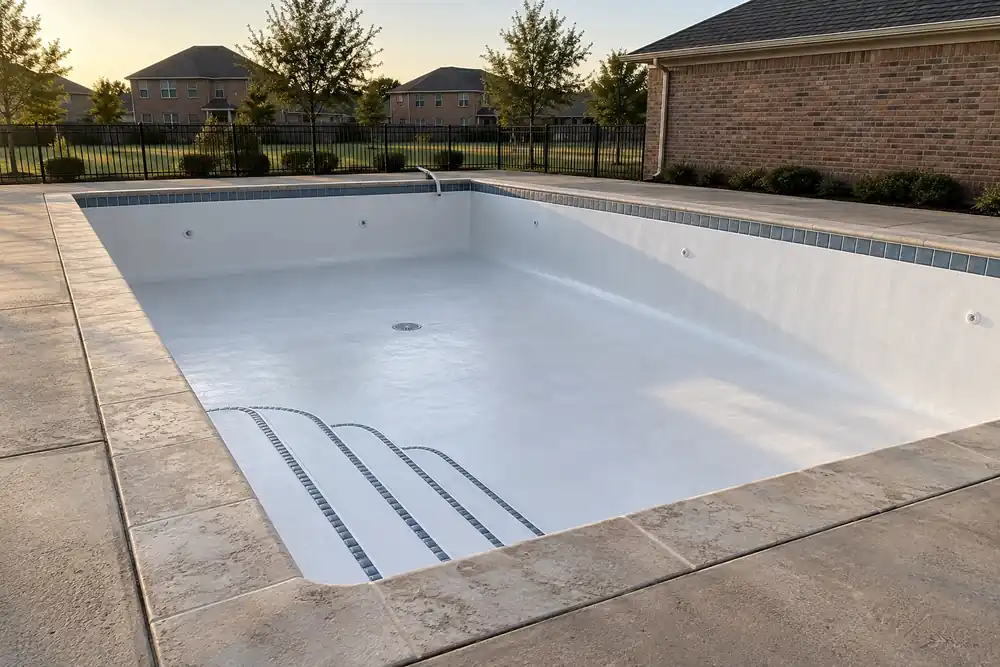
Plaster
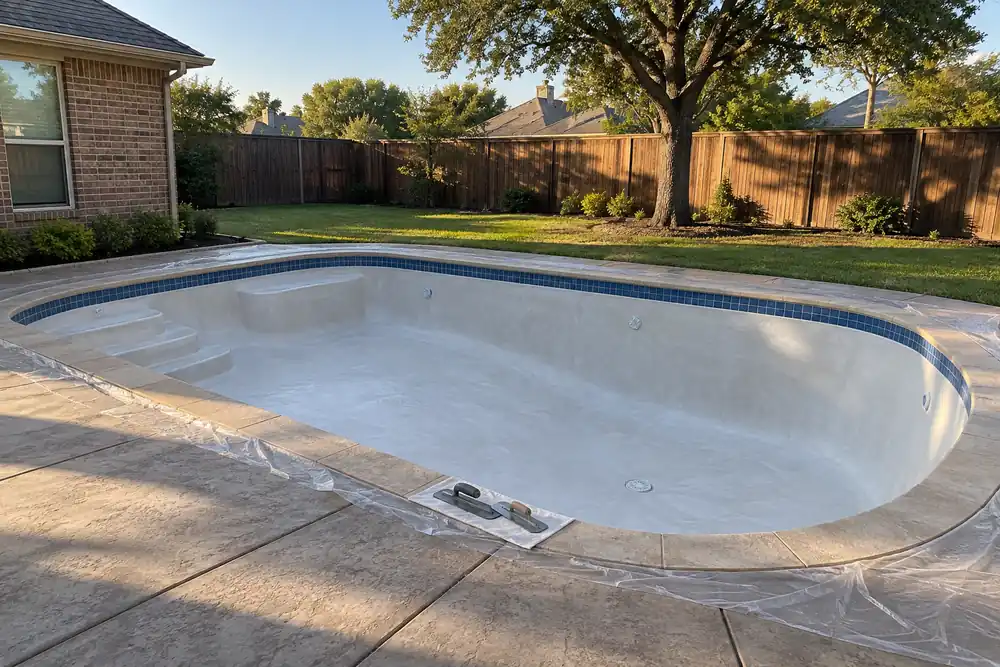
CL Industries describes plain plaster as water, Portland cement and either marble dust or silica sand, the least expensive finish and the one with the shortest lifespan. NPT notes that white plaster was the main option when pools spread into backyards in the 1950s. White and colored plaster are the finishes of pool replastering.
Quartz
Quartz finishes put quartz in the aggregate. Wet Edge Technologies sells a fortified blend of marble and quartz that it says is preferred over traditional plaster for longevity and strength, and Pebble Technology International makes a silica-based quartz finish, PebbleQuartz, that it calls much more durable than traditional marble-based quartz finishes while keeping the clean, uniform look of plaster. More on a quartz pool finish.
Pebble
Pebble Technology International sources naturally tumbled stones from New Zealand to Chile and screens each stone for size so the texture comes out even. NPT's StoneScapes mixes natural quartz pebble, specialty aggregates, iron oxide pigments and white Portland cement, and NPT puts its strength at 9,000 to 10,000 psi at 28 days with its modifier; Pebble Technology International's lab results give PebbleTec 9,913 psi at 28 days. More on a pebble pool finish.
Tile
A tiled interior is a different build. LATICRETE wants the waterproofing under submerged tile to form one continuous pan, and doesn't recommend waterproofing only the waterline; Lightstreams, a glass tile maker, lists 21 days after grouting before the pool is filled. For glass under water, LATICRETE recommends face-mounted sheets, warning that some back-mounting glues soften or swell and lose their hold, and Lightstreams calls variation in surface, color and shading normal in its cast glass.
Polished and glass bead
Polished finishes are ground smooth after they go on: NPT says its diamond-polished PolishedScapes can be re-polished over its life to bring back the luster. Glass bead finishes such as NPT's JewelScapes are smooth to the touch.
Call or request a free estimate any time, 24/7.
(469) 526-3886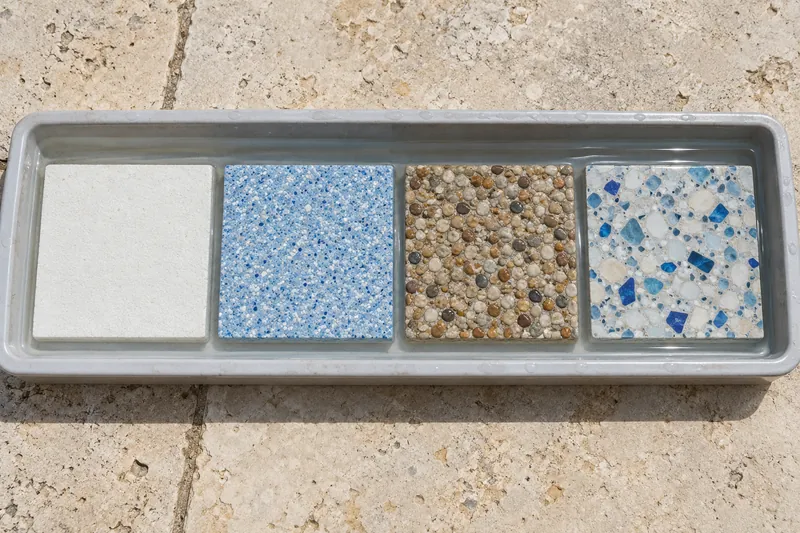
How long each finish lasts
Here is each finish's surface life on the National Plasterers Council's ratings, with the makers' own figures beside them:
- White plaster: a 5 to 8 year surface by the Council's rating. SGM says early wear, such as roughening, minor staining and small areas of spalling or pitting, typically shows within 3 to 5 years.
- Quartz: 10 to 15 years by the Council. SGM builds its Diamond Brite for 8 to 12 years, with many pools going longer when they're looked after consistently.
- Polished: 8 to 12 years by the Council.
- Pebble: 12 to 18 years by the Council. SGM cites industry averages of 10 to 20 years for exposed pebble.
- Glass bead: no Council figure; SGM expects many installations to pass 20 years.
- Tile: no Council figure; typical Dallas–Fort Worth figures for 2026 give a tile interior 25 years or more.
Climate counts too. SGM says hot, sunny climates speed up plaster's deterioration, while cooler climates with less UV can stretch its life toward the top of the range. DFW Airport's 1991–2020 normals from NOAA average 106.2 days a year reaching 90°F, 20.3 of them reaching 100°F.
Call or request a free estimate any time, 24/7.
(469) 526-3886Texture, color and how a finish looks in the water
Smooth or textured underfoot
The National Plasterers Council expects properly hard-troweled plaster to be no rougher than 220-grit sandpaper, about as smooth as an eggshell, but warns that steps, benches and walk-out areas shouldn't be made overly smooth, to prevent slipping. For exposed pebble, Pebble Technology International's lab results give PebbleTec a wet dynamic coefficient of friction, a measure of slip resistance, of 0.63. CL Industries calls its polished marble finishes silky smooth yet non-slip.
Color and light
CL Industries says the more direct the sunlight, the lighter the water looks. The Council adds two points on cement itself: limestone cement doesn't bind with pigment, so colors can come out somewhat muted, and more mix water tends to give a lighter color while less gives a darker one.
Judging the finish once the pool is full
The Council says to look at a finish with the pool full of clean, balanced water, in the morning, the afternoon or on a cloudy day, and never at night under the pool lights. Pebble Technology International agrees that light shining across a surface exaggerates waviness and doesn't count that as a defect. Normal mottling, a cloudy shading from uneven moisture and hydration, needs no remedy, the Council says, and usually fades over time.
Call or request a free estimate any time, 24/7.
(469) 526-3886What each finish costs
- Paint
- $1–$2
- Plaster or marcite
- $6–$8
- Quartz plaster
- $7–$10
- Pebble
- $7–$15
- Tile
- $8–$30+
National averages per square foot of pool surface, 2025. Published figures, not our prices.
For a 1,000-square-foot pool, those national averages for 2025 run from $1,000 to $2,000 for paint to $8,000 to $30,000 or more for tile. Around Dallas–Fort Worth, typical 2026 figures run $4,000 to $7,000 to put white plaster in a pool of 15,000 to 25,000 gallons, $6,500 to $10,000 for quartz, $8,000 to $15,000 for pebble, and $15,000 to $40,000 or more to tile the whole interior.
Call or request a free estimate any time, 24/7.
(469) 526-3886Choosing the best pool finish for your pool
The National Plasterers Council says any of these finishes can give years of reliable performance and dazzling beauty in a well-made, well-maintained pool, and that the key is understanding each one's strengths and weaknesses and choosing wisely. Set side by side, the trade-offs run like this:
- Budget and how long you'll keep the pool. Plaster costs least and lasts the shortest time; pebble costs more and carries the Council's longest rating.
- Water chemistry. The Council calls colored ceramic quartz much more durable than standard plaster and far more resistant to changing water chemistry, yet able to show some surface problems under extreme chemistry, and says pebble can be damaged under the most extreme chemical conditions too.
- Feel underfoot. Hard-troweled plaster is close to eggshell-smooth, polished finishes are smoother still, and exposed pebble is textured; the Council warns against overly smooth steps and benches.
- Who stands behind the material. Makers set their own warranty terms: CL Industries' 10-year warranty on its pre-blended finishes applies only when a factory-approved applicator installs them and the owner registers within 30 days.
Call or request a free estimate any time, 24/7.
(469) 526-3886Pool finish questions
What type of pool finish is best?
It depends on budget and how long you'll keep the pool. On the National Plasterers Council's ratings, pebble lasts longest at 12 to 18 years and is the most durable surface available, while white plaster, at 5 to 8 years, is the most affordable finish on the market. Quartz sits between them at 10 to 15 years.
What is the smoothest pool finish available?
Each maker names its own. Pebble Technology International calls its buff-polished PebbleBreeze its smoothest finish, NPT says the same of its diamond-polished PolishedScapes, and Wet Edge Technologies of its hand-polished Primera Stone. Among unpolished finishes, hard-troweled plaster is meant to feel no rougher than 220-grit sandpaper.
How long does a pebble finish last on a pool?
The National Plasterers Council rates pebble a 12 to 18 year surface, and SGM cites industry averages of 10 to 20 years. Pebble Technology International says some pebbles come loose during the first cure and a small loss over time is normal, but that unbalanced water can weaken the cement and loosen pebbles in larger amounts.
What is the most affordable pool finish?
Paint costs least to put on, at $1 to $2 a square foot by national averages for 2025, but those same figures say pool paint lasts only 5 to 7 years. Among cement finishes, CL Industries calls plain plaster the least expensive option, with the shortest lifespan.
Choose a pool finish with a free estimate
Call or send a request any time, day or night, with the finish your pool has now and the ones you are weighing.