Pool Tile Cleaning and Calcium Removal in Flower Mound, TX
Flower Mound Pool Resurfacing handles pool tile cleaning and calcium removal in Flower Mound, Texas: taking the white scale line off waterline tile with a non-acid remover and a nylon brush, or by blasting it with fine media while the water is lowered below the tile line. The National Plasterers Council defines scale as minerals or metals that come out of the pool water and stick to tile and other surfaces, leaving stains and roughness, and names calcium carbonate as a major part of it. By typical Texas figures for 2026, bead blasting costs $900 to $2,400 a job and takes 3 to 6 hours, with no draining.
Request a free estimate, any time. We'll talk through the kind of tile, how heavy the scale is, and which removal method the tile's maker allows.
Call or request a free estimate any time, 24/7
No charge · answered 24/7
Get free estimates
What the white line on pool tile is
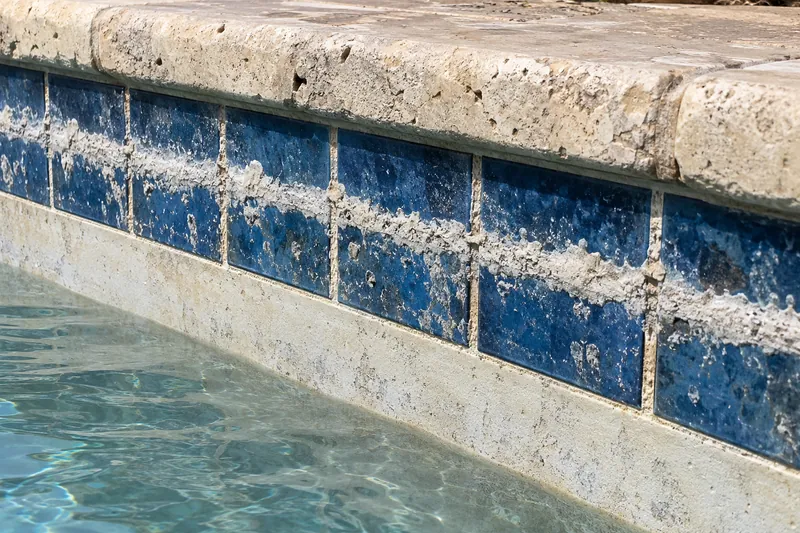
Evaporation leaves calcium behind
Orenda, a pool chemical maker, calls the evaporation line on tile a common type of scale: water evaporates off the tile and leaves its calcium behind, and as the pool loses water, what remains holds more calcium. Lunada Bay Tile, a tile maker, notes that evaporation is highest at the waterline. LATICRETE explains why: water oversaturated with minerals sheds them as scale, water undersaturated dissolves whatever it touches, and balanced water can drift out of balance within 24 hours.
Reading the saturation index
The Pool & Hot Tub Alliance uses the Langelier Saturation Index, worked out from pH, temperature, total dissolved solids, alkalinity and calcium hardness, to predict whether water will deposit calcium carbonate or dissolve it. Above zero the water may form scale; below zero it may attack cement. The Alliance's range for proper balance is -0.3 to +0.5. Sources differ on where scaling starts: Orenda puts it above +0.30, while Oceanside Glass & Tile calls 0.0 to 0.5 acceptable and warns that readings above 0.5 can bring cloudy water and faster scaling. Orenda adds that calcium hardness alone is usually not what drives scale; it takes high pH, warm water or carbonate alkalinity as well.
Scale, or something else
Real scale lands on every surface in the water, Orenda says, tile, plastic fittings, metal ladders and lights alike, so white calcium found only on cement is something else, such as etching, mottling or plaster dust. Calcium silica scale, which often looks rounded like grains of rice, can form on cement surfaces, seems immune to muriatic acid and has no known chemical remover. Tile that is cracked or loose under the scale is a job for pool tile repair.
Call or request a free estimate any time, 24/7.
(469) 526-3886How calcium comes off pool tile
By hand, without acid
Oceanside Glass & Tile removes scale with an acid-free calcium remover and a nylon-bristle brush, and rules out pumice stones, wire brushes and abrasive or acidic cleaners. The maker of the Pumie scouring stick keeps it off glass, fiberglass and plastics and warns that some decorative tile is fragile. On acid the tile makers are firm: Oceanside says products containing hydrofluoric, hydrochloric, muriatic or phosphoric acid must not touch its tile, and that a spill is neutralized at once with baking soda and water, and Lunada Bay Tile says never to put muriatic acid directly on glass or ceramic tile. Orenda doesn't recommend acid on scale either, and warns that scale usually comes back unless the water's saturation is corrected.
Bead and salt blasting
For heavier scale, Orenda names grinding or bead blasting. Kramer Industries, a maker of blasting media and equipment, lowers the water about 6 inches below the tile and shoots glass beads at low pressure, saying the beads won't harm tile or glaze and sink to the floor for the pool's cleaning equipment to pick up; it wants everyone, pets included, out of the pool and off the deck while blasting runs. The tile makers disagree on media. Oceanside rates glass bead the aggressive end of the range and baking soda the mild end, says baking soda or a mineral salt of similar hardness such as kieserite removes scale and stays safe for glass tile, and asks for a test in a hidden spot; Lunada Bay Tile advises against blasting glass or ceramic tile at all. Blasting crews describe machines with a built-in vacuum that pulls the deposits back as they come off, then a hand wipe-down of the tile.
Sealers on tile and grout
Lunada Bay Tile recommends sealing a new tile installation after it is set and before the pool is filled, and calls the sealer sacrificial, so it is reapplied from time to time; Oceanside says sealers help cement grout, natural stone and masonry such as coping. Where the whole interior finish needs cleaning, not just the tile, the job is a pool drain and acid wash.
Flower Mound Pool Resurfacing will match the method to your tile and the scale on it.
Call or request a free estimate any time, 24/7.
(469) 526-3886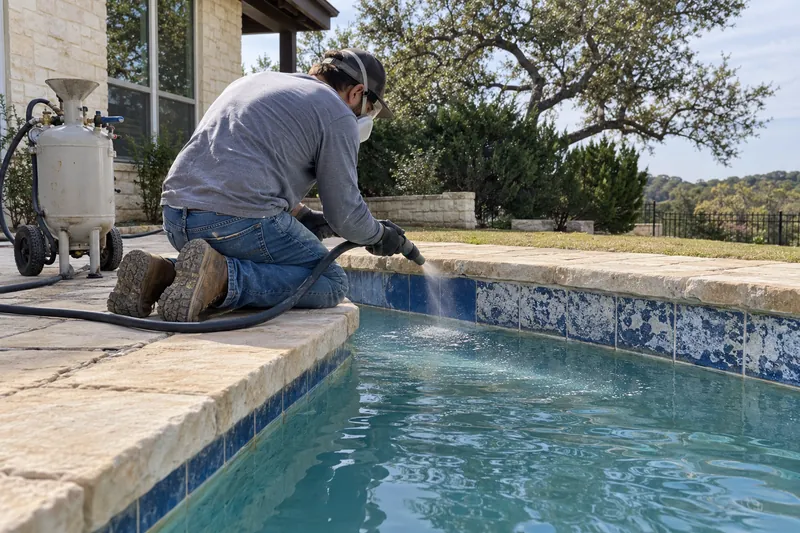
Keeping scale off pool tile in Flower Mound
Lunada Bay Tile recommends brushing tile weekly with a soft brush or non-abrasive pad, above all at the waterline, and running overflow features continuously from sunrise to sunset, because minerals are left behind each time water dries on the tile. It asks for calcium hardness of 200 to 400 ppm and pH of 7.2 to 7.8 to protect tile; LATICRETE allows pH 7.2 to 8.0 and warns that calcium below 200 to 250 ppm lets chlorine draw calcium out of cement grout and mortar.
The Town buys its water, all of it from lakes and rivers, from the Upper Trinity Regional Water District and Dallas Water Utilities, and its 2025 water quality report doesn't print hardness or calcium; monthly test results come on request. Northlake's 2025 report does print them: total hardness of 108 to 150 ppm as calcium carbonate, or 6 to 9 grains per gallon, calcium of 37.6 to 48.1 ppm and pH of 7.8 to 8.5, and our page on pool tile cleaning in Northlake covers that town.
Heat plays a part as well. Orenda counts warm water among the factors that push calcium carbonate out, and Grapevine Dam's 1991–2020 summer normal high is 93.9°F. Topping up a pool that evaporation has lowered counts as outside water use under Stage 1 of the Town's drought rules; as of October 2026 the Town was under its Long-Term Water Conservation Plan, not an emergency stage.
Call or request a free estimate any time, 24/7.
(469) 526-3886Pool tile cleaning costs
- Bead blasting, 3–6 hours, no draining (Texas, 2026)
- $900–$2,400
- Acid washing, 1–2 days, usually drained (Texas, 2026)
- $600–$1,100
- Light scale, chemical or pumice, per linear ft (national, 2025)
- $3–$6
- Moderate scale, glass bead or soda, per linear ft (national, 2025)
- $6–$8
- Heavy scale, salt or multi-pass, per linear ft (national, 2025)
- $8–$12
Published Texas and national figures, not our prices; no Dallas–Fort Worth figure was found. A real price needs a look at the tile.
The national figures add job minimums of $250 to $500 for light scale, $400 to $850 for moderate and $750 to $1,000 or more for heavy. National figures from 2025 also put a professional acid wash of stained but otherwise sound tile at $150 to $300, as an alternative to replacing it.
Call or request a free estimate any time, 24/7.
(469) 526-3886Pool tile cleaning questions and answers
How can I remove calcium deposits from my pool tiles?
Match the method to the scale. Light scale comes off with an acid-free calcium remover and a nylon brush, as Oceanside Glass & Tile does it; heavier scale is ground or blasted off with the water lowered, using media the tile's maker accepts. Then correct the water balance, or the scale usually returns.
Will muriatic acid remove calcium deposits?
The tile makers say keep it off the tile. Lunada Bay Tile says never to put muriatic acid directly on glass or ceramic tile, Oceanside Glass & Tile warns that some acids damage tile glaze and iridescent glass, and Orenda doesn't recommend putting acid directly on scale. Orenda adds that calcium silica scale seems immune to muriatic acid anyway.
How do you clean pool tiles without draining?
By lowering the water instead of emptying the pool. For blasting, Kramer Industries brings the level down to about 6 inches below the tile, and the spent beads sink to the floor for the pool's cleaning equipment to collect. Blasting crews describe the water as cloudy and low afterward, until the filter clears it.
How much does it cost to clean pool tiles?
Typical Texas figures for 2026 put bead blasting at $900 to $2,400 a job, done in 3 to 6 hours with no draining. National figures from 2025 run from $3 to $12 a linear foot of waterline tile, depending on how heavy the scale is and the method, with job minimums from $250 to $1,000 or more.
What is the best way to clean swimming pool tiles?
Little and often. Lunada Bay Tile recommends brushing the tile weekly with a soft brush or non-abrasive pad so mineral buildup can't take hold, and Oceanside Glass & Tile uses a nylon brush rather than pumice, wire brushes or acidic cleaners. Water kept within the Pool & Hot Tub Alliance's saturation range does the rest.
Get a free pool tile cleaning estimate
Flower Mound Pool Resurfacing answers calls and estimate requests 24/7. Tell us the kind of tile, how thick the white line is and when it was last cleaned.