Pool Mastic and Expansion Joint Repair in Flower Mound, TX
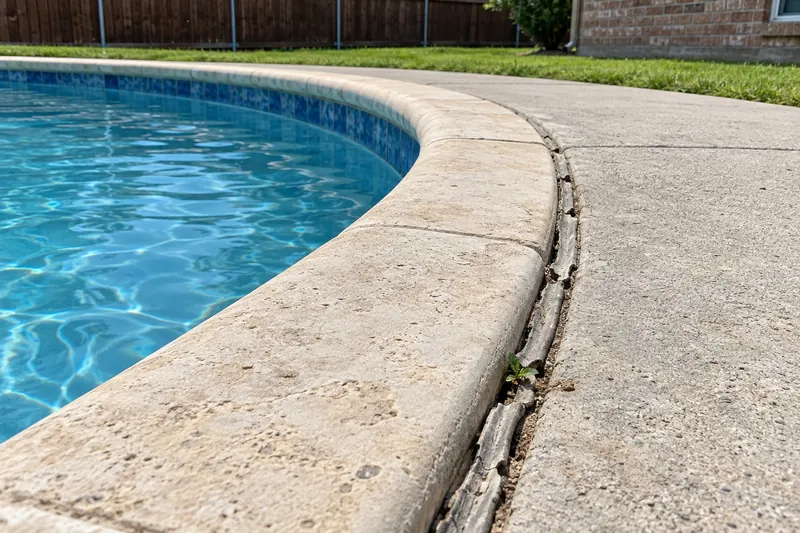
Flower Mound Pool Resurfacing handles pool mastic and expansion joint repair in Flower Mound, Texas: cutting cracked or loose sealant out of the joint between the coping and the deck, cleaning the joint walls, and pouring new flexible joint sealant over a foam backer rod. Mastic is the everyday name for that sealant, and a pool structural engineering firm sums up its job: the joint has to run the full depth of the deck so no part of the slab can press on the coping or the pool, and it only keeps doing that if it is maintained. W. R. Meadows' rule for that sealant is a 2:1 width-to-depth ratio, with a depth never under 1/4 inch or over 1/2 inch.
Request a free estimate, any time. We'll talk through the joint's width and depth, the sealant that suits it, and whether the coping or the deck needs work first.
Call or request a free estimate any time, 24/7
No charge · answered 24/7
Get free estimates
What pool mastic does
An isolation joint
The trade calls it an expansion joint, but it is more properly an isolation joint, one that lets the deck and the pool move separately. The National Ready Mixed Concrete Association describes isolation joints the same way for any slab, separating it from walls, footings, stairs and other fixed points, and says concrete cracks where design and construction don't allow for its movement with moisture and temperature. Sections 306.7 and 306.7.1 of the 2021 International Swimming Pool and Spa Code set two tests for this joint: it must keep water out, and it must be built to protect the coping and its mortar bed from the deck's expected movement.
When the joint stops working, pressure from the deck can loosen or crack the coping and tile and, in extreme cases, the bond beam beneath them, and the damage often shows as horizontal cracks in the waterline tile. The same engineering firm adds that no steel should run from the bond beam into the deck.
Coping, pavers and poured decks
Marion Ceramics, as quoted by Acme Brick, leaves an open joint between the tail of the coping and the deck and seals it to keep moisture out, noting that mortar can work its way out of coping joints over time. Where pavers meet the coping, Belgard calls for foam expansion material to protect the bond seam and Unilock for grout or flexible sealant. The code also wants a joint wherever a deck meets existing concrete work, so relative movement can't damage the pool. For public pools, the CDC's Model Aquatic Health Code, a model rather than Texas law, asks for a continuous watertight joint between the deck and the coping.
Where the coping itself has cracked or lifted, pool coping repair comes before new sealant. Flower Mound Pool Resurfacing will look at the joint, the coping and the deck together.
Call or request a free estimate any time, 24/7.
(469) 526-3886How a mastic joint is replaced
Cutting out the old sealant
W. R. Meadows, which makes DECK-O-SEAL, separates two repairs: where the sealant is damaged but still bonded to the concrete, the damaged section is cut out and refilled; where the bond has failed, all of it comes out and the joint is cleaned before resealing. The old sealant is cut free with a knife run down each side against the concrete, the remains are wire-brushed or ground off, and the joint walls are wiped with alcohol just before resealing. If sealant from one kit sets up only in patches, the maker says the two parts weren't mixed long enough and the material has to come out.
Backer rod and joint shape
Joints must be clean and dry, and new concrete fully cured, W. R. Meadows says, citing 28 days as the industry standard. A foam backer rod sets the depth, and both W. R. Meadows and Sika make the joint twice as wide as the sealant is deep, with the sealant never less than 1/4 inch or more than 1/2 inch deep. DECK-O-SEAL isn't used in joints narrower than 1/4 inch, or wider than 1 inch without the maker's specific advice, and its two parts are mixed for at least 10 minutes. Sika primes any joint that will sit fully under water and sets a maximum chlorine exposure of 5 ppm for its sealant.
Choosing the sealant
DECK-O-SEAL is a two-part polysulfide made for use in and around pools. Its pourable, self-leveling grade, the one most used, is for joints above the waterline, as is its one-part, non-sag ONE STEP, while its #125 and GUN GRADE are made for joints below it. The same maker's HS-1 SL is a one-part, self-leveling hybrid of silyl-modified polymer for pool decks, rated for 25 percent movement and not for underwater use. Sika's Sikaflex SL 1, a one-component self-leveling polyurethane, allows plus or minus 35 percent movement, and Sika moves joints wider than 1-1/2 inches to its two-part Sikaflex SL 2.
Call or request a free estimate any time, 24/7.
(469) 526-3886Why mastic joints fail around Flower Mound pools
Much of the ground here moves with moisture. The 1980 soil survey of Denton County warns that clays high in montmorillonite swell when wet and shrink and crack when dry, with enough pressure to crack walls and foundations unless, and sometimes even if, they are specially reinforced. NRCS rates 33.9 percent of the town's non-water land Very limited for homes with shrink-swell among the reasons, and rates its heaviest clays, Heiden and Branyon, Very limited for concrete driveways and sidewalks for the same reason. No official source covers what that movement does to pool decks in particular, though a 2007 engineering guideline for pools in Houston's expansive soils places isolation joints between the coping and the surrounding flatwork.
Weather sets the working window. W. R. Meadows applies DECK-O-SEAL between 40°F and 122°F; the two-part sealant is tack-free in four hours, sets firm within 24 hours at 77°F, longer in cool weather, and needs 24 hours before rain, while the one-part ONE STEP takes 5 to 10 days to cure. Grapevine Dam's 1991–2020 normals make May and October the wettest months and count 44.3 nights a year at or below freezing. Pool chemistry shows on the joint too: heavy shock treatments can leave a temporary white chalking on DECK-O-SEAL that fades as chlorine returns to normal, and the maker cleans it with a mild detergent and a soft bristle brush, never abrasives.
In Lakewood Village, where about 88.8 percent of the mapped land sits in soils NRCS rates Very limited for homes with shrink-swell among the reasons, the same work is covered under pool mastic repair in Lakewood Village. Cracked, sunken or rocking slabs are a job for pool deck repair, and Mortex, which makes Kool Deck, also makes a PVC control joint for pool decks with a replacement top that fits over existing joints, part of cool deck repair.
Call or request a free estimate any time, 24/7.
(469) 526-3886Pool mastic replacement costs
- Mastic replacement, per linear ft (DFW, 2026)
- $7.50–$13.75
- Basic / premium / complex, per linear ft (DFW, 2026)
- $7.50–$9.50 / $11–$13.75 / $13.75–$18
- Complete replacement, typical home pool (DFW, 2026)
- $750–$2,300
- Professional replacement, per linear ft (national, 2024)
- $5–$15
- Pool with about 100 ft of perimeter (national, 2024)
- $500–$1,500
Published Dallas–Fort Worth and national figures, not our prices. A real price needs the joint measured.
The national figures cover removing the old mastic, cleaning the joint and applying the new sealant. Because both sets of figures are priced by the linear foot, the length of the pool's perimeter sets most of the total.
Call or request a free estimate any time, 24/7.
(469) 526-3886Pool mastic questions and answers
What is the purpose of pool mastic?
It seals the isolation joint between the coping and the deck, so water stays out and the deck can move without pushing on the coping and the pool wall. The 2021 International Swimming Pool and Spa Code asks for exactly that: a watertight joint that protects the coping and its mortar bed from the deck's movement.
How much does it cost to replace a pool mastic?
Typical Dallas–Fort Worth figures for 2026 put mastic replacement at $7.50 to $13.75 a linear foot, or $750 to $2,300 for a complete replacement on a typical home pool, and national figures from 2024 run $5 to $15 a linear foot. Flower Mound Pool Resurfacing prices a joint after measuring it and checking the coping and deck.
What type of caulk is best for pool expansion joints?
The makers sell joint sealants built for pool decks in three chemistries: two-part polysulfide such as DECK-O-SEAL, silyl-modified polymer such as HS-1 SL, and self-leveling polyurethane such as Sikaflex SL 1. Pick the grade for where the joint sits, since DECK-O-SEAL's pourable grade is for above the waterline and its #125 and GUN GRADE for below, and size the joint at twice as wide as the sealant is deep.
How can I repair damaged expansion joints?
Follow the sealant maker's steps. W. R. Meadows cuts out only the damaged section where the old sealant is still bonded, but removes all of it where the bond has failed; the joint is then cleaned, its walls wiped with alcohol, and new sealant poured over a backer rod set to the right depth.
What are the common problems with expansion joints?
A joint that isn't maintained loses its protection, and the deck then presses on the coping, which can crack or dislodge coping and tile and leave horizontal cracks along the waterline tile. Sealant from a poorly mixed two-part kit sets up only in patches and has to come out, and heavy shock treatments can leave a temporary white chalking on the sealant.
Get a free pool mastic repair estimate
Flower Mound Pool Resurfacing answers calls and estimate requests 24/7. Tell us how long the joint is, whether the sealant is cracked or missing, and what the coping and deck are made of.