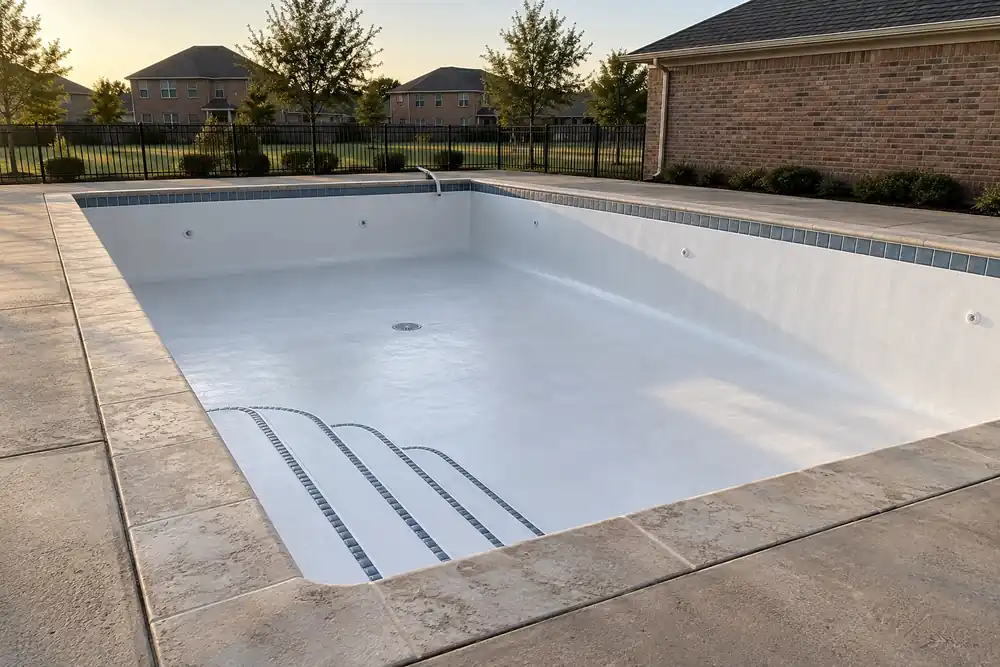
Pool Mastic and Expansion Joint Repair in Lakewood Village, Texas
Flower Mound Pool Resurfacing repairs pool mastic and expansion joints in Lakewood Village, Texas, replacing cracked, hardened or pulled-away sealant in the joint where the deck meets the coping so the slab can move without pressing on the pool.
Lakewood Village sits on the Lewisville Lake shore about a mile south of Farm Road 720 and eleven miles southeast of Denton, with public land managed by the U.S. Army Corps of Engineers along its waterfront. Free estimates are open around the clock; we'll ask how long the joint runs, what the coping and deck are made of, and where the old sealant has given way.
Call or request a free estimate any time, 24/7
No charge · answered 24/7
Get free estimates
Ferris and Heiden clays under the town
The USDA soil survey maps 10 soil units inside Lakewood Village's Census boundary, and clays dominate them. Ferris-Heiden clay on 5 to 15 percent slopes covers about 35.4% of the mapped land, Wilson clay loam on 1 to 3 percent slopes about 31.4%, and Heiden clay on 3 to 5 percent slopes about 16.2%. Ferris, the leading soil, is a smectitic clay whose highest layer reaches a linear extensibility of 17 percent, nearly twice the line of 9 above which the 1980 Denton County survey calls shrink-swell very high, and NRCS rates its map unit "Very limited" both for homes without basements and for homes on concrete slabs, because of shrink-swell and slope. About 88.8% of the town's mapped land lies in map units rated "Very limited" with shrink-swell among the reasons.
The county survey warns that where shrink-swell is moderate to very high, shrinking and swelling can damage buildings, roads and other structures, and special design is often needed. NRCS measures that movement as the change in a soil clod's size from wet to dry, and a higher figure means more of it. The ratings speak for each soil type as mapped; no backyard was tested.
Why a moving deck needs a joint
A concrete deck and the pool beside it move differently, and the joint between them is what keeps one from shoving the other. Without a working joint, the deck's expansion bears on the pool shell, which can crack or knock loose coping and tile and, at worst, crack the bond beam. On poured and precast coping, the vertical joint is normally packed with foam backer rod and topped with flexible mastic, and under a cantilevered deck, the horizontal gap is normally left unfilled. A pool structural engineering firm wants the mastic joint carried through the full depth of the deck and kept up so it goes on working, with no steel tying the bond beam to the deck. A 2007 set of pool guidelines for Houston's expansive soils, written by a geotechnical engineer for that region, places isolation joints between the coping and the flatwork around the pool.
The model pool code's 2021 edition wants that joint watertight and designed to shield the coping, and the mortar beneath it, from the movement expected of the deck, with another joint at any spot where a deck butts against older concrete. The Town's pool application lists the earlier 2018 edition, so ask the Town which text it applies.
Flower Mound Pool Resurfacing will check how the deck, the coping and the joint between them have moved.
Call or request a free estimate any time, 24/7.
(469) 526-3886Lakewood Village homes and their age
The 2020 Census counted 242 housing units in Lakewood Village, 229 occupied and 13 vacant, and 635 residents; the Census Bureau's estimate for July 1, 2025 is 802, on 0.805 square miles of land. The Bureau's 2020–2024 survey estimates, whose margins are wide for a town this small, count 253 units: 90 built in the 2000s (about 35.6%), 51 in 2010 or later (about 20.2%), 10 of them since 2020, 46 in the 1990s (18.2%), 29 in the 1980s (11.5%) and 37 before 1980 (14.6%), with a median year built of 2002, plus or minus four years.
All but two of those units, 251 or about 99.2%, are single-family detached houses, and the survey finds no apartment buildings or mobile homes. Owners live in 237 of the 242 occupied homes and 5 are rented. The median owner-occupied home is valued at $522,200, with a margin of error of $141,243, and the median household income is $152,000 (margin $30,999).
Call or request a free estimate any time, 24/7.
(469) 526-3886The Town's pool application and the deck
Lakewood Village requires a pool permit before a pool or spa is built or installed, and among the building codes on its residential pool application are the 2018 International Swimming Pool Code and International Residential Code, the 2018 energy code and the 2017 National Electrical Code. Contractors who must be licensed under state law or local ordinance register with the Town before working. The plans are drawn to scale and stamped by the electric provider, and by the gas provider where gas is used; they show the equipment, the pool's volume, depth sections, and all deck and area drains, gutter downspouts and other means of capturing water. Piers or retaining walls over 48 inches need an engineer's seal, and existing lot drainage may not be changed in a way that creates a nuisance for a neighbor or the right-of-way.
The application covers new construction and installation, and it doesn't say whether resealing a deck joint or other repair to an existing pool needs a permit, so ask the Town's Building Services before work starts.
Waterfront lots and the Corps of Engineers
On waterfront lots the survey has to show the actual 537-foot line above mean sea level, not an estimate, and a pool in the floodplain needs a consent letter from the U.S. Army Corps of Engineers in the application. Pools, spas, decks and equipment stay out of every easement, and a pool must keep 3 feet or more from a building with a foundation, plus at least a foot of distance for each foot of depth. The lake land beside the town is public land the Corps manages, putting ecosystem-based management and conservation first; private exclusive use isn't allowed, though adjacent owners may get permission for certain activities.
Call or request a free estimate any time, 24/7.
(469) 526-3886Resealing a deck joint
Taking out the old sealant
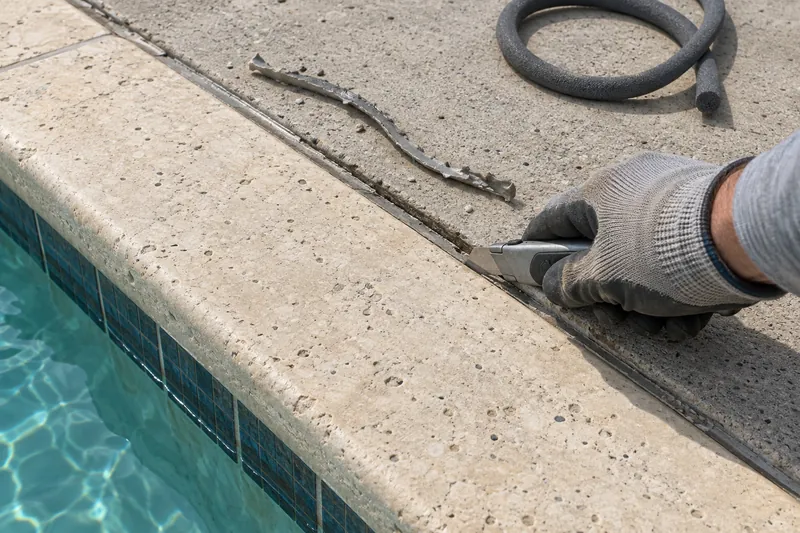
W. R. Meadows, maker of the DECK-O-SEAL joint sealant, treats a failed joint one of two ways. If the sealant is torn but still stuck to the concrete, only the damaged length is cut out and refilled; if it has let go of the concrete, all of it is removed. Either way the old material is sliced free along both edges with a linoleum knife or razor, the remains are wire-brushed or ground away, and the joint walls get an alcohol wipe right before the new sealant goes in. A two-part kit that cures only in patches wasn't mixed long enough, and that material has to come back out.
Joint shape and sealant grade
The maker wants the sealant half as deep as the joint is wide, between 1/4 and 1/2 inch, over a foam backer rod, and doesn't put it in joints under 1/4 inch wide, or over 1 inch without its specific advice. DECK-O-SEAL is a two-part polysulfide that, once cured, stretches or compresses up to 25 percent; the pourable grade and the one-part ONE STEP are meant for joints that sit above the waterline, while #125 and GUN GRADE go below it. Other makers offer other chemistries: W. R. Meadows' one-part HS-1 SL, a silyl-modified hybrid for pool decks with 25 percent movement, and Sika's Sikaflex SL 1, a self-leveling polyurethane rated for plus or minus 35 percent, with its two-part SL 2 for joints wider than 1-1/2 inches. Sika asks for primer where a joint will sit fully under water and caps chlorine exposure at 5 ppm.
Weather and cure times
DECK-O-SEAL goes on between 40°F and 122°F and needs 24 hours before rain. At 77°F its two-part grade gives about an hour of working time, turns tack-free in four hours and cures in 24, while the one-part ONE STEP is tack-free in a day and cures in 5 to 10 days. It isn't for use under water, and painting over it is a mistake, because a coat stiffer than the sealant can crack and come away.
Flower Mound Pool Resurfacing will talk through the sealant grade that suits your joint's width and depth.
Call or request a free estimate any time, 24/7.
(469) 526-3886The Grahams, the lake and a plesiosaur
In the late 1950s and 1960s, the Town's history says, E. Allen Graham and his sons Bill and Frank began turning cattle country and cotton fields into a lakefront community, starting with gravel roads and a handful of homes. Streets were paved, wells drilled, and a water and sewer system built before many neighboring communities had one, and families who came for weekend lake homes stayed year-round. The Handbook of Texas says the community probably began in the 1970s and gives 165 residents when it incorporated by 1980 and 342 in 2000; the Town dates its incorporation to April 26, 1977, as a Type B town that later became a Type A municipality.
In 1971 erosion along the shore exposed a cluster of large, dark bones, and a University of Texas graduate student, Douglas Lawson, excavated a 96-million-year-old marine reptile; Southern Methodist University research calls the place the Lakewood Village Locality, and a resident later found another plesiosaur skeleton on the shoreline. Oak Point, about 2.5 miles to the north-northwest by our calculation from the Census Bureau's center points, is another lakeshore town of that decade, incorporated on April 7, 1976; our page on pool deck resurfacing in Oak Point covers it.
Joint repair beside coping, tile and deck work
A failed joint often travels with other repairs. Flower Mound Pool Resurfacing also takes on pool deck repair, cool deck repair, coping repair, waterline tile repair, and tile cleaning and calcium removal. That last job may come up here: the Town's water comes from a deep well about 1,800 feet down in the Trinity Aquifer, with total dissolved solids generally measuring 800 to 900 mg/L against the state's 1,000 mg/L secondary guideline, and the Town notes such water can leave spots, scale or deposits. Typical Dallas–Fort Worth figures for 2026 run from $7.50 to $9.50 a linear foot for a basic mastic replacement to $13.75 to $18 for complex projects, with most jobs between $7.50 and $13.75; these are published figures, not our prices. For a painted interior, see pool painting in Lake Dallas, a city about 2.7 miles to the west-southwest.
How a mastic joint is redone
Look at the joint and its neighbors
Cracked or loose coping, displaced tile and gaps where the sealant has let go show how far the deck has moved.
Ask the Town
The pool application covers new pools, so Building Services says whether this repair needs a permit.
Cut out and clean
Damaged sealant is cut out, or all of it where the bond has failed, and the joint walls are ground clean and wiped with alcohol.
Set the depth
A foam backer rod sets the sealant at 1/4 to 1/2 inch deep, half the joint’s width.
Pour in the right weather
The sealant goes in between 40°F and 122°F with a dry day ahead, and the right grade is used above or below the waterline.
Keep it up
The joint is checked and resealed as it ages, since a mastic joint only protects the coping while it is maintained.
Call or request a free estimate any time, 24/7.
(469) 526-3886Plan a pool mastic repair in Lakewood Village
Flower Mound Pool Resurfacing answers calls and estimate requests 24/7. Tell us roughly how many feet of joint there are, where the sealant has cracked or gone, and what the coping is made of.