HOA and Community Pool Resurfacing in Flower Mound, TX
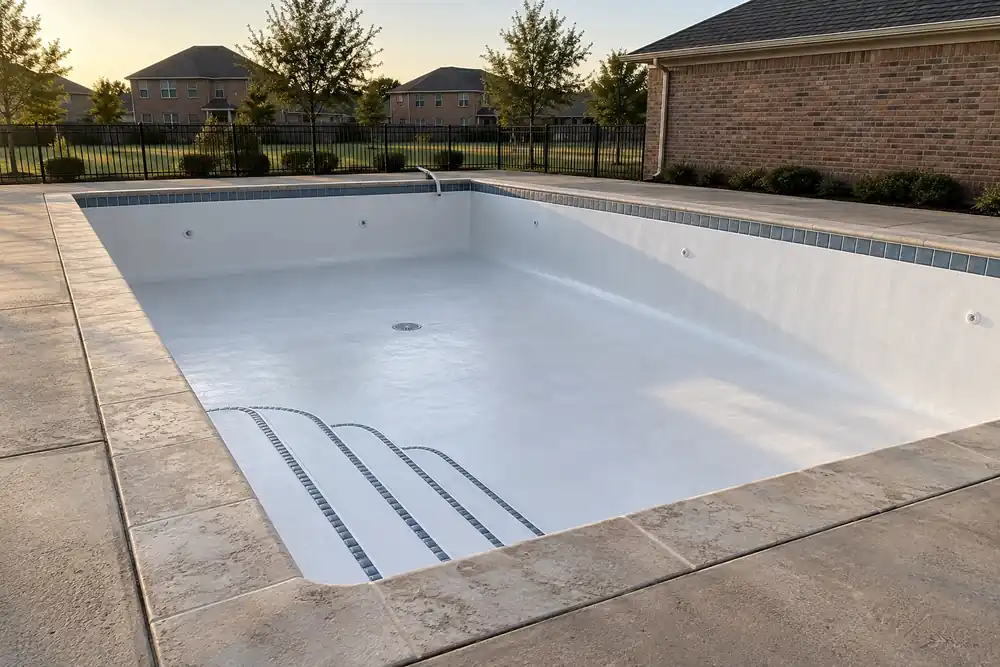
Flower Mound Pool Resurfacing handles HOA pool resurfacing in Flower Mound, Texas, for the amenity pools, tot pools and spas that homeowners and property owners associations run for their residents. Texas health rules count a property owners association’s pool as a Class C public pool even though the general public can’t swim there, so a board resurfacing one works under the state’s public-pool rules and the Town’s own public-pool article. National reserve-planning figures for 2026 put replastering a typical community pool at $8,000 to $25,000.
Request a free estimate, any time. A board can go over finish and color with us, along with when the pool can close, the drain covers, and the figures it needs for its reserve plan.
Call or request a free estimate any time, 24/7
No charge · answered 24/7
Get free estimates
How Texas and the Town classify HOA and community pools
Residents-only pools are still public pools
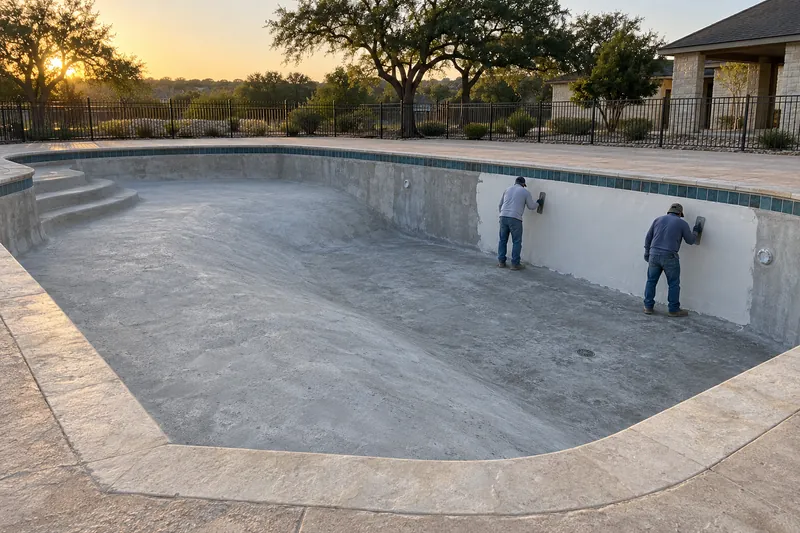
The Texas Department of State Health Services sorts pools by who may swim in them, not by who owns them. A pool limited to members and their guests, such as a property owners association’s, is Class C, and a public pool may be privately owned and charge no fee at all. Only a pool on private property used by no more than two resident families and their guests, such as one serving a single-family home or a duplex, counts as residential. Inside the town, Flower Mound’s public-pool article reaches every pool except one built or kept as part of a single-family home or a two-residence townhouse, the same article that covers the apartment, hotel and club pools on our commercial pool resurfacing page.
Federal drain-cover law counts community pools
The Virginia Graeme Baker Pool and Spa Safety Act treats a pool open only to the residents of a residential real estate development, or to members of an organization and their guests, as a public pool and spa, so an HOA pool needs anti-entrapment drain covers that meet the federal standard. The Consumer Product Safety Commission adds that a public pool with a single drain that can be blocked, or with several drains on the same plane less than three feet apart, needs a second device or system to prevent entrapment. Its inspection checklist looks for covers that are intact, with no loose or missing screws and no cracks or breakage, and Custom Molded Products tells owners to replace the cover and screws on its Galaxy drain every seven years.
Ask Flower Mound Pool Resurfacing for a free estimate on a community pool.
Call or request a free estimate any time, 24/7.
(469) 526-3886What Texas asks of the association that runs the pool
Pool yard enclosures and the 31-day inspection
Texas Health and Safety Code chapter 757 reaches pools owned, controlled or maintained by a property owners association. The pool yard has to be completely enclosed, at least 48 inches high measured from the ground on the side away from the pool, and its gates must close and latch by themselves, take a lock and open outward, with the latch generally at least 60 inches above the ground. The association must inspect the enclosures, the gates and their self-closing and self-latching devices at least once every 31 days, a duty the law says may not be waived under any circumstances.
A certified operator and an operating permit
Texas puts every Class C pool and spa, HOA pools among them, under the supervision of a properly trained and certified operator. The state accepts the National Recreation and Park Association’s Aquatic Facility Operator course, the Pool & Hot Tub Alliance’s Certified Pool Operator course, the ASPSA’s Licensed Aquatic Facility Technician course, or an equivalent tested course that the local authority approves. In Flower Mound a public pool also needs the Town’s operating health permit, good for one year, and a pre-opening inspection, and the Town’s guide for homeowners associations points boards to Environmental Health with pool maintenance questions.
Flower Mound Pool Resurfacing will talk through how a resurfacing fits around the operator’s schedule and the Town’s inspection.
Call or request a free estimate any time, 24/7.
(469) 526-3886HOA pools in and around Flower Mound
Neighborhoods the Town lists with HOA pools
The Town’s subdivision records flag HOA pools in neighborhoods such as Wellington of Flower Mound, Bristol Place at Bridlewood, Stone Hill Farms, the Villages of Northshore, Stafford Estates, The Legends and Lakeside DFW. The same records date Wellington of Flower Mound’s first phase to 1995, Villages of Northshore Phase 2a to 1996, Stone Hill Farms Phases 1 and 2 to 1997 and Bristol Place at Bridlewood Phase 1 to 1998. Wellington’s association lists two junior Olympic-size pools and a tot pool among its amenities, and the Town says Canyon Falls, the master-planned community it shares with Northlake and Argyle, has two swimming pools and a splash pad.
Decks and spas at the amenity center
Although it is only a model and not Texas law, the CDC’s Model Aquatic Health Code wants every deck slip resistant and textured, wet or dry, and rules out carpet, artificial turf and wood on the perimeter deck. Texas itself bars standing water on public-pool decks and asks that deck drains be kept clean so water can’t collect. Reserve planners price the deck as its own component, apart from the pool’s interior, and the coatings and overlays for it are covered under pool deck resurfacing.
To the north, the Lantana Community Association lists two Junior Olympic-size pools and three more neighborhood pools with playgrounds in Larkspur, Sandlin and Heritage, and our page on HOA pool resurfacing in Lantana covers that community. Flower Mound Pool Resurfacing serves associations across the towns around Flower Mound.
Call or request a free estimate any time, 24/7.
(469) 526-3886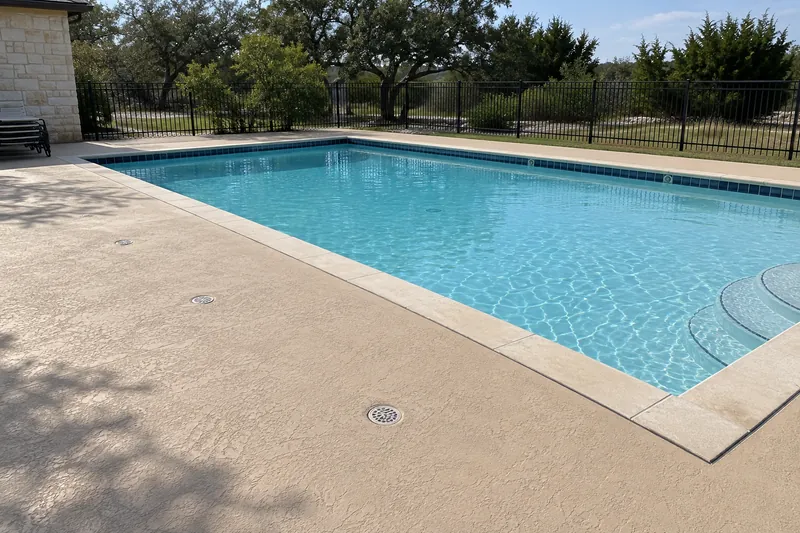
What HOA pool resurfacing costs
- Replastering a typical community pool (national, 2026)
- $8,000–$25,000
- Suggested yearly set-aside for the pool interior (national, 2026)
- $667–$3,125
- Resurfacing a 3,000 sq ft HOA pool deck (national, 2026)
- $9,000–$36,000
- Suggested yearly set-aside for that deck (national, 2026)
- $600–$3,600
- Interior renovation of a community spa, per spa (national, 2026)
- $4,000–$15,000
- Full rebuild of a gunite community spa (national, 2026)
- $25,000+
National HOA reserve-planning figures, not our prices. A community pool is priced after it is measured.
Those reserve figures divide each component’s replacement cost by its useful life, which they put at 8 to 12 years for standard white plaster and for a community spa’s interior. Contractors measure a pool’s interior surface, walls and floor, to price the work, and in national 2026 figures, commercial replastering comes to $6.50 to $8.00 a square foot of that surface. For changes beyond a new surface, such as a new entry, a lift or new features, see commercial pool remodeling, and Town permit questions are covered in the guide to pool remodel permits and HOA approval.
Call or request a free estimate any time, 24/7.
(469) 526-3886HOA pool resurfacing questions and answers
How often does an HOA pool need to be resurfaced?
The National Plasterers Council rates traditional white plaster as a 5-to-8-year surface, quartz at 10 to 15 years, polished finishes at 8 to 12 and pebble at 12 to 18. National HOA reserve-planning figures for 2026 use 8 to 12 years for standard white plaster, and the same span for renovating a community spa’s interior.
How much should an HOA set aside for pool resurfacing?
National reserve-planning figures for 2026 suggest $667 to $3,125 a year for a typical community pool’s replaster, which is its $8,000 to $25,000 replacement cost spread over an 8-to-12-year life, and $600 to $3,600 a year for a 3,000-square-foot pool deck. Flower Mound Pool Resurfacing can measure the pool so the board works from its own surface area.
What are the essential rules for an HOA pool in Texas?
An HOA pool is a Class C public pool, maintained under a certified operator, with free chlorine of at least 1.0 part per million in the pool and 2.0 in a spa under state law. Its pool yard needs an enclosure at least 48 inches high, inspected at least every 31 days, and its drains need covers that meet the federal standard. In Flower Mound it also needs the Town’s yearly operating health permit.
What are the regulations for private swimming pools in Texas?
For a backyard pool, mostly through city codes. The state’s public-pool rules exclude a pool used by no more than two resident families and their guests, chapter 757’s enclosure law reaches only apartment and property owners association pools, and a city may set its own pool fence standards. Texas law sets the May 1, 2019 version of the International Swimming Pool and Spa Code as the pool code for its cities, with leave to adopt a newer edition, and Flower Mound uses the 2024 edition.
Does the ADA apply to an HOA pool?
Not while it stays private. The Justice Department says community pools tied to a private residential community and limited to residents and their guests aren’t covered by the ADA’s accessibility requirements. A community pool made available to the public for rental or use falls under Title III, and one owned or run by a state or local government under Title II.
Get a free HOA pool resurfacing estimate
Flower Mound Pool Resurfacing answers calls and estimate requests 24/7. Tell us the community, how many pools and spas it runs, and when the board can close them.