Commercial Pool Remodeling in Flower Mound, TX
Flower Mound Pool Resurfacing handles commercial pool remodeling in Flower Mound, Texas, for hotels, apartment communities, clubs and HOAs whose pools need more than a new finish: accessible entries and lifts, suction outlet upgrades, new tile and markings, and rebuilt decks. The 2010 ADA Standards ask that a newly built or altered pool, wading pool or spa at a business give people with disabilities an accessible way into and out of the water. Under section 242, one such entry, a fixed lift or a sloped entry, serves a pool with under 300 linear feet of wall; at 300 feet or more, a pool needs two.
Request a free estimate, any time. We'll talk through the scope, which rules each change brings with it, and how much of the work fits into one closure.
Call or request a free estimate any time, 24/7
No charge · answered 24/7
Get free estimates
When a commercial pool project counts as a remodel
Remodel, alteration or repair
Flower Mound’s public-pool article keeps the word remodel for replacing or modifying a public pool, its structure or its circulation system; everyday maintenance and repair fall outside it. Under the state’s rules, a minor addition, alteration, renovation or repair to an existing public pool or spa, and to its mechanical, electrical and plumbing systems, may follow the construction standard that applied when the pool was built. A new finish on its own is covered on the commercial pool resurfacing page.
Substantial alterations and plan approval
The CDC’s Model Aquatic Health Code, a national model code and not a Texas rule, draws its line at half of the replacement cost: work on a pool or facility costing more than 50% of what it would take to replace is a substantial alteration, and work at 50% or less is non-substantial. Under the same model code, nobody may begin a substantial alteration until the construction plans have been submitted to and approved by the authority having jurisdiction.
Flower Mound Pool Resurfacing will talk through how your project measures against these lines.
Call or request a free estimate any time, 24/7.
(469) 526-3886Pool lifts, sloped entries and transfer walls
Which pools the ADA reaches
The Justice Department says Title III of the ADA requires newly built and altered business facilities to be fully accessible under the ADA Standards for Accessible Design. The 2010 Standards define an alteration as a change that affects or could affect usability, with remodeling, renovation, rehabilitation and reconstruction all included, while normal maintenance, painting and changes to mechanical and electrical systems don’t count unless they affect usability. For existing pools, businesses must remove barriers where that is readily achievable, which it isn’t if it would involve significant difficulty or expense. A community pool limited to residents and their guests sits outside these rules, as the page on HOA and community pool resurfacing explains.
How many accessible entries a pool needs
Under section 242 of the 2010 Standards, a pool with 300 linear feet of pool wall or more needs two accessible means of entry and exit, one of them a fixed pool lift or a sloped entry and the other a transfer wall, a transfer system or pool stairs. A smaller pool needs at least one, and it has to be a fixed lift or a sloped entry. Texas has its own 2012 Texas Accessibility Standards, administered by the Texas Department of Licensing and Regulation and in effect since March 15, 2012, with sections 242 and 1009 on swimming pools, wading pools and spas.
Lift and sloped-entry dimensions
A lift goes where the water is no more than 48 inches deep, unless the whole pool is deeper, with its raised seat over the deck at least 16 inches from the pool edge and the deck between them sloped no steeper than 1:48. The seat stops 16 to 19 inches above the deck, is at least 16 inches wide and works without help from both the deck and the water, and a single-person lift carries at least 300 pounds. A sloped entry reaches 24 to 30 inches below the still water, with handrails 33 to 38 inches apart, and a transfer wall stands 16 to 19 inches above the deck. The 2027 model code adds that pool and spa lifts be listed and labeled to UL 60335-2 and installed to ICC A117.1 and NFPA 70.
Ask Flower Mound Pool Resurfacing to look at where a lift or sloped entry would fit your pool.
Call or request a free estimate any time, 24/7.
(469) 526-3886Suction outlets, tile and markings in a remodeled public pool
Drain fittings and turnover
The Consumer Product Safety Commission’s rule requires every pool or spa drain cover made or sold in the United States to meet ANSI/APSP/ICC-16 2017, the standard the Commission adopted as the successor in 2019. Texas adopts that fitting standard and the ANSI/PHTA/ICC-7 suction entrapment standard alongside the 2021 code for commercial pools, and Flower Mound’s code sends public pools to the state’s suction-entrapment rules. The 2027 model code asks for suction outlets, where installed, and the skimming system each to be designed for 100 percent of the circulation turnover rate.
Depth markers, stair edges and reference tiles
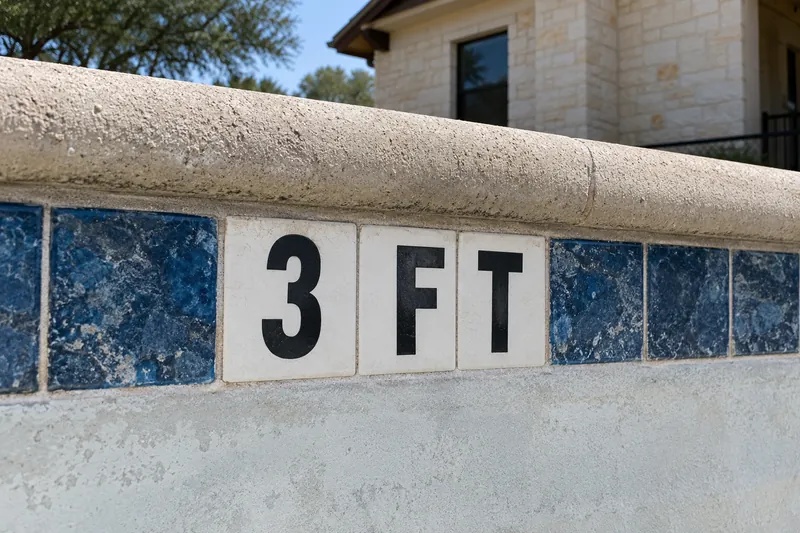
The 2021 code places public-pool depth markers at the deepest and shallowest points and at every slope change, at depth steps of no more than 2 feet and no more than 25 feet apart, accurate to within 3 inches, with deck markers within 18 inches of the water. The CDC’s model code is stricter in water under 5 feet deep, marking it at 1-foot intervals. Stair treads get their leading edges outlined in slip-resistant contrasting tile or another permanent marking 1 to 2 inches wide, and the model code puts a contrasting reference tile at the deepest point for checking water clarity, 4 by 4 inches in pools up to 10 feet deep and 8 by 8 inches in deeper ones. Where a pool is 5 feet deep or less, the 2021 code puts the No Diving symbol on the deck beside a depth marker at least every 25 feet. Waterline and trim tile work is on the page for pool tile repair and replacement.
Steps and shelves in a public pool
In a public pool, the 2021 code wants stair treads at least 24 inches wide at the leading edge, and a tanning ledge or sun shelf used as the required entry and exit may sit no deeper than 12 inches below the waterline. The Model Aquatic Health Code allows underwater shelves beside water 3 feet 6 inches deep or shallower, caps them at 24 inches deep with a slip-resistant, color-contrasting nosing, and keeps bench seats within 20 inches of the water line in areas no deeper than 5 feet.
Flower Mound Pool Resurfacing can price the tile, markings and stairs with the rest of the remodel.
Call or request a free estimate any time, 24/7.
(469) 526-3886Rebuilding the deck around a commercial pool
The 2021 code asks for a deck or unobstructed access around at least 90 percent of a public pool’s perimeter, and decking at least 4 feet wide on the sides and rear of any diving equipment. The Model Aquatic Health Code wants perimeter decks at least 4 feet wide and flush with the pool walls or coping, sloped away from the water at no less than 1/8 inch per foot for smooth finishes such as tile or lightly broomed concrete, 1/4 inch for exposed aggregate or a medium broom, and 3/8 inch for heavy textures such as brick. It also calls for a continuous watertight expansion joint between the perimeter deck and the coping, built to protect the coping and its mortar bed from deck movement, watertight expansion joints between deck pours, and deck edges that are bevelled or rounded.
Neighboring cities write their own rules: Grapevine, where 37.3% of housing units sit in buildings of five or more units, handles public pools, spas and hot tubs in a separate chapter of its code from backyard pools, and our page on commercial pool remodeling in Grapevine covers that city.
Call or request a free estimate any time, 24/7.
(469) 526-3886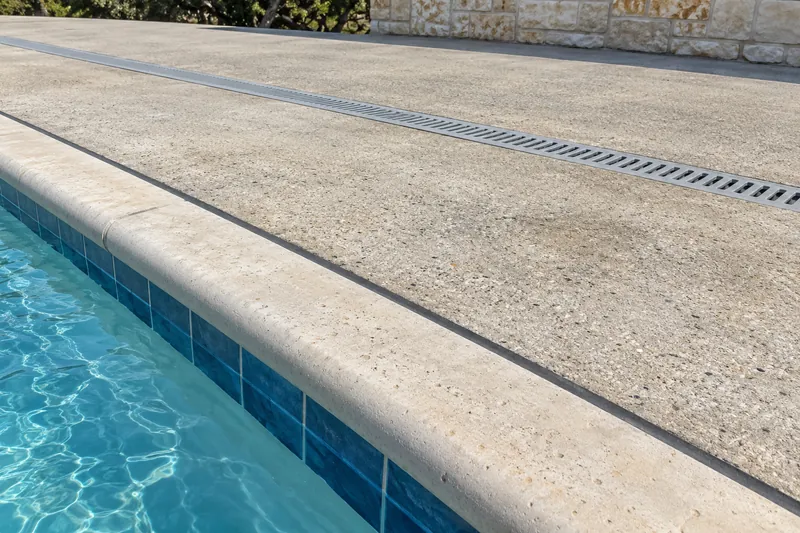
Commercial pool remodeling questions and answers
Can you renovate an existing commercial pool?
Yes. The state’s public-pool rules bring the 2021 International Swimming Pool and Spa Code to construction, alteration, renovation, enlargement and repair alike, though minor work on an existing pool may stay with the standard it was built to. Under the CDC’s model code, work costing more than half the pool’s replacement cost needs approved plans first. Flower Mound Pool Resurfacing will talk through which parts of your project fall where.
How much does a commercial pool remodel cost?
A remodel is priced on its scope after a site visit. For the resurfacing share, commercial replastering’s national benchmark for 2026 runs $6.50 to $8.00 for every square foot of the pool’s interior surface. National 2026 figures also note that waterline tile, coping repair and light niche work usually ride along, sharing the one drain and refill.
Does a hotel pool need a pool lift?
If it is being built or altered, yes, or a sloped entry instead: under the 2010 ADA Standards a pool with less than 300 linear feet of wall needs at least one fixed lift or sloped entry. A hotel pool that isn’t being altered still has to remove barriers where that is readily achievable.
Does a remodeled public spa need accessible entry?
Yes. The 2010 ADA Standards require at least one accessible means of entry for a spa: a pool lift, a transfer wall or a transfer system. Under the 2021 code a public spa also carries at least two permanent, slip-resistant depth markers with numbers at least 4 inches tall, placed on the deck within 18 inches of the design waterline.
Who reviews plans for a commercial pool remodel in Texas?
The Texas Department of State Health Services may review plans for public pools and spas, and it tells the owner or operator in writing when it intends to; it or the local authority may also inspect at any reasonable time without notice. In Flower Mound, the Town’s public-pool article adopts the state’s standards and requires an operating health permit and a pre-opening inspection, so check with Environmental Services and Building Inspections before work starts.
Get a free commercial pool remodeling estimate
Flower Mound Pool Resurfacing answers calls and estimate requests 24/7. Tell us the kind of property, what you want changed, and when the pool can close.