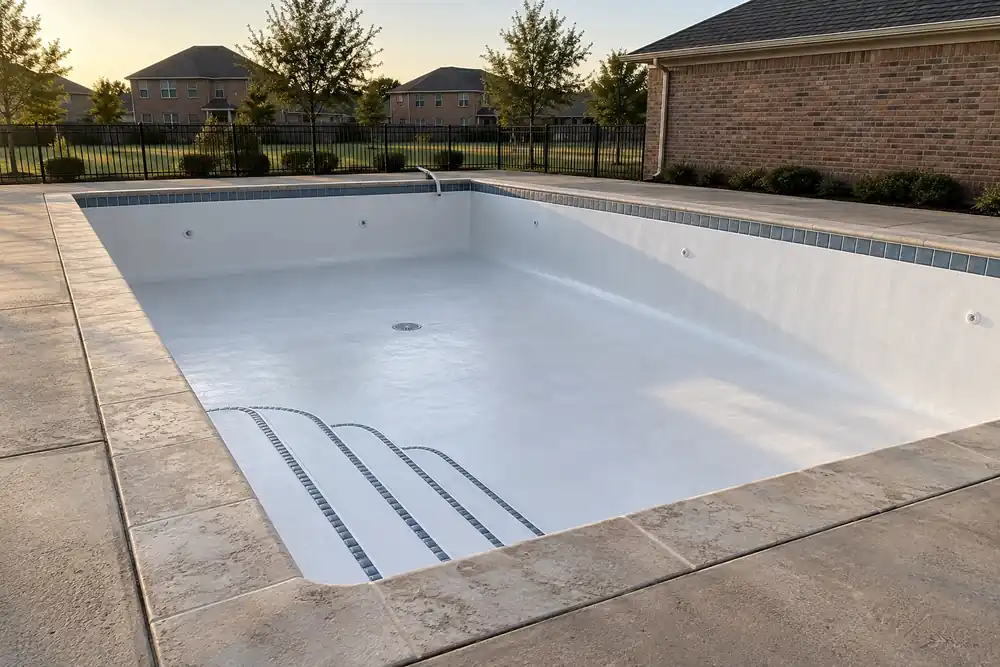
Pool Remodel Permits and HOA Approval in Flower Mound, TX
Flower Mound Pool Resurfacing walks through pool permit rules and HOA approval for a pool remodel in Flower Mound, Texas: which work the Town's pool code covers, what a permit costs and takes, and what an association can ask to see.
Permit questions go to the Town of Flower Mound's Building Inspections, and the Town's rules change by ordinance, so this guide quotes the Town's documents with their dates. Your HOA's rules are a separate matter that the Town doesn't enforce.
Call or request a free estimate any time, 24/7
Which pool work needs a permit in Flower Mound
Remodels and repairs
The Town's amendments to its pool code require anyone who plans to build, enlarge, alter, repair, move or demolish a pool or spa, or to install, alter, repair, convert or replace a system the code regulates, to apply to the code official and get the permits first. Since October 1, 2025, residential permit applications have to meet the 2024 International Residential Code, the 2024 International Swimming Pool and Spa Code, the 2024 International Energy Conservation Code and the 2023 National Electrical Code, with the Town's local amendments. Under the pool code's 2021 and 2027 editions, the altered or repaired part is built to new-system standards while the untouched rest of the pool can stay as it is, provided the work leaves nothing unsafe, insanitary or overloaded.
Replastering and resurfacing
Flower Mound made the 2024 International Swimming Pool and Spa Code its pool code by Ordinance No. 31-25 in September 2025, and that edition exempts replastering or resurfacing an existing pool or spa from its permit rule. The Town's own documents don't mention replastering or resurfacing, though, and its amended code still calls for a permit before a pool is altered or repaired, so ask Building Inspections before the work begins. The exemption names only replastering and resurfacing; remodels, spas, decks, and electrical and plumbing work aren't in it.
Spas, wiring, plumbing, decks and fences
Hot tubs and spas need a permit, a self-contained spa included, because inspectors have to check its electrical or plumbing work; that covers plans to add a spa to an existing pool. Electrical and plumbing work each need a Town permit, done by an electrician and a plumber licensed by the State of Texas and registered with the Town. A wood deck needs a permit, while concrete flatwork that isn't structural, isn't tied to a driveway or the house foundation and isn't in the public right-of-way doesn't. Repairing or replacing a fence needs one too, unless only pickets of the same height and material are swapped, and the Town flags special requirements where the fence is the pool barrier.
Call or request a free estimate any time, 24/7.
(469) 526-3886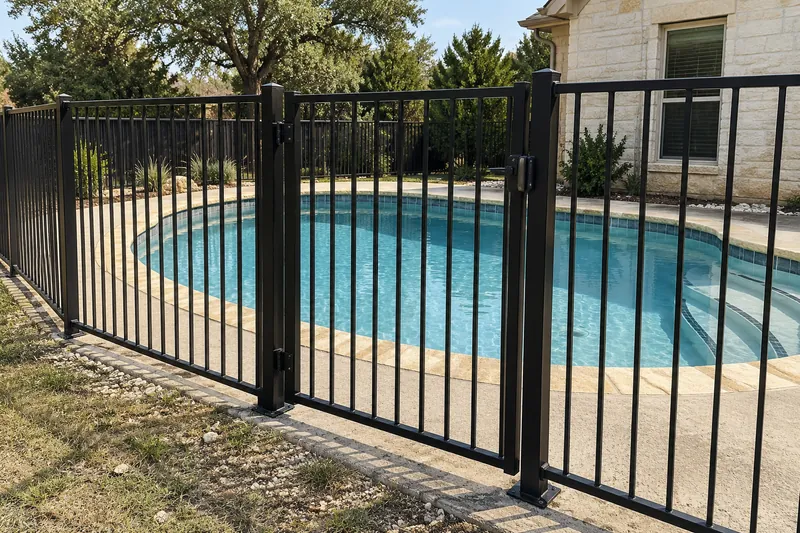
Applying for a pool permit
What goes in the application
Applications are filed through the Town's eTRAKiT system. The Town's Swimming Pool Construction Information Packet, written for building a pool, asks for plans stamped by the electric provider (Oncor or CoServ), a site plan, a separate drainage and access plan, a notarized Pool Construction Affidavit and Pool Alarm Affidavit, and a gas line diagram if a heater is planned. A job with several outdoor projects goes in as one Umbrella (UMB) permit, each project following its own packet.
Review times and deadlines
Plan review for a residential remodel or addition takes about 5 working days. Once issued, a pool permit lapses if work doesn't start within 45 days or hasn't passed final inspection within 180 days, and an application left unpursued is treated as abandoned after 45 days. Changes to approved plans must be re-stamped before an inspection, at $110 an hour with a $110 minimum, and can take up to two business days.
Fees and contractor registration
Under Ordinance No. 36-26, in force from October 1, 2026, an in-ground pool permit costs $430 and a spa or above-ground pool permit $250, and the $120 plan review fee is credited to the permit once the plans are approved; the pool packet adds a drainage inspection fee, so ask Engineering whether one applies. The schedule's $250 residential remodel fee, for work that adds no square footage, isn't tied to pools anywhere in it. Whoever applies registers as a contractor with the Town for the calendar year: $40 for a general contractor, with plumbing, mechanical and electrical contractors exempt from the fee.
Call or request a free estimate any time, 24/7.
(469) 526-3886Inspections and site rules during the work
The inspection sequence
The pool packet lists the inspections in order: pre-drainage; belly steel and pool placement; deck steel, electrical bond, underground electrical and plumbing; P-trap and gas line; pre-plaster; flatwork; final drainage; and the pool final. The drainage inspections are the Town Engineering Department's check that the pool doesn't block drainage on your lot or your neighbors', and no work starts until the pre-drainage meeting, which the pool contractor must attend, is approved. Before any water goes in the pool, the permanent fence has to be installed, inspected and approved. The packet is written for new construction, so ask Building Inspections which of these a remodel needs.
Deck and electrical checks
The packet sets a concrete pool deck at 3½ inches thick or more, reinforced with rebar of 3/8 inch or larger spaced 18 inches or closer, and the steel and electrical bond are inspected before the concrete goes down. At the pool final, the Town looks for a GFCI-protected receptacle 10 to 20 feet from the pool's edge, GFCI protection on every pool light except fiber optic, safety glass in windows within 5 feet of the water and bonded metal within 5 feet of the pool walls.
Working hours and debris
Permitted work runs from 7 a.m. to 7 p.m. on weekdays and 9 a.m. to 5 p.m. on weekends. Any project that needs a dumpster or roll-off for its debris must use Republic Services, the Town's solid-waste franchise.
Call or request a free estimate any time, 24/7.
(469) 526-3886Barriers, setbacks and pool steps
Pool barriers and gates
The Town's pool barrier stands at least 48 inches tall, measured on the outside, away from the pool, with no more than 2 inches under it (4 inches over a solid surface such as a deck) and no opening a 1-3/4-inch sphere can pass. Pedestrian gates self-close and self-latch, with the latch 54 inches from the bottom of the gate, and swing away from the pool. The Town's amendments delete the code's section on mesh fences as pool barriers. Where a wall of the house is part of the barrier, the homeowner certifies one protection by a notarized form, at or before the pre-plaster inspection: door and window alarms listed to UL 2017, a safety cover listed to ASTM F1346, or self-closing, self-latching doors with the release at least 54 inches up. While a pool is under construction, a temporary fence at least 48 inches high surrounds it until the permanent one is up.
Setbacks and easements
No pool, spa or hot tub may sit in the front yard or, with its deck, in an easement, and each stays at least five feet from the side and rear property lines; ask the Town where it measures from. A pool stays at least 3 feet from any building with a foundation and a foot away for every foot of its depth, or it needs a sealed engineered design; above-ground pools and spas are exempt from that foundation setback. Equipment stays out of the front yard, easements and drainage swales, at least 2 feet off the property line and off any shared fence, with a gutter or rain guard above it where it sits beside an overhanging roof.
Steps, benches and ledges
Backyard pool stairs follow the pool code's residential chapter, and the Town's amendments leave its stair rules as written: in the 2021 edition, treads at least 10 inches deep with 240 square inches of walking surface, and risers other than the top and bottom ones no taller than 12 inches. Those rules shape tanning ledges and pool steps added in a pool remodeling job. Diving areas follow the code's minimum water envelopes or the diving equipment maker's, whichever is greater. The Town's own stair sizes and swimout stripe are amendments for public pools, such as apartment and HOA pools.
Call or request a free estimate any time, 24/7.
(469) 526-3886HOA approval before a pool remodel
Many Flower Mound residents live in neighborhoods with homeowner associations, the Town's HOA guide says, and its subdivision records mark 18,438 of the town's 26,444 residential lots with HOA requirements. Because the Town doesn't regulate deed restrictions or HOA rules, its pool packet asks owners to check both before building.
What associations ask for
Bridlewood's association reviews every exterior change through a modification application: a signed request, photos, a plot map showing the change and, where the Town requires one, the Town permit. In Wellington, adding a pool needs approval from the Architectural Control Committee set up under Article X of the community's Master Declarations, a Town permit doesn't stand in for it, and its review can take up to 30 days. An association's review committee can also look up a home's Town permits by address in eTRAKiT.
Fences and enclosures
Under Texas Property Code §202.022, an HOA can't prohibit a see-through pool enclosure, transparent mesh or clear panels set in metal frames, no taller than six feet and designed against climbing, if it meets state or local safety rules; the association may still regulate how it looks. Since the Town's amendments delete the code's mesh-fence barrier section, check with Building Inspections before choosing one.
Call or request a free estimate any time, 24/7.
(469) 526-3886HOA and apartment pools follow separate rules
A pool that isn't built or kept with a single-family home or a two-residence townhouse falls under the Town's public-pool article, which adopts the state's public-pool standards. In that article a remodel is a replacement of, or change to, the pool, its structure, its circulation system or their parts; routine maintenance and repair are not remodels. Texas Health and Safety Code chapter 757 adds enclosure rules that reach only pools run by an apartment owner or a property owners association: at least 48 inches high, gates that self-close, self-latch, lock and open outward, and a latch generally at least 60 inches up. A city's own standards for those enclosures must match the chapter, and a city may fine up to $1,000 a violation. None of it applies to a backyard pool.
Call or request a free estimate any time, 24/7.
(469) 526-3886Pool permit questions
Do you need a permit for a pool in Texas?
Texas adopts the International Swimming Pool and Spa Code, as it stood on May 1, 2019, as the pool code for its cities and lets a city adopt a newer edition; in a city that regulates pools, the code covers all construction, alteration, remodeling, enlargement and repair. Flower Mound uses the 2024 edition and requires a permit before an in-ground pool, an above-ground pool more than 24 inches deep, a hot tub or a spa is built or installed.
How much is a pool permit in Texas?
In Flower Mound, from October 1, 2026: $430 for an in-ground pool permit, $250 for a spa or above-ground pool, and a $120 plan review that counts toward either one. A drainage inspection fee may be added.
How far does a pool have to be from the house in Texas?
In Flower Mound, at least 3 feet from any building with a foundation, and at least a foot away for every foot of the pool's depth, so a part of the pool 5 feet deep sits at least 5 feet from the house. A pool closer than that needs a sealed engineered design.
Do you need a permit to fill in a pool?
In Flower Mound, demolishing a pool or spa is on the list of work the Town's amended code says needs a permit first. Filling in only part of a pool, such as a deep end, is a question for Building Inspections, since the same section covers altering a pool.
Is refinishing a pool considered remodeling?
For public pools, which include apartment and HOA pools, the Town's article keeps normal maintenance and repair out of its definition of a remodel. For a backyard pool, the 2024 code the Town adopted names replastering and resurfacing in its permit exemption, while the Town's amended code requires a permit before a pool is altered or repaired; ask Building Inspections how your job is classed.
Plan a permitted pool remodel with a free estimate
Reach us 24/7 by phone or the estimate form. Say what you would like changed, and we’ll talk through the permits and HOA review it may need.