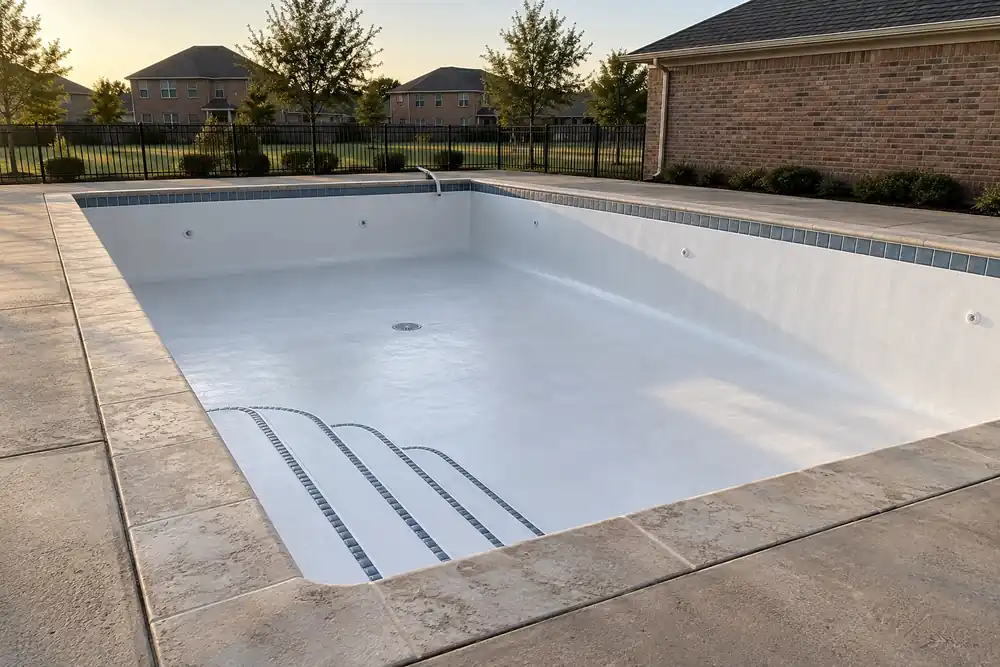
Pool Coping Repair and Replacement in Trophy Club, Texas
Flower Mound Pool Resurfacing repairs and replaces pool coping in Trophy Club, Texas, a town whose largest mapped soil, Branyon clay, falls in the 1980 county soil survey's very high shrink-swell class.
Trophy Club lies off State Highway 114, about fifteen miles southwest of Denton, with 36 holes of golf winding through its neighborhoods, the 877-acre Trophy Club Park and the Community Pool at 500 Parkview Drive. Free estimates are available around the clock; we'll go over the coping material, the joint at the deck and whether the Town wants a permit.
Call or request a free estimate any time, 24/7
No charge · answered 24/7
Get free estimates
Trophy Club homes by decade
The U.S. Census Bureau's 2020–2024 survey estimates count 4,876 housing units in Trophy Club, with a margin of error of 313. Of those, 872 (17.9%) were built in the 1990s and 828 (17.0%) in the 1980s, while 1,110 date from 2000–2009, 1,368 from 2010–2019, 148 from 2020 or later and 550 from before 1980. The median home was built in 2002, give or take three years. Single-family detached houses make up 4,523 of the units, or 92.8%, owners live in 4,195 of the 4,757 occupied homes, and the median owner-occupied home is valued at $675,100, with a median household income of $201,054.
A country-club plan from 1973
In 1973, the Handbook of Texas records, Houston developers brought Westlake's city council a proposal for an upscale planned community centered on a country club. Ben Hogan designed its eighteen-hole course, and the town took its name from the plan to show Hogan's golf trophies at the club. A municipal utility district for water and sewer followed in 1975, and by 1977 the development had its golf course, a community swimming pool, tennis courts and a clubhouse. The community incorporated on January 19, 1985, after a vote that passed with 80%, when Westlake released 2,555 acres from its extraterritorial jurisdiction. The Handbook counts 3,922 residents in 1990 and 6,350 in 2000; developer Jeff Beck began developing the town's remaining 1,250 acres in the 1990s, and a Public Improvement District formed in 2007 opened the way for about 1,400 homes in the Highlands of Trophy Club. The 2020 Census found 13,688 people, and the Bureau's estimate for July 1, 2025 is 13,695.
Neighborhood associations
The Town's directory lists homeowners' associations for Churchill Downs, Hogan's Glen, the Trophy Club Townhome Community, The Highlands (with Abbey Moor and Turnberry listed apart), The Knoll, The Lakes of Trophy Club and The Villas of Trophy Club. Its pool permit form says plainly that the Town has no legal authority to enforce deed restrictions and that permit approval doesn't exempt anyone from HOA rules, so those come first.
Flower Mound Pool Resurfacing will talk through replacing or resetting your coping with the association's rules in mind.
Call or request a free estimate any time, 24/7.
(469) 526-3886Branyon clay and the coping joint
What the soil survey maps
Of the 44 soil map units the USDA survey draws inside Trophy Club's Census boundary, the largest is Branyon clay at 0 to 1 percent slopes, on about 11.2% of the mapped land. Branyon's linear extensibility, the survey's gauge of how far a soil swells as it wets, reaches 13 percent, beyond the 9 percent line the 1980 Denton County survey uses for very high. The next largest units are gentler: Gasil fine sandy loam on about 8.5% and 7.5% at two slope ranges, rated 1.8 percent and low, and the Birome-Rayex-Aubrey complex on about 8.2%, rated 4.5 percent and moderate. The same survey cautions that shrinking and swelling in soils rated moderate or higher can harm buildings, roads and other structures, and that such ground often calls for special design.
Why the joint carries the load
Coping sits between two things that move differently: the pool wall it caps and the deck beside it. Where coping meets a concrete deck, the 2021 International Swimming Pool and Spa Code wants a watertight isolation joint, placed to keep the deck's expected movement from damaging the coping and its mortar bed. Where that joint is missing, a pushing deck can crack or dislodge coping and tile, and in extreme cases crack the bond beam. Pool structural engineers carry the flexible joint down the full depth of the slab, keep reinforcing steel from running out of the bond beam into the deck, and warn that a joint left without maintenance can lose that protection. Guidelines a Houston geotechnical engineer presented to the Foundation Performance Association in 2007, written for that city's expansive soils, likewise place isolation joints between coping and flatwork.
Flower Mound Pool Resurfacing will check the deck joint along with the coping, so a new edge isn't set against the same pressure.
Call or request a free estimate any time, 24/7.
(469) 526-3886The Town's permit rules for pool work
Trophy Club wants a permit before any new construction and before any addition, alteration or repair of existing buildings and structures. Its list of codes adopted as of April 2022 runs through the 2021 International Building, Residential, Plumbing, Mechanical, Fuel Gas, Fire, Energy Conservation and Property Maintenance codes and the 2020 National Electrical Code, and names no swimming pool code. Nothing on the Town's pages says whether a coping replacement needs its own permit, so ask the permitting department before the old coping comes off.
What the swimming pool application sets
The Town's pool permit application keeps a pool at least 6 feet from side and rear property lines and out of every easement, and holds the water's edge 6 feet or more from the house foundation unless an engineer certifies the design. Pool equipment has to be screened from the street and from neighbors. Gates in the barrier must be at least 4 feet tall and 3 feet wide, self-closing and self-latching; a temporary fence surrounds the pool while it is built, and the permanent fence has to stand before the final inspection. House doors that open toward the pool need a self-closing, self-latching device at 54 inches, an audible alarm, or a powered safety cover.
Inspections and fees
Inspections on a Trophy Club pool run in order: belly and ground steel, underground electrical, deck steel and ground, pre-plaster, electrical final, and a final that includes the barrier; a pool heater takes a separate plumbing permit. Fees follow the project's value. Between $25,001 and $50,000, for example, the permit is $391.25 for the first $25,000 plus $10.10 for each added $1,000, with a plan review fee of 35% of the permit fee and a $50.00 pool plumber fee on top.
Call or request a free estimate any time, 24/7.
(469) 526-3886Water and drought stages
Trophy Club Municipal Utility District No. 1 serves most homes. It buys roughly 80% of its water from the City of Fort Worth, which draws raw water from the Tarrant Regional Water District, and blends it with water from four wells, one Trinity and three Paluxy; the TCEQ gave the District its Outstanding Public Water System Award in 2022. Its 2025 report prints no hardness line, so test the fill water before any work that ends with a refill.
The Town and the District have kept Stage 1 restrictions in place since April 22, 2014: sprinklers twice a week by address, none on Mondays, and a request that customers drain and refill pools less often. Homes in the Public Improvement District, the Highlands, fall under the Town's own drought plan. Its Stage 2 bars filling, draining or refilling pools and hot tubs except to keep a pool structurally sound, run and maintain it, or fix a safety problem, and its Stage 3 bars them outright, lets existing pools top up without automatic fill valves, and stops new pool and spa permits. Check the stage before any job that lowers the water.
From the Medlin settlers to the Parkview Drive pool
The Town traces its history to 1847, when Charles and Matilda Medlin and about twenty other families left Missouri by wagon train with the Peters Colony to settle along Elizabeth (Denton) Creek, then moved to higher ground after floods; the Medlin Cemetery remains. In 2002 the Town took over 877 acres known as Marshall Creek Park, with a boat dock and fishing area, under a 25-year lease from the U.S. Army Corps of Engineers, and renamed it Trophy Club Park in 2007. Between 2003 and 2005, 10-acre Independence Park opened with four baseball fields, the community pool opened, and the town adopted a home-rule charter with council–manager government.
The Community Pool at 500 Parkview Drive, open to residents and their guests, has a 6-lane competition pool and a splash pad and is home to the Tritons swim team. The Town rebuilt the complex in 2025–26 as project 25-004: crews drained the lap pool to fix a leak found during construction, waterproofed the surge tanks, finished the tile work and readied a new pool for plaster, and the complex reopened for Memorial Day weekend 2026 with a kiddie play structure, an in-pool lounge shelf, larger sun decks and new shade pavilions. The Council's chosen option improved the leisure pool and shade and dropped a planned waterslide complex to stay within budget.
West-southwest of town lies Westlake, whose council released Trophy Club's land from its jurisdiction in 1985; we cover that town on our page about glass tile pool finishes in Westlake.
Coping beside tile, decks and finishes
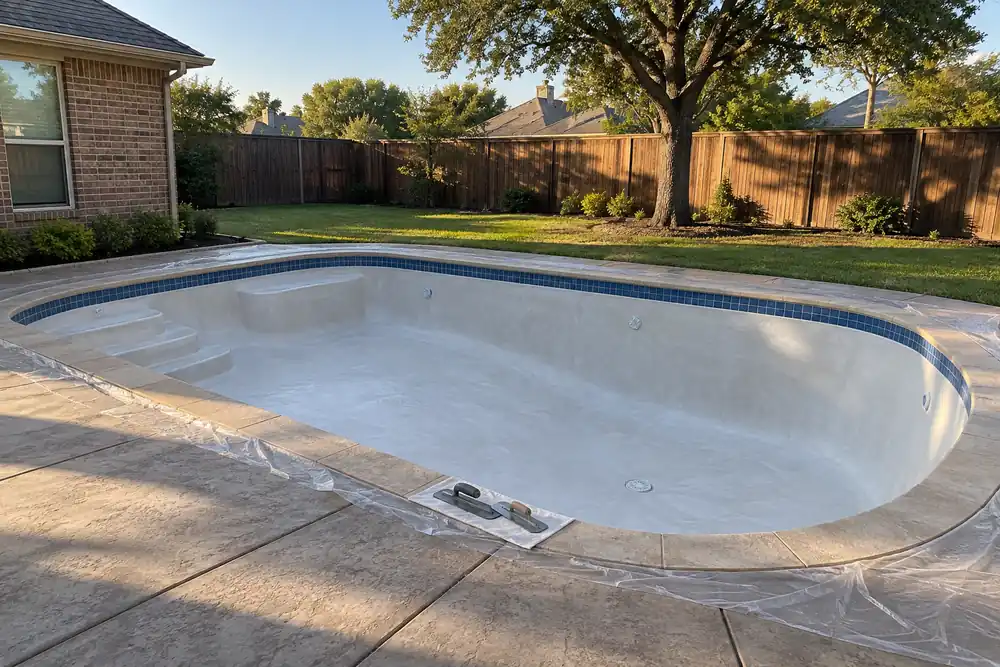
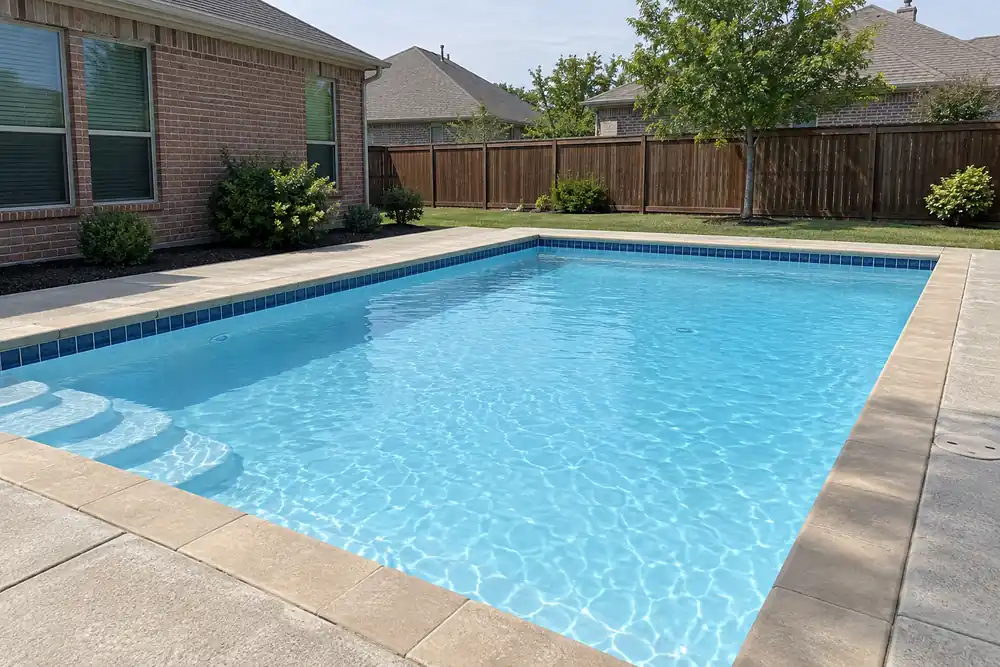
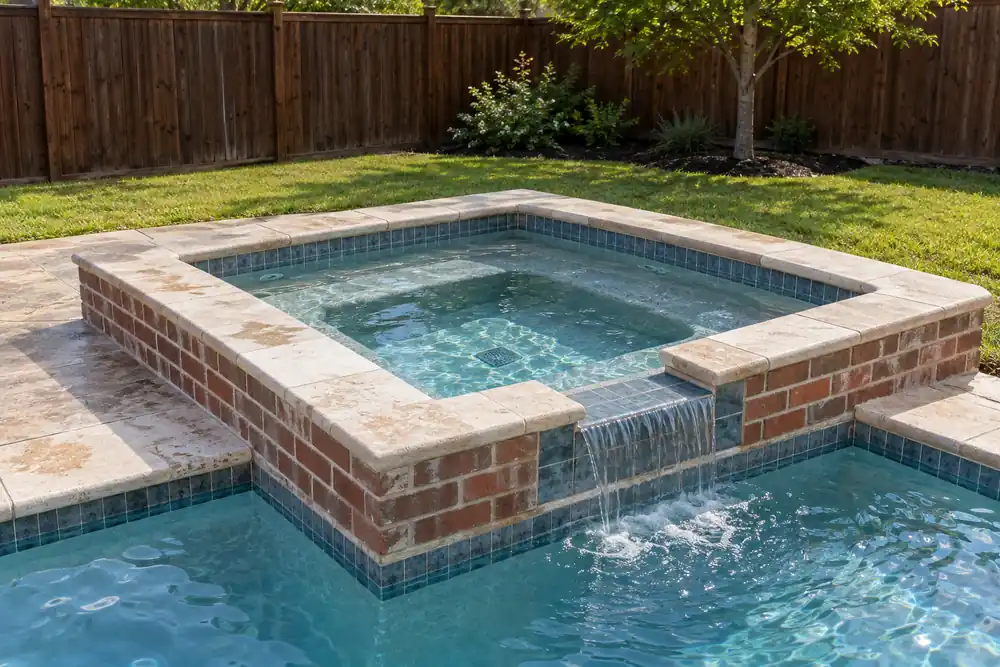
Coping sits between the waterline tile and the deck, so both can be looked at when it is measured. Flower Mound Pool Resurfacing also handles waterline tile repair, mastic and expansion joint repair, travertine and paver decks, pool replastering, and pebble and quartz finishes. By material, typical Dallas–Fort Worth figures from 2026 price coping per linear foot installed at $15 to $30 for bull nose, $18 to $40 for pavers, $20 to $35 for brick, $30 to $55 for travertine and $25 to $60 for natural stone, with a cantilevered edge poured with the deck at $10 to $20; these are published figures, not our prices.
To the south-southeast, our page on polished pool finishes in Southlake covers that city.
How a coping replacement runs
Clear it with the HOA
The Town’s permit form leaves deed restrictions and association rules to the owner, so any architectural approval comes first.
Ask the permitting department
Trophy Club requires a permit to alter or repair a structure; the Town says whether coping work needs one and which pool rules it reviews against.
Check the deck joint
The joint between deck and coping and the deck’s edge are checked, since a deck that bears on the coping can crack or loosen new pieces as well as old ones.
Strip and prepare the beam
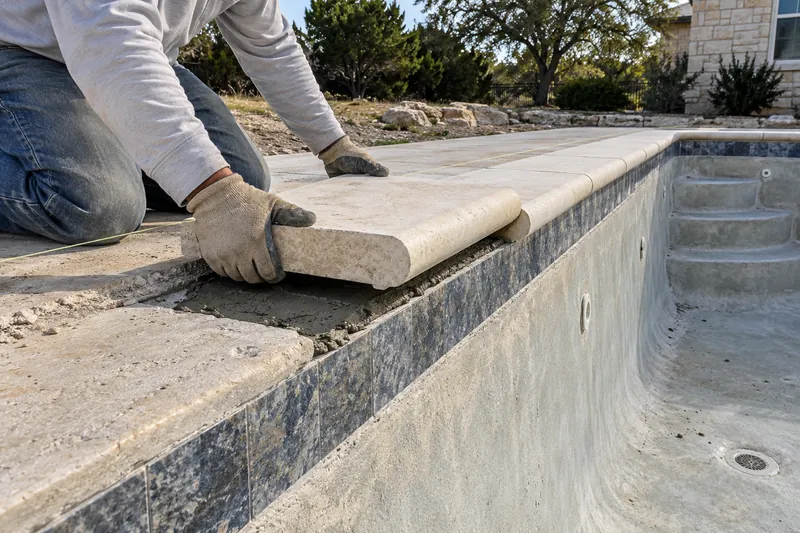
The old coping comes off, and the top of the wall is roughened so the mortar grips; where the bond beam is built back up, it is chipped, water-blasted and coated with bonding paste on a surface kept damp but not wet.
Set and grout the coping
Unilock’s method sets each piece on concrete adhesive at the wall and a bed of modified mortar under the rest of the piece, with 1/4-inch joints filled with a flexible exterior grout.
Seal the deck joint
Backer rod and a flexible sealant close the joint once any new concrete has cured; W. R. Meadows cites 28 days as the industry standard and keeps its sealant 1/4 to 1/2 inch deep at a 2:1 width-to-depth ratio. Check the water stage before any refill.
Call or request a free estimate any time, 24/7.
(469) 526-3886Plan a pool coping repair in Trophy Club
Flower Mound Pool Resurfacing answers calls and estimate requests 24/7. Tell us what the coping is made of, where it has cracked or come loose, and whether the deck beside it has moved.