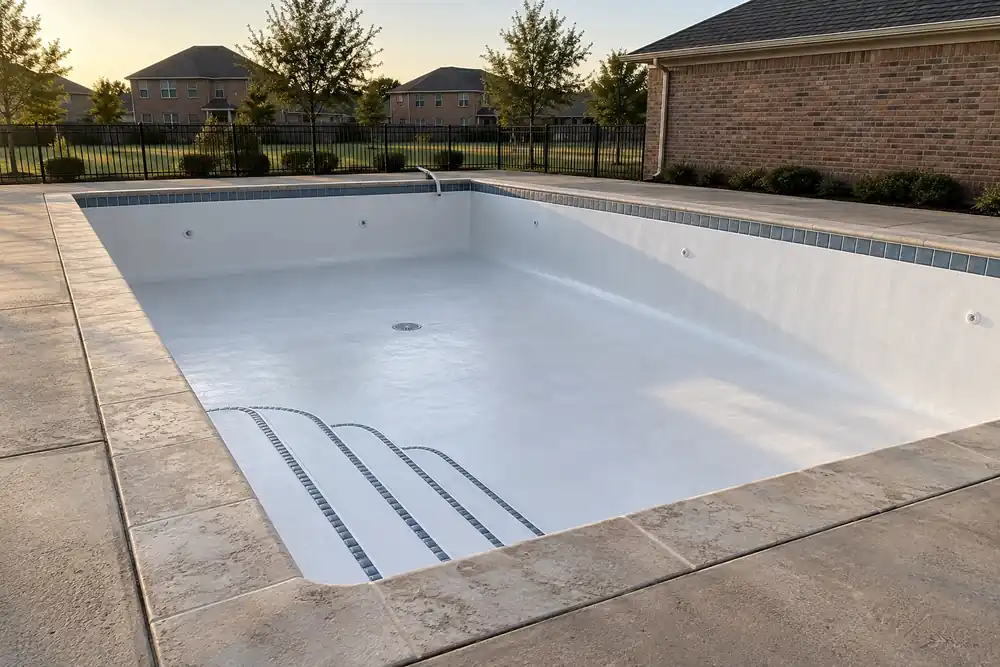
Spa Resurfacing in Flower Mound, TX
Flower Mound Pool Resurfacing handles spa resurfacing in Flower Mound, Texas: a new plaster, quartz, pebble or polished finish inside a concrete spa, on its own or in the same job as the pool beside it. The National Plasterers Council points out that pool and spa finishes, unlike other masonry, sit constantly under water treated with powerful chemicals, so the minerals in the surface and in the water are always interacting. Published 2026 ranges put replastering an attached spa at $15 to $25 a square foot.
Request a free estimate, any time. We'll talk through the finish, the spillway and tile, the wait before the heater goes back on, and whether the pool should be done at the same time.
Call or request a free estimate any time, 24/7
No charge · answered 24/7
Get free estimates
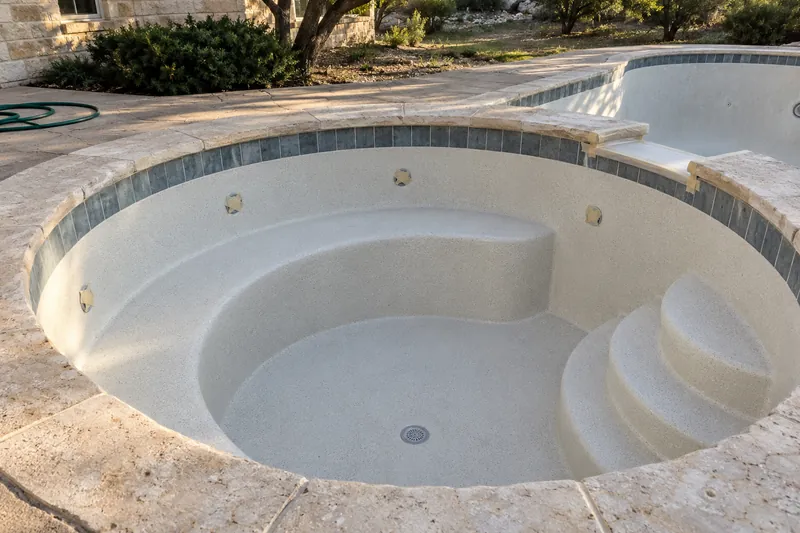
Why a spa finish works harder than a pool's
Hot water and the saturation index
Water balance for plaster is read on the Langelier Saturation Index, and temperature is one of its inputs. On the National Plasterers Council's calculator the temperature factor climbs from 0.6 at 76°F to 0.7 at 84°F, 0.8 at 94°F and 0.9 at 105°F, and a positive index means the water leans toward forming scale, so the same water reads differently at spa heat than at pool temperature.
Heaters, spillways and jets
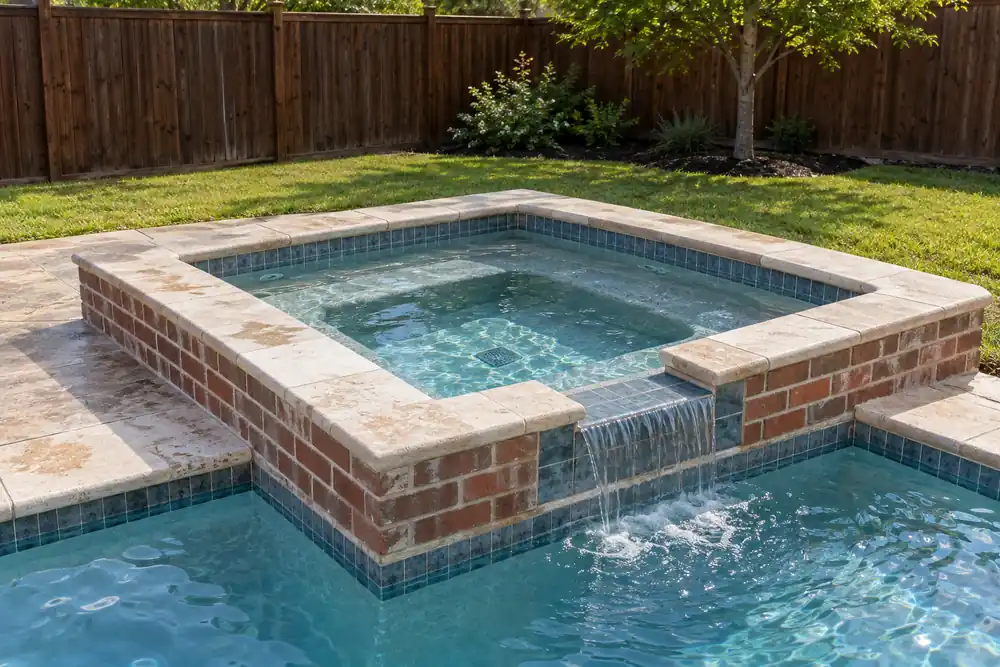
Universal White Cement says salt systems, heaters and spillways create local zones of higher stress on plaster, and that poor circulation, chemicals added in one spot and badly sized equipment can shorten plaster life in those areas. A spillway also leaves minerals on the tile each time it stops and dries, which is why Lunada Bay Tile, a tile maker, wants overflow features to run continuously from sunrise to sunset. Scale already on a spa's tile line is covered under pool tile cleaning and calcium removal.
Dissolved solids and draining
The Pool & Hot Tub Alliance recommends testing total dissolved solids (TDS) monthly in home pools and spas. It says a spa should be drained completely once its TDS runs 1,500 ppm or more above the source water's, or once its calculated water replacement interval has passed, because high TDS can lead to staining or etching. No maker or industry body gives spa finishes a wear rate of their own.
Call or request a free estimate any time, 24/7.
(469) 526-3886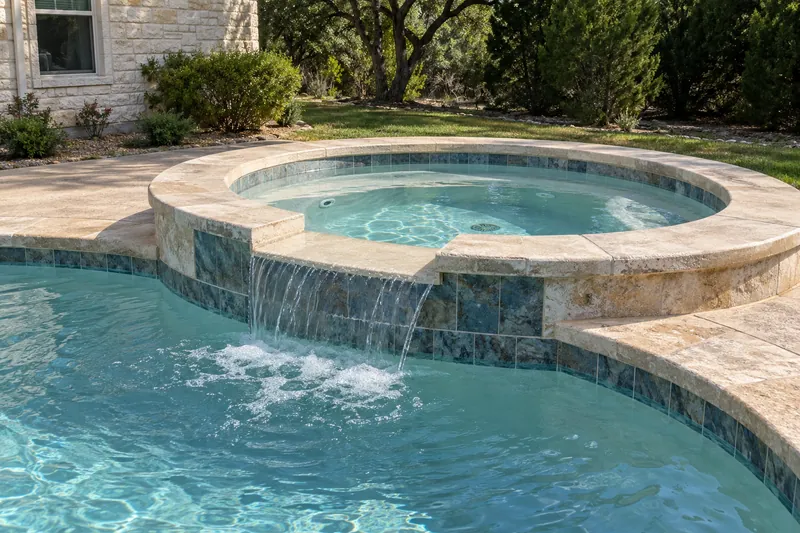
Finishes for a spa
A spa takes the same cement finishes as a pool. White or colored plaster, the finish of pool replastering, is the plain option. CL Industries says its polished marble, smooth yet non-slip, is popular for spas and entertainment pools, and SGM's Durazzo may need a second, finer pass with a 120-grit diamond disk in spas and other high-contact areas. Paint is where the makers disagree: Insl-x doesn't recommend painting spas and hot tubs because of their long spells at high temperature, while Ramuc lists spas for its EP Hi Build epoxy and calls epoxies the coatings of choice for indoor pools, spas and whirlpools.
Call or request a free estimate any time, 24/7.
(469) 526-3886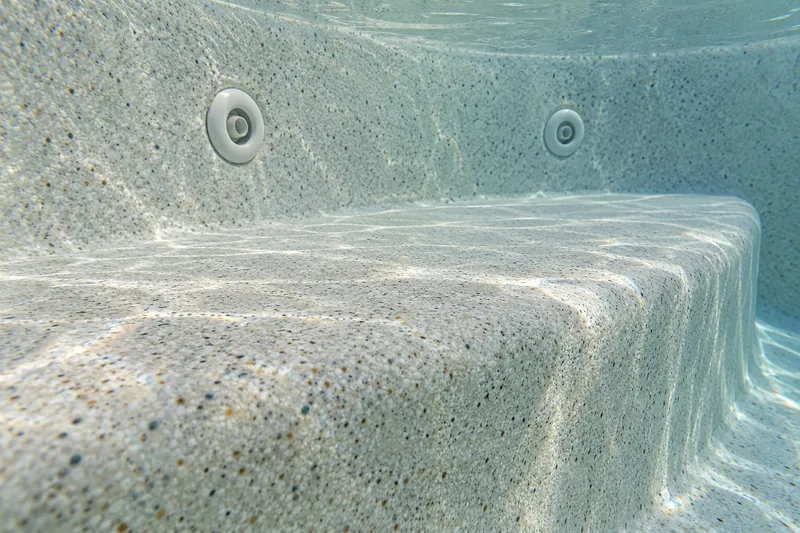
How a spa is resurfaced
The steps follow a pool resurface on a smaller shell. SGM's manual sounds out hollow and delaminated plaster and saws it out 3 inches beyond each hollow spot, undercuts the old plaster 2 inches back and 3/8 inch deep at tile and fittings so the new finish doesn't feather out, and plugs the inlet lines during plastering. Over sound old plaster, makers such as SGM, CL Industries and Premix-Marbletite bond the new finish on with a bond coat; Pebble Technology International strips the old surface first.
When an attached spa and its pool are refilled, NPT says the spa shouldn't be allowed to flow into the pool during the fill, and the National Plasterers Council wants the fill to run without stopping, since an interruption can leave a discolored ring. Before anyone gets in, every suction outlet cover goes back on: the International Swimming Pool and Spa Code bars use of a spa while a cover is missing, damaged, broken or loose.
The 2024 edition of that code, which Flower Mound adopted by Ordinance No. 31-25, says no permit is required for replastering or resurfacing an existing pool or spa, though the Town's own amendments still require permits to alter or repair one; confirm with Building Inspections before work starts. Building a new spa onto a pool is a different job, covered under adding a spa to a pool.
Flower Mound Pool Resurfacing will talk through the prep, the finish and the fill for your spa.
Call or request a free estimate any time, 24/7.
(469) 526-3886Spa resurfacing costs
- Attached-spa replastering, per sq ft (2026)
- $15–$25
- Attached spa of 40–80 sq ft at $20 a sq ft (2026)
- $800–$1,600 on top of the pool
- Pool with an attached spa, replastered (2026)
- $8,000–$20,000
- Community spa, basic replaster (national, 2026)
- $2,500–$6,500
Published ranges for 2026; the first three name no area. No Dallas–Fort Worth or Texas spa figure was found. Not our prices.
The same 2026 ranges put a standard pool alone at roughly $5,500 to $12,000, against $8,000 to $20,000 with an attached spa, with white plaster around $8,000 to $11,000 for the combined surfaces and pebble around $14,000 to $18,000 or more. For a community spa, national figures for 2026 put the typical HOA scope, plaster plus waterline tile, jet fittings, light and equipment repairs, at $4,000 to $15,000.
Call or request a free estimate any time, 24/7.
(469) 526-3886Spa resurfacing questions and answers
How do I know if my spa needs resurfacing?
The trade's signs for pool finishes apply. The National Plasterers Council says resurfacing becomes necessary when cracks and deterioration can no longer be patched or repaired, or the appearance is no longer acceptable; Pebble Technology International lists rough or pitted surfaces, discoloration and cracks; and SGM adds widespread etching, persistent dark mottling, calcium nodules and any sign of the finish separating from the shell.
Can I resurface my spa myself?
The National Plasterers Council says resurfacing takes expert plasterers with years of experience, because a pool finish is a special cement mix placed and finished in one single application. Some finishes are also sold through approved applicators only: CL Industries' 10-year warranty on Hydrazzo, for one, applies only when a factory-approved applicator installs it.
What is the longest lasting spa finish?
No source rates spa finishes on their own. For pools, the Council's ratings put pebble first at 12 to 18 years; quartz follows at 10 to 15, polished at 8 to 12 and white plaster at 5 to 8.
What is the cheapest way to resurface a spa?
Plaster, which CL Industries calls the least expensive option; published 2026 ranges price an attached spa's replaster at $15 to $25 a square foot. Paint costs less per square foot on a pool, $1 to $2 by national figures for 2025, but Insl-x doesn't recommend painting spas, while Ramuc lists spas for its epoxy.
When can a spa be heated after it is resurfaced?
The sources differ. The National Plasterers Council's white paper says not to run the heater for 28 days, while its start-up card waits until the water is balanced and no plaster dust remains; the Pool & Hot Tub Alliance points to the finish maker's figure, normally 2 to 4 weeks; NPT says plaster dust is typically gone between day 4 and day 10; and Pebble Technology International waits at least 14 days on its pebble finishes. Follow the maker of the finish in your spa.
Get a free spa resurfacing estimate
Flower Mound Pool Resurfacing answers calls and estimate requests 24/7. Tell us about the spa, the finish on it now, and whether it spills into the pool.