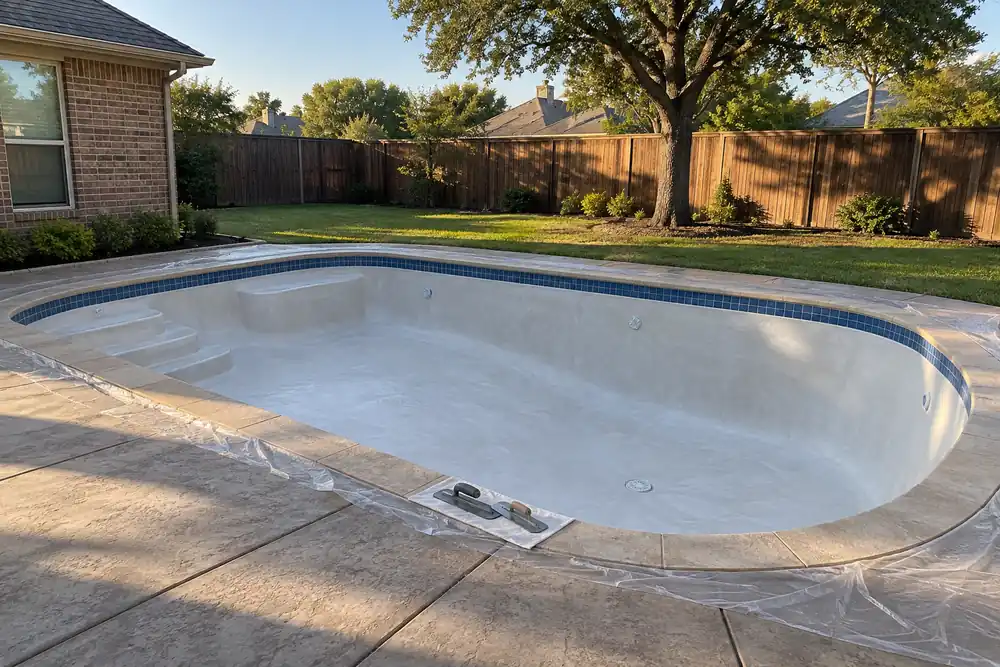
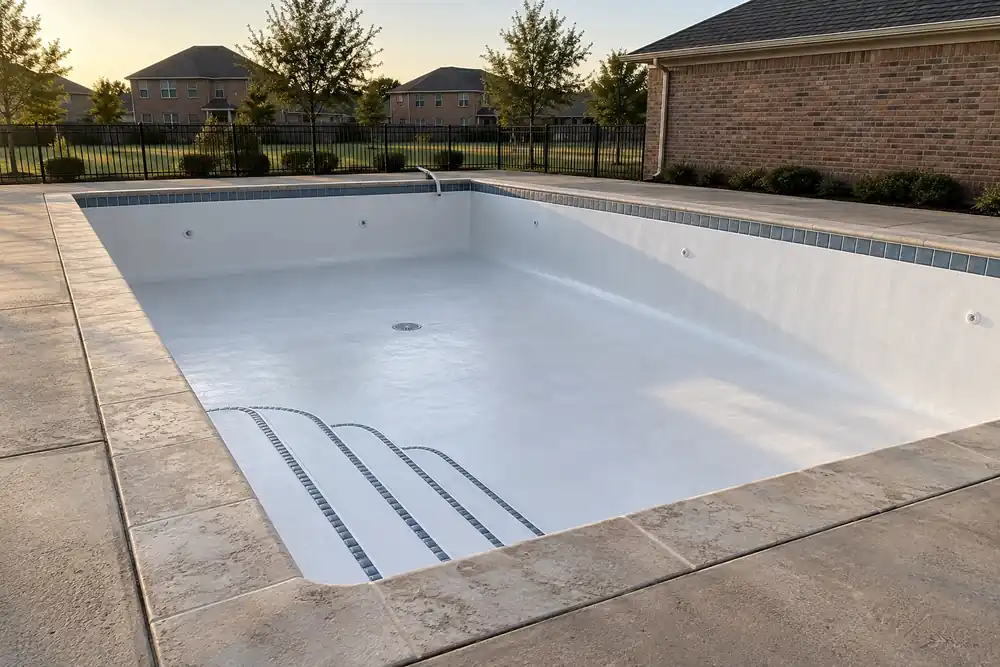
Pool Plaster Repair in Denton, Texas
Flower Mound Pool Resurfacing provides pool plaster repair in Denton, Texas, for backyard pools and for apartment and other commercial pools, in a city where about 41.9% of the 60,531 housing units counted in the Census Bureau's 2020–2024 survey were built before 1990.
Denton is the seat of Denton County, at the point where Interstate 35 divides into 35E toward Dallas and 35W toward Fort Worth. The 1896 courthouse stands on the square, the University of North Texas and Texas Woman's University made it a college town, and the City runs the Denton Natatorium, Water Works Park and the Civic Center Pool. Request a free estimate day or night, and we'll look at the hollow, chipped or stained plaster and go over the City's permit before anything is cut out.
Call or request a free estimate any time, 24/7
No charge · answered 24/7
Get free estimates
Denton's older homes and apartment buildings
The survey counts 16,270 of Denton's housing units as built before 1980, about 26.9%, and another 9,119 in the 1980s, so 25,389 predate 1990. Building picked up again later: 13,217 units went up in 2000–2009, the busiest decade, and 15,173 since 2010, of them 3,618 in 2020 or later, which puts the median year built at 1997, give or take two years.
About 56.1% of the units, 33,962, are single-family detached houses, while 17,883, about 29.5%, sit in buildings of five or more units, 4,624 of them in buildings of 50 or more; 2,210 are mobile homes. Owners and renters split the 56,664 occupied homes evenly, at 28,332 each. Owner-occupied homes have a median value of $348,200, households a median income of $76,019, and the city grew from 139,869 residents in the 2020 Census to an estimated 169,431 on July 1, 2025.
Flower Mound Pool Resurfacing repairs plaster in backyard pools and in apartment, club and other commercial pools throughout Denton.
Call or request a free estimate any time, 24/7.
(469) 526-3886A permit for any pool repair in Denton
The City of Denton is plain about repairs. Any construction, alteration, movement, repair or maintenance of a pool, spa or hot tub, in-ground or above-ground, requires a permit, and so does demolishing a pool. A plaster patch here is a question for Development Services before it is a job.
Denton adopted the 2021 International Swimming Pool and Spa Code by Ordinance 22-668 and applies it to the design, construction, alteration and repair of pools and spas. Section 102.4 of that edition holds repair work to the standard for new work without dragging the rest of an existing pool up to current code, and it lets minor repairs follow the existing pool's manner and arrangement where they are approved and not hazardous. The 2021 permit section also lacks the sentence, first added in the 2024 edition, that exempts replastering or resurfacing an existing pool from a permit.
The City's fee schedule lists a pool permit at $378 and a spa, hot tub or above-ground pool at $50. It doesn't say which line a repair falls under, so ask when you apply. Every pool, hot tub and spa in Denton must also sit inside a fence at least 48 inches high that meets the City's rules on gate latch heights, non-climbable fencing and door alarms.
Call or request a free estimate any time, 24/7.
(469) 526-3886Apartment and public pools: plaster after inspection
Texas treats the pools at apartment complexes, condominiums, hotels, property owners associations, clubs and schools as Class C public pools, though the general public can't use them. In Denton those pools also answer to the City's Health and Food Safety division. City Code 14-114 requires a permit to operate, plans carry a $250 review fee, and the annual health permit for a commercial pool or spa costs $163, plus a $236 application fee for a new one.
For pool construction, the division's guide sets a pre-plaster inspection, and it won't approve a pool for plaster until every part of the pool and its fence is finished except the water. That inspection looks at step spacing and, where a pool has a tanning ledge, a zero-entry point or very deep water, the tile markings. The guide also warns that a facility that changes owners or is extensively remodeled may have to upgrade to current codes: any change to the venue's designed characteristics counts as an extensive remodel, while swapping equipment one for one is normal maintenance. Ask the division whether a plaster repair on an existing public pool calls for an inspection.
Under state rules, a minor repair to an existing public pool may meet whatever construction standard applied when that pool was built. The 2021 code that Texas adopts for public pools keeps their interior finishes from hiding anything in the water and sets their color at a Munsell value of 6.5 or higher.
Two fence heights for two kinds of pool
The City's residential pool page sets a 48-inch minimum fence. Its public-pool guide checks an apartment pool's enclosure against Health and Safety Code chapter 757 and a motel's against state health rules, and it cites City Ordinance 90-149 with a 60-inch minimum height, so a property manager should ask which rule covers the pool before work starts.
Call or request a free estimate any time, 24/7.
(469) 526-3886Sanger clay, two weather stations and freeze-thaw
The USDA soil survey maps 67 soil units on land inside Denton. The largest are Ponder loam at about 8.6% of the mapped land, Sanger clay at 6.4% and Callisburg fine sandy loam at 5.8%; grouped by main soil, Sanger leads at about 11.6%, ahead of Ponder at 9.7% and Wilson at 8.7%. Sanger swells by up to 9.1 percent in linear extensibility. The 1980 Denton County survey puts anything over 6 percent in its high shrink-swell class and notes that a very high class, over 9 percent, is sometimes used. For Sanger clay's largest unit, NRCS gives a Very limited rating for houses, with or without slab foundations, citing shrink-swell, and about 59.1% of the city's mapped land sits in units whose main soil is rated the same way. A rating describes a soil, not a particular backyard.
Freezing nights and the waterline
NOAA's 1991–2020 normals come from two stations inside the city, and they differ on cold. Denton Municipal Airport averages 51.6 nights a year at 32°F or below and a winter average low of 34.3°F, while Denton 2 SE averages 37.9 such nights and 35.9°F. The National Plasterers Council explains that a finish kept under water escapes freeze-thaw, because even a few inches of water usually hold it above freezing; the damage comes in the waterline band, where water wicks up into the finish, first as white efflorescence just above the waterline, then as a rough surface losing aggregate, and finally as thin layers that crack, lift or peel. It ranks steps, benches and sun ledges in that band as most at risk, advises at least 4 inches of water above them, and says the damage is not a material or workmanship defect.
Summer runs the other way. The airport station averages 103.9 days a year at 90°F or above, 21.7 of them at 100°F or above, with a June–August average high of 94.2°F, and SGM, a plaster maker, says hot, sunny climates speed up the deterioration of plaster.
Call or request a free estimate any time, 24/7.
(469) 526-3886Lewisville Lake, Ray Roberts and the drought plan
The City has owned its water utility since 1905. It gained storage in Lewisville Lake after that lake's dam went up in the 1950s and contracted in the 1980s for water from the new Lake Ray Roberts, and its 2025 water quality report names those two lakes as the supply, treated at two City plants.
Denton's drought plan, Ordinance 24-640, reaches pools at every stage. Stage 1 requires written approval before a pool is drained and refilled, Stage 2 limits pool water to replacing normal losses and evaporation, and Stage 3 bans filling or refilling pools, other than topping up an existing pool for losses, along with permits for new pools, hot tubs and spas. The City moved to Stage 1 on August 19, 2026, as a precaution during a treatment-basin repair, and lifted it on August 23, so check the stage before any repair that needs the water out.
Not every patch needs a drain. SGM makes Dynamite Pool Patch, a quick-setting specialty cement, for patching under water: the crack or hole is chiseled to a V, and when the patch is stopping a leak it is pressed in and held at least five minutes, then dampened for fifteen more. Hollow areas that spread across a floor are a different case, since Universal White Cement, a white cement maker, reads spreading or patterned hollows as a bond problem that patching may only postpone.
County seat, college town and historic districts
Denton was founded in 1857 to give the county a seat near its center, on 100 acres donated by Hiram Cisco, William Woodruff and William Loving, and like the county it takes its name from John B. Denton. It wasn't incorporated until 1866, under a charter providing for a mayor and five aldermen; a mayor-commission charter ran from 1914 to 1959, when a new charter set up the council-manager government. North Texas Normal College, now the University of North Texas, opened in 1890, and the Girls' Industrial College, now Texas Woman's University, followed in 1903.
W.C. Dodson designed the 1896 Denton County Courthouse as a blend of Romanesque Revival and Second Empire, built of granite, sandstone and locally quarried limestone; it was substantially renovated in 1987 and later restored. The City lists 69 local historic landmarks in more than seven styles, from Craftsman to Mid-Century Modern, many of them along West Oak Street, and three local historic districts covering over 80 acres on the west and north sides, besides two National Register districts. Its roll of neighborhood groups and HOAs runs from Austin Street/TWU, Avondale and Beaver Creek HOA to Bent Oaks Estates, Braly Heights and the Bungalows at Old North Park.
In March 1921 a petition asked the city commission for a bond election to buy Quakertown, a Black community, and turn it into a city park. The City began buying Quakertown properties in May 1922, and residents could sell outright or have their houses moved to Solomon Hill, across the railroad tracks.
Plaster repair beside replastering, cracks and tile
A plaster repair often turns up other work. Besides patching, Flower Mound Pool Resurfacing handles full replastering, quartz and pebble finishes, structural crack and leak repair, tile and coping, and drain and acid wash. One nearby page covers pool tile repair in Corinth; another covers pool drain and acid wash in Shady Shores.
Published figures help weigh a patch against a new surface. Typical Dallas figures for 2026 put the average pool repair, of any kind, at $250 to $1,200, and a published 2026 planning range with no area named puts a professional spot patch or small crack repair at about $150 to $400. A consumer guide's 2026 rule of thumb sets a $600 patch that buys two more seasons, about $300 a year, against a $6,000 replaster lasting ten years, roughly $600 a year but with the whole surface renewed. Those are published figures, not our prices.
Call or request a free estimate any time, 24/7.
(469) 526-3886Steps in a pool plaster repair
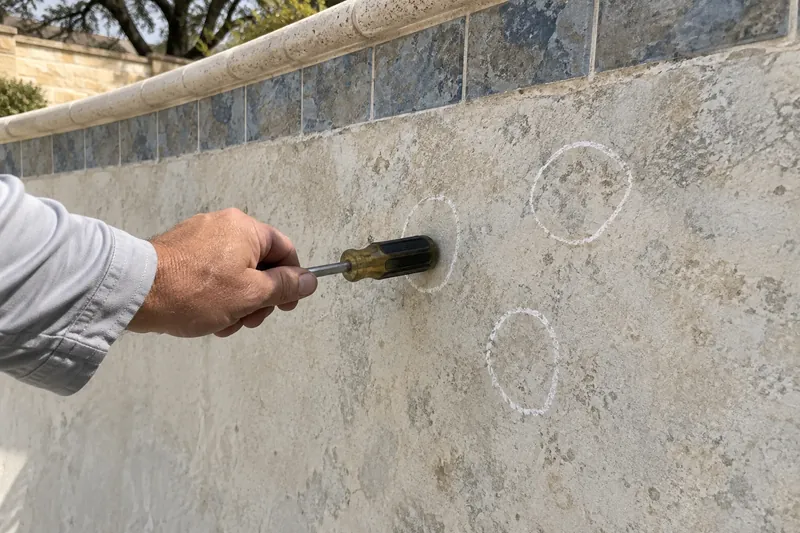
Sound out the plaster
Tapping the finish in a grid with a plastic or rubber tool separates crisp, bonded plaster from the dull, drum-like note of plaster that has let go, and a drained pool gives the clearest reading.
Apply to Development Services
The City requires a permit for any pool repair or maintenance; ask which fee line covers a plaster patch.
Check the drought stage
Under Stage 1 of Ordinance 24-640, draining and refilling a pool takes the City’s written approval.
Cut out and patch
Loose plaster comes out back to sound edges, and the patch goes in with the pool drained or, with an underwater patching cement, with the water in.
Ask about inspection for public pools
Apartment, hotel and club pools answer to Health and Food Safety; ask whether the repair calls for its pre-plaster inspection.
Brush and filter after the fill
The National Plasterers Council’s Technical Bulletin 4 wants plaster dust removed and filtered out within the first 3 to 5 days after the pool is full, before it carbonates onto the surface.
Call or request a free estimate any time, 24/7.
(469) 526-3886Patching and replastering costs, answered
Can pool plaster be patched, and does a patch need a permit in Denton?
Often, if the damage is limited. Universal White Cement says a handful of small, separate hollow spots can sometimes be chipped out and patched while the rest of the surface holds, and the National Plasterers Council turns to resurfacing once a finish is past patching or repair. In Denton a patch still counts as a repair under the City's permit rule, so Flower Mound Pool Resurfacing will raise the permit when the pool is looked at.
How much to replaster a pool in Texas?
Published 2025 figures for Dallas–Fort Worth put replastering an aging concrete pool at $6,000 to $15,000, depending on materials and labor, or $6.50 to $8.00 a square foot, and typical Texas figures for the same year put resurfacing at $5,000 to $15,000. A real price needs the pool measured, walls and floor together.
Plan a pool plaster repair in Denton
Phone or send the estimate form whenever it suits you; Flower Mound Pool Resurfacing answers at any hour. Tell us where the plaster has popped, sounds hollow or has stained, and whether the pool serves a home or an apartment complex.