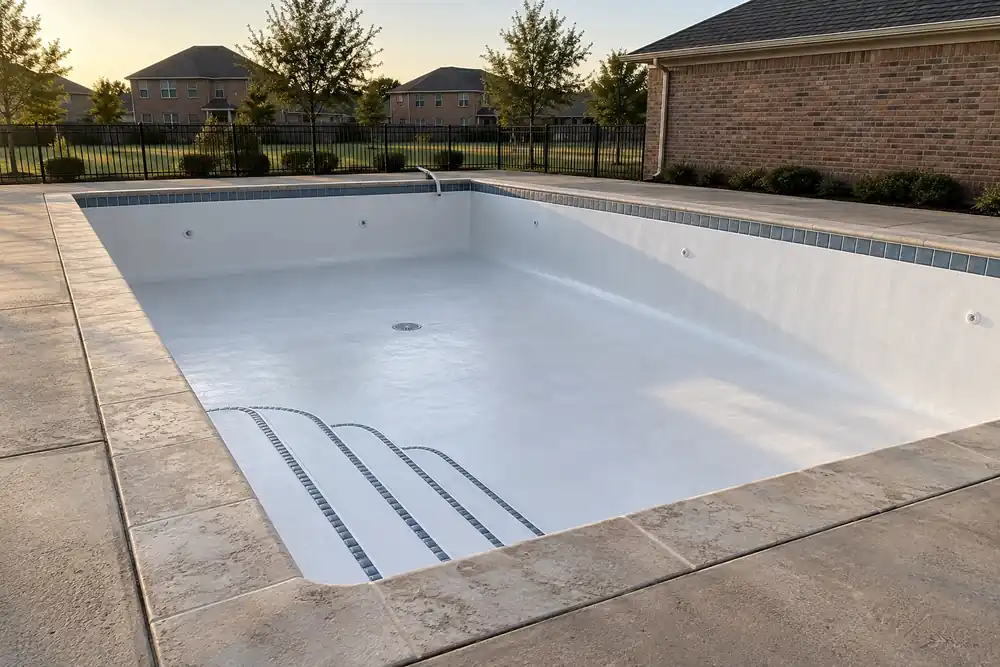
Pool Crack Repair in Flower Mound, TX
Flower Mound Pool Resurfacing handles pool crack repair in Flower Mound, Texas: telling cracks in the finish from structural cracks in the gunite or shotcrete shell, injecting cracks that leak or keep moving, and patching the shell before a new finish goes on. The National Plasterers Council defines the shell as the pool's substrate structure, formed concrete or shotcrete (wet-mix, or dry-mix, also known as gunite) sprayed over a steel reinforcing grid, and the surface the interior finish is applied to. Typical Dallas–Fort Worth figures from 2025 run from $500 to $1,500 for a minor structural crack to $5,000 to $15,000 or more for major structural damage.
Request a free estimate, any time. We'll talk through where the crack runs, whether it is moving or losing water, and what a repair can and can't fix.
Call or request a free estimate any time, 24/7
No charge · answered 24/7
Get free estimates
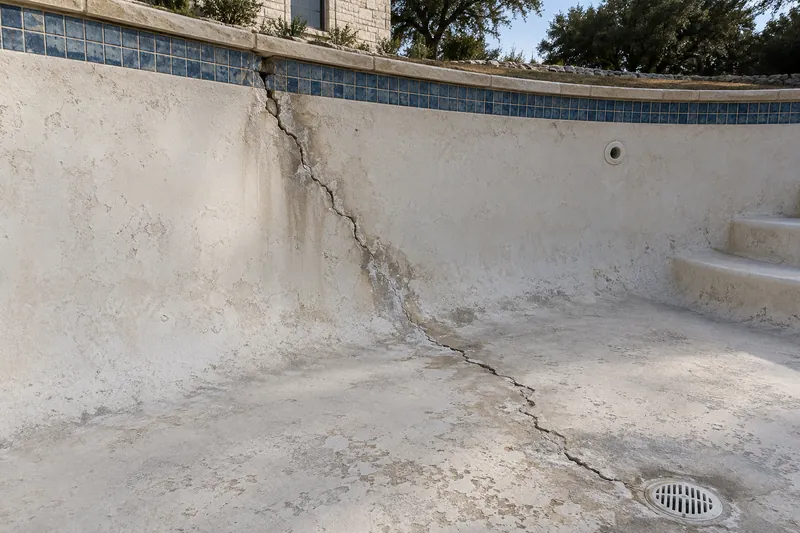
Pool cracks: in the finish or in the shell
Shrinkage cracks in the finish
Not every crack reaches the structure. The National Plasterers Council keeps the name shrinkage crack for one that opens during application or within 24 hours of the finish's final set; a crack through the structural shell is another matter. Universal White Cement, a white cement maker, reads circular or spider cracks gathered around a single patch as a sign of plaster coming loose rather than of a broken shell, and that work is covered under pool plaster repair.
Structural cracks in the shell
Shotcrete is only a way of placing concrete, the American Shotcrete Association points out, so any method that repairs cracks in concrete applies to a shotcrete pool shell. Its guidance sorts cracks by cause. Small holes missed during shooting, and certain shrinkage, autogenous or plastic cracks, can often just be plugged or patched. Cracks from structural movement, or from stress built up inside the structure, call for a deeper investigation that settles both the cause and the remedy before any repair is chosen.
Rust stains and thin cover over the steel
Rust bleeding through plaster can start in the shell. Where it comes from steel shot with too little concrete over it, the Association puts the responsibility for proper cover on the shotcrete contractor, and says a section shot with reduced cover is far less durable than its designer intended. An article in the Association's magazine gives the mechanism: with too little cover, water reaches the reinforcing steel and starts corrosion that can spall the concrete off.
Flower Mound Pool Resurfacing will talk through which kind of crack your pool has before a repair is chosen.
Call or request a free estimate any time, 24/7.
(469) 526-3886What makes a pool shell crack
How the shell was shot and cured
The Association's technical director names the questionable shotcrete practices pool owners and builders bring to him most often: rebound reused in the mix, missing curing, too little velocity at the nozzle, uneven thickness and excessive porosity. For pool shells the Association recommends gunite, the dry-mix process, reaching at least 4,000 psi in compressive strength at 28 days, shot by an ACI-certified nozzleman and cured for at least 7 days; new shotcrete left uncured in windy, hot or dry weather, it warns, is more likely to shrink and crack.
Water pressure under an empty pool
Groundwater around a pool pushes up on the shell. River Pools, a fiberglass pool maker, says that when too little water is left in the pool the shell can bulge, crack or even float, and that the same principles hold for every type of pool: with enough uplift, concrete pools float too.
Ground that shrinks and swells
The engineering guidance below was written for pools on Houston's Gulf Coast clays, not for North Texas. In 2007 guidelines presented to the Foundation Performance Association, a Houston geotechnical engineer wrote that expansive soils can cause major damage to pool structures in the Gulf Coast area, and that he had seen many pools there move and crack. He recommends isolating the pool structure from expansive soil, designing its plumbing connections to allow for movement, and having it designed by a structural engineer licensed in Texas who reviews the geotechnical report. Where a tree was taken out before the pool was built, or dies later, he warns that the clay below can swell for several years afterward.
Flower Mound Pool Resurfacing will talk through what may have moved your pool's shell and what that means for a repair.
Call or request a free estimate any time, 24/7.
(469) 526-3886Flower Mound clay soils and pool cracks
Soil maps show much of Flower Mound on ground that moves. USDA soil data clipped to the town's boundary rate the main soil Very limited for homes, with shrink-swell as a full-weight reason, on 9,059.14 of its 26,697.51 non-water acres, about 33.9 percent. Navo clay loam, which covers more of the town than any soil but one, and Wilson clay loam both reach a linear extensibility of 7.5 percent, a measure the USDA's Natural Resources Conservation Service reads as more potential for soil movement the higher it goes; Heiden clay reaches 12.2 percent and Branyon clay 13.0. On the 1980 Denton County soil survey's scale, a change of more than 6 percent is high shrink-swell and more than 9 percent very high.
That survey also describes the force involved. Some Denton County clays, rich in the clay mineral montmorillonite, swell as they get wet and shrink and crack as they dry, pushing hard enough to crack foundations and walls that aren't specially reinforced, and sometimes ones that are. Not all of the town is clay: Gasil fine sandy loam, rated Not limited for homes, has a linear extensibility of only 1.8 percent. The survey writes about foundations, walls and roads rather than pools, and the nearest pool engineering advice is Houston's, so each crack's cause is still checked on its own.
In The Colony, the soil survey maps that same Branyon soil as the main soil on about 61.2 percent of the mapped land, and our page on pool crack repair in The Colony covers that city.
Flower Mound's amended pool code requires a permit application to the code official, and the permits it calls for, before anyone repairs or alters a pool. The 2021 edition of the model International Swimming Pool and Spa Code lets minor repairs be made in the same manner and arrangement as the existing pool, where they are approved and not hazardous. Ask the Town's Building Inspections before a crack is cut open.
Call or request a free estimate any time, 24/7.
(469) 526-3886How pool cracks are repaired
Investigation first
Repair starts with the cause. Many epoxies and polyurethanes are used to inject cracks, the Association notes, and finer cracks need a thinner, lower-viscosity material to get in, but it leaves the choice to someone who knows shotcrete cracking, an engineer or an injection specialist, who looks at the cracks and recommends a specific repair. Where spider-web cracking leaves the shell's strength in doubt, it advises a qualified local engineering firm to plan, take and test cores under ASTM C42/C42M or ASTM C1604/C1604M.
Injection for cracks that move or leak
For a crack that will keep moving, or that sits under water, the Association prefers a filler able to take thermal movement in the years ahead over a brittle product, and says many injectable polyurethane grouts can do it; a coating laid over a moving crack needs enough thickness and elasticity to bridge it. Prime Resins, a resin maker, describes its Prime Flex 900 XLV as a low-viscosity hydrophilic polyurethane injected under pressure into actively leaking joints and cracks, hairline cracks included, where it reacts with water and expands into a closed-cell, watertight foam that flexes as the structure expands and contracts.
Patching and new shotcrete
Where new shotcrete goes onto the old shell, the Association's conditions are a clean surface roughened to about 1/16 inch or more and brought to saturated surface-dry, with the shotcrete placed at high velocity, so the joint acts monolithically instead of as a cold joint; the success of an overlay or patch, it says, depends heavily on that surface preparation. Thickening a cracked or thin wall is a different matter, because wall thickness is part of the pool engineer's design: the added shotcrete needs more reinforcing steel, to be confirmed with the pool designer.
Cracks at the skimmer, leaks and fiberglass
A crack that opens around the skimmer is a repair of its own, covered under pool skimmer repair, and a crack that is losing water is also a leak, confirmed and sealed under pool leak repair. Fiberglass pools have no gunite shell: River Pools describes their spider cracks as small hairline cracks in the gelcoat surface, usually cosmetic and not structural, and that work falls under fiberglass pool repair.
Flower Mound Pool Resurfacing will talk through injection, patching or new shotcrete for the crack in your pool.
Call or request a free estimate any time, 24/7.
(469) 526-3886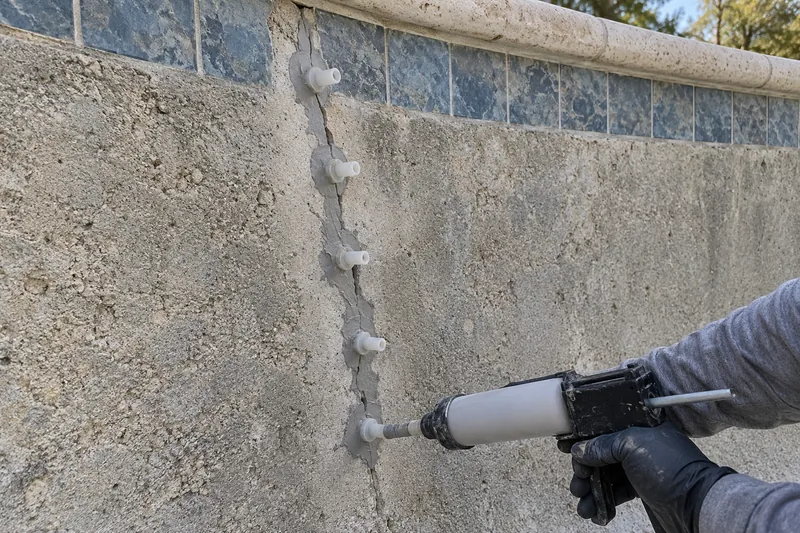
Pool crack repair costs around Dallas–Fort Worth
- Minor structural cracks (DFW, 2025)
- $500–$1,500
- Moderate cracks with rebar exposed (DFW, 2025)
- $2,000–$5,000
- Major damage needing resurfacing or a new shell (DFW, 2025)
- $5,000–$15,000+
- Small cracks, gunite or concrete, per linear ft (national, 2025)
- about $75
- Bond beam repair with tile and coping, per linear ft (national, 2025)
- $70–$80
- Patching and resurfacing a beam crack along the pool (national, 2025)
- around $4,000–$6,000
Published averages and other companies’ ranges, not our prices. A real price needs a look at the pool.
National figures note that a bond beam repair typically includes replacing the tile and coping, which is why it is priced with them. Published prices for structural crack repair disagree widely, so treat these as a guide to scale: the kind of crack, whether steel is exposed and how much finish has to come off set the price.
Call or request a free estimate any time, 24/7.
(469) 526-3886Pool crack repair questions and answers
How much does it cost to repair a crack in a pool?
Typical Dallas–Fort Worth figures from 2025 put minor structural cracks at $500 to $1,500 and moderate cracks with exposed rebar at $2,000 to $5,000, while national 2025 figures price small cracks in a gunite or concrete pool at about $75 a linear foot. Flower Mound Pool Resurfacing will price your crack after seeing how long it is and what it has done to the shell.
Can a crack in a pool be repaired?
Yes. Since a shotcrete shell is concrete placed a particular way, the American Shotcrete Association applies the usual concrete crack repairs to it. Small holes and some shrinkage cracks are often just plugged or patched, while a movement crack needs its cause found first, sometimes by coring and testing the shell.
What is a good crack filler for swimming pools?
One matched to the crack. Prime Resins says the choice starts with whether a crack is weeping, a hairline leak that needs a low-viscosity resin able to get into it, or gushing, which needs a fast reaction or set time. For cracks that will keep moving, the American Shotcrete Association prefers a flexible filler, such as an injectable polyurethane grout, to a brittle one.
Can I repair cracks in my swimming pool underwater?
Some, yes. Xypex describes its Patch'n Plug as a fast-setting hydraulic cement that stops flowing water in seconds and seals cracks and other defects in concrete, and Prime Resins' hydrophilic resin is made to react with water as it seals an actively leaking crack. A structural crack still needs its cause looked into before any patch goes in.
Do hairline cracks in new pool plaster need repair?
Usually not on their own. The National Plasterers Council says every cementitious pool finish develops some shrinkage or check cracking before the fill, and that these cracks typically reseal underwater as the cement keeps hydrating; it recommends getting a new finish fully underwater as soon as practical to limit that cracking and the risk of the finish debonding from the shell. Cracks that keep growing, or that run straight through the shell, are a different matter.
Get a free pool crack repair estimate
Flower Mound Pool Resurfacing answers calls and estimate requests 24/7. Tell us where the crack runs, how wide it is, and whether the water level is dropping.