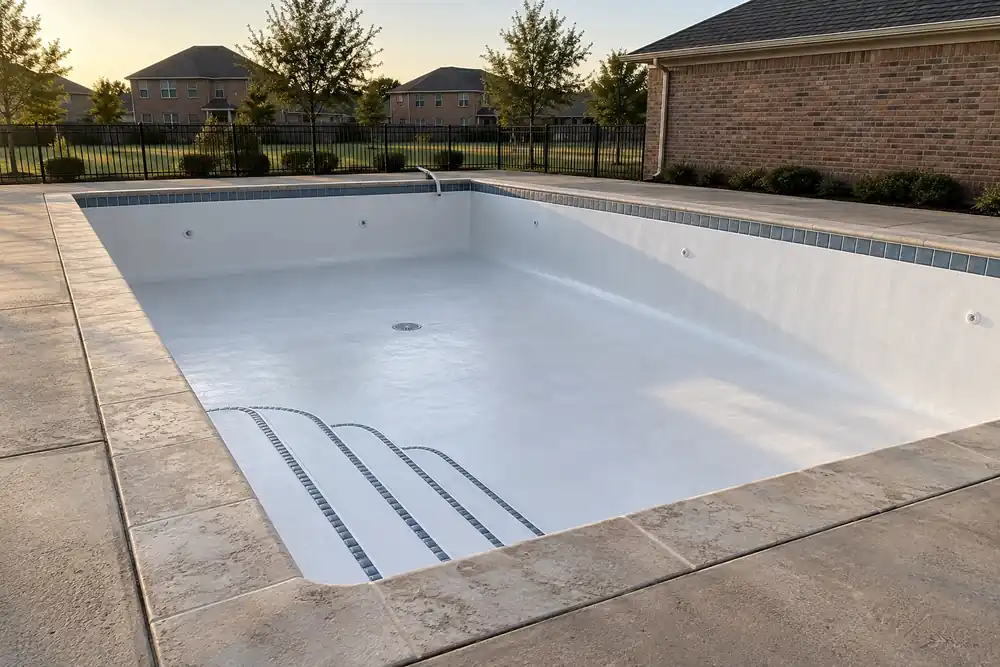
Pool Painting in Flower Mound, TX
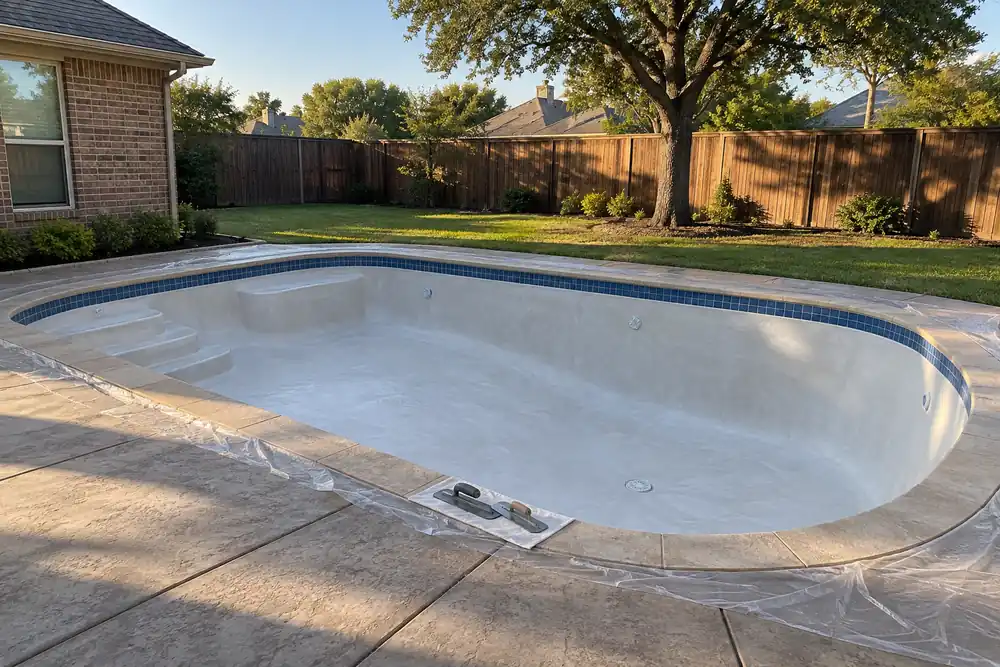
Flower Mound Pool Resurfacing handles pool painting in Flower Mound, Texas: epoxy, acrylic or rubber-based pool paint on a cleaned, etched and fully dried plaster or concrete shell, the least costly pool finish to put on by national figures for 2025, which price it at $1 to $2 a square foot. Ramuc, a pool paint maker, calls paint a viable option once a plaster finish has aged, roughened and stained to the point that the owner is weighing a replaster.
Request a free estimate, any time. We'll talk through what is on the pool now, the paint that can go over it, and the run of dry days the job needs.
Call or request a free estimate any time, 24/7
No charge · answered 24/7
Get free estimates
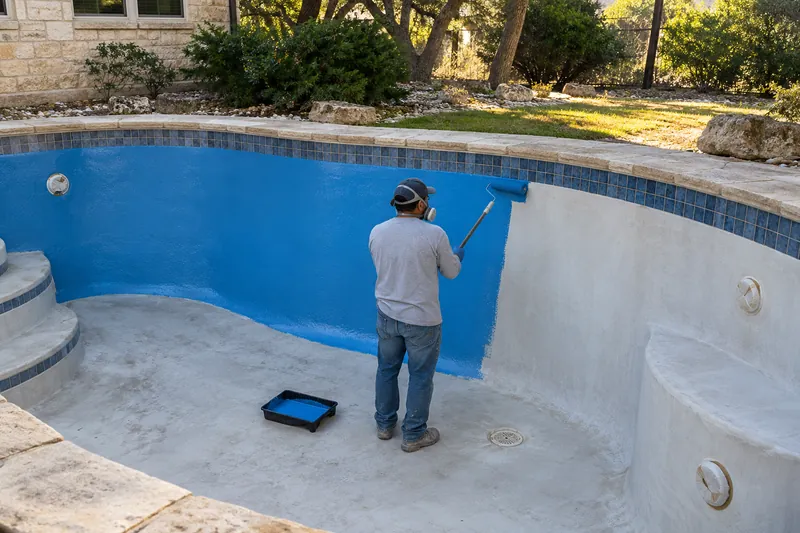
Epoxy, acrylic and rubber-based pool paint
Olympic, the pool paint line of Kelley Technical Coatings, gives acrylic enamel 2 to 3 years of service, synthetic or chlorinated rubber 2 to 3, and epoxy 5 to 8. Insl-x, Benjamin Moore's pool paint line, calls a paint's life impossible to predict but tells owners to expect 3 to 5 years, depending on the coats, climate, chlorination, chemical balance, sun, color, use and cleaning.
Which paint suits which pool
Any unpainted masonry pool can take rubber, epoxy or acrylic, Ramuc says, while steel needs a metal primer first and fiberglass calls for epoxy, which makes fiberglass pool resurfacing a job of its own. Insl-x describes its epoxy as a two-component polyamide that resists chlorine but chalks and fades in sunlight over time, and its rubber-based paint as a low-sheen coating for concrete pools with fresh or salt water. For public pools, which run more chlorine, Insl-x points to epoxy or chlorinated rubber.
Ask Flower Mound Pool Resurfacing for a free estimate on painting your pool.
Call or request a free estimate any time, 24/7.
(469) 526-3886Painting over old pool paint
New paint has to suit the old. Insl-x puts epoxy only over solvent-based epoxy, chlorinated rubber only over chlorinated rubber, and synthetic rubber over either rubber, while its waterborne acrylic goes over most coatings in good condition. Olympic allows synthetic rubber over chlorinated rubber but not the reverse, and Kelley's epoxy bulletin says never to recoat a rubber-base coating with epoxy. To identify the old coating, Olympic dissolves a chip: denatured alcohol dissolves acrylic, a 75/25 blend of mineral spirits and solvent dissolves synthetic rubber, only full-strength solvent or xylol dissolves chlorinated rubber, and a chip nothing dissolves is epoxy. Ramuc will analyze chips owners send in.
When the old paint has to come off
Kelley Technical Coatings says never to recoat a pool that is scaling, peeling or blistering beyond a few small spots, and Insl-x adds full removal where more than 4 older layers have built up. Scraping or sanding old paint may release lead dust, Insl-x warns, so it calls for a NIOSH-approved respirator and a HEPA vacuum for cleanup.
Call or request a free estimate any time, 24/7.
(469) 526-3886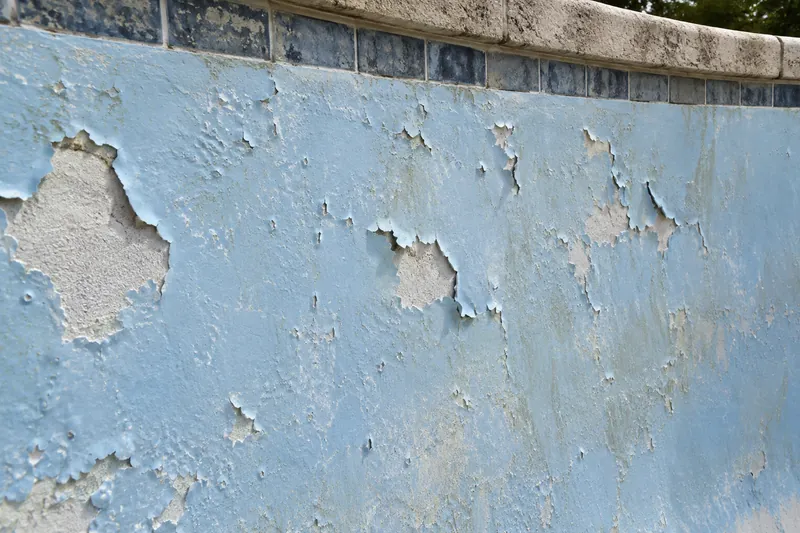
How a pool is prepared and painted
Bare plaster
Ramuc sounds aged plaster for hollow or crumbling areas and has them repaired first, because its coatings are no repair for weak surfaces; where the plaster can't be saved, pool replastering is the alternative. Cracks are filled with hydraulic cement or polyurethane sealant, never silicone. Olympic washes with trisodium phosphate rather than soap, which leaves a film, and Insl-x etches bare plaster with a 10 percent muriatic acid solution, triple-rinses it and lets it dry 3 days; properly etched, Olympic says, it feels like fine sandpaper. New plaster waits until its surface pH is 9 or less, or 30 to 60 days.
Previously painted pools
Here the makers split. Insl-x scuff-sands with 150 to 180 grit and says never to acid etch a painted surface, while Olympic recommends an acid wash even on coated pools to clear chalky residue and mineral deposits. On primer, Olympic primes bare plaster with GUNZITE or POXOPRIME II, while Ramuc calls its EP Hi Build Epoxy self-priming.
Dry enough to paint
Rubber-base paint needs a 100 percent dry surface, Olympic says, or trapped water blisters the film. Ramuc's test waits for 5 dry, sunny days, then tapes 2-by-2-foot sheets of clear plastic to the deep-end wall and floor; condensation under them within about 4 hours means wait 24 hours and test again.
Two thin coats
Insl-x always applies two thin coats with a short-nap roller, and Ramuc traces blistering to a nap thicker than 3/8 inch, paint laid on too thick, a damp surface, direct sun, filling before the cure, or incompatible paints. Insl-x puts a 30-by-10-foot pool averaging 5 feet deep at about 730 square feet of paintable surface, roughly 2 gallons a coat over an old coating, and Kelley makes steps and shallow areas slip resistant by sifting silica sand onto the wet coat.
Flower Mound Pool Resurfacing will talk through the prep, the paint system and the coats.
Call or request a free estimate any time, 24/7.
(469) 526-3886Painting a pool in Flower Mound's weather
The makers paint in mild weather: Insl-x between 50°F and 85°F and out of direct sun, the east wall in the morning while it is shaded and the west wall in late afternoon, and Ramuc between 50°F and 90°F with nights no colder than 50°F, or its epoxy won't cure properly. Grapevine Dam's 1991–2020 normal high reaches 95.3°F in July and 95.7°F in August, above both ceilings, and its freeze-free season runs from March 14 to November 17 in half of all years.
Olympic ties its epoxy's cure before filling to temperature, from 3 days at 75 to 85°F to 6 days at 60 to 65°F; Insl-x waits at least 7 days after the last coat; and Ramuc wants 5 to 7 dry days outdoors plus a day for each day of rain, which counts most in May and October, Grapevine Dam's wettest months. Insl-x never covers a curing pool with a tarp or solar blanket, which traps solvent. After the fill, it adds shock through a chlorinator or the skimmer so concentrated chlorine doesn't touch the new paint, and Ramuc warns that filling too soon leaves a blush that looks like fading.
Ask the Town of Flower Mound's Building Inspections whether your job needs a permit before work starts. Lake Dallas, whose permit guide says pool repairs and remodels need one, has its own page on pool painting in Lake Dallas.
Call or request a free estimate any time, 24/7.
(469) 526-3886Pool painting costs around Dallas–Fort Worth
- Pool paint, per sq ft (Dallas, 2026)
- about $1
- Painting, per sq ft (national, 2025)
- $1–$2
- Paint or epoxy coating, per pool (national, 2026)
- $1,500–$5,000
- Painting a pool bottom, no draining or repairs (national, 2024)
- $1,400–$2,500
Published Dallas and national figures, not our prices. A painting job is priced after the old coating is identified.
Dallas cost figures for 2026 give pool paint two to five years and say even high-quality epoxy won't last longer than seven before it needs reapplying. No published figure prices acrylic pool paint apart from epoxy. The guide to pool finishes compared sets paint beside plaster, quartz, pebble and tile.
Call or request a free estimate any time, 24/7.
(469) 526-3886Pool painting questions and answers
What kind of paint do you use on a swimming pool?
Pool paint comes in three families: epoxy, rubber-based (synthetic or chlorinated rubber) and acrylic. Ramuc says bare masonry can take any of them, fiberglass takes epoxy, and a painted pool takes a paint compatible with the coating already on it. Olympic rates epoxy the longest-lived of the three, at 5 to 8 years.
How much does it cost to paint a pool?
Dallas figures for 2026 put pool paint at around $1 a square foot; national figures put painting at $1 to $2 a square foot in 2025 and a paint or epoxy coating at $1,500 to $5,000 a pool in 2026, before draining or repairs. Flower Mound Pool Resurfacing prices a painting job after identifying the old coating and checking the plaster beneath it.
Is painting your pool a good idea?
It can be, on sound plaster. Ramuc calls paint a viable option for aged, rough and stained plaster, and Kelley Technical Coatings says its ZERON epoxy may be used to refinish rough, stained or worn-out white plaster. The trade-off is life, 3 to 5 years before repainting by Insl-x's estimate, and paint is no fix for hollow or crumbling plaster.
What time of year is best to paint a pool?
No paint maker names a month; their limits are temperatures and dry days. By Insl-x's 50°F to 85°F and Ramuc's nights no colder than 50°F, Flower Mound's freezing nights and its midsummer afternoons, with normal highs above 95°F at Grapevine Dam, both fall outside the window, and rain in May and October adds cure days.
Can you paint over old pool paint?
Yes, when the new paint is compatible and the old film is sound. Identify the coating first, with Olympic's chip test or by sending a chip to Ramuc, then match it or choose a paint made to go over it, such as Insl-x's waterborne acrylic. Paint that is peeling, scaling or blistering, or more than 4 older layers, comes off first.
Get a free pool painting estimate
Flower Mound Pool Resurfacing answers calls and estimate requests 24/7. Tell us about the pool, what is on its walls now and when it was last painted.