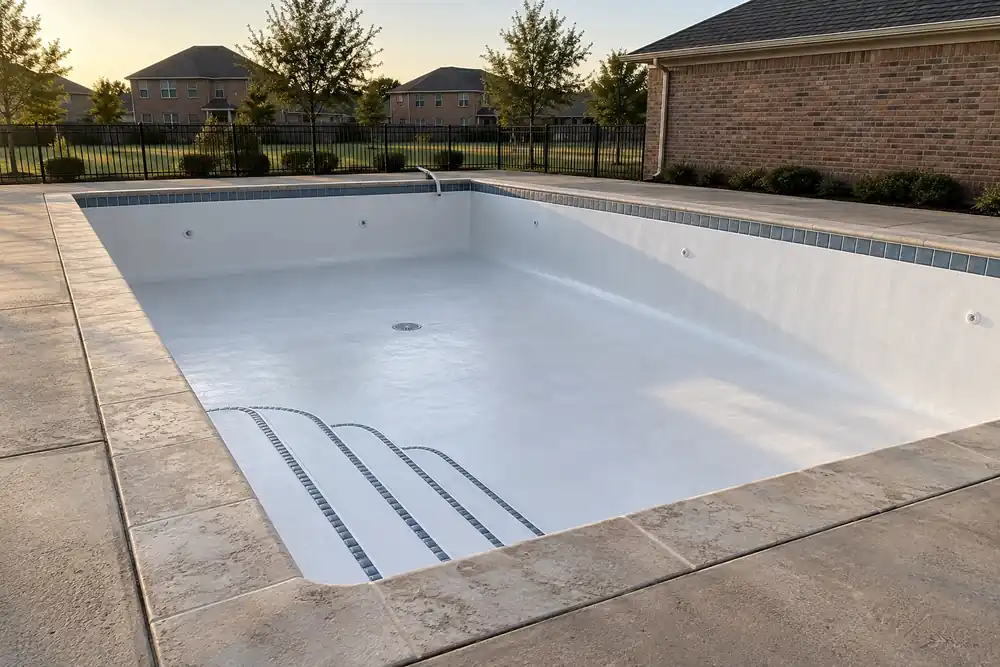
Commercial Pool Resurfacing in Lewisville, Texas
Flower Mound Pool Resurfacing provides commercial pool resurfacing in Lewisville, Texas, where 21,668 of the city's 54,237 housing units, about 40.0%, are in buildings of five or more units, according to the Census Bureau's 2020–2024 estimates.
Lewisville sits nine miles northeast of Dallas–Fort Worth International Airport on Interstate 35E, near Vista Ridge Mall, with Lewisville Lake a mile to the northeast and the City's own Thrive Aquatics facility among its parks. Estimates are free and can be requested at any hour; we'll cover the finish, the closure and the City's sign-offs for an apartment, hotel or club pool.
Call or request a free estimate any time, 24/7
No charge · answered 24/7
Get free estimates
Apartments and rented homes by the numbers
Of those units, 6,352 are in buildings of 50 or more, 24,942 (about 46.0%) are single-family detached houses and 1,310 are mobile homes. More homes are rented than owned: renters occupy 27,874 of the 51,915 occupied homes and owners 24,041, about 46.3%. The 1990s were the biggest building decade, with 12,891 units, the median unit dates from 1997, and the median owner-occupied home is valued at $378,500. The 2020 Census counted 111,822 residents and 46,656 housing units, and the Census Bureau estimates 139,006 residents on July 1, 2025.
A planned mix of housing
The Handbook of Texas describes Lewisville as a planned mix of single- and multiple-family housing with an award-winning park system, and in 2025 the City's Parks and Recreation Department was named a National Gold Medal Award winner. Growth came with the expansion of the lake's dam, Interstate 35E and DFW Airport, then with new industries, corporate moves and Vista Ridge Mall, taking the population to 46,521 in 1990 and 77,737 by 2000.
Flower Mound Pool Resurfacing will go through a property's pools and spas with its manager before any finish is chosen.
Call or request a free estimate any time, 24/7.
(469) 526-3886Semi-public pools under the City Code
Lewisville's code sorts pools three ways. A private pool belongs to a single-family home or duplex, a public pool is open to the general public, and a semi-public pool is privately owned and open only to a defined group, such as motel guests, apartment residents or club members. Nobody may run a public or semi-public pool without a City permit, which names a manager of operations who lives or works on the premises and holds a current certificate from a training course. The fee is due by March 1 each year, and City-owned and private pools are exempt.
The City's Health Services division inspects the public pools and spas run by apartment complexes and hotels, mostly in the summer months, and also inspects after a complaint.
Water and surfaces the code sets for every pool
For public, private and semi-public pools alike, the code wants a pH between 7.2 and 8.2, water clear enough to see the main drain from outside the pool, at least one part per million of chlorine where chlorine is used and no algae, with walls, floors and equipment kept clean and sanitary at all times.
A pool left empty
The owner of a private or semi-public pool that isn't being maintained must drain it and then fill it with dirt or sand or cover it securely, and the code presumes that a pool left drained for 60 days is no longer maintained. That date is worth keeping in view when a resurfacing schedule is set.
Call or request a free estimate any time, 24/7.
(469) 526-3886What Texas asks of a Class C pool's new finish
Texas treats apartment, condominium, hotel, club and property owners association pools as Class C public pools and holds their alteration, renovation and repair to the 2021 edition of the International Swimming Pool and Spa Code. That edition keeps the interior of a non-residential pool from hiding objects or surfaces in the water and sets a floor of 6.5 on the Munsell color value scale, a floor the 2024 edition raises to 8.0. Surfaces that bathers stand on must be slip resistant, and the federal Virginia Graeme Baker Act also counts pools at apartment complexes, residential developments and hotels as public pools for its drain-cover rules.
Markers that sit in the surface
Texas places depth markers in the top 4-1/2 inches of the wall just below the coping, at least two to a pool, with characters at least 4 inches tall in a contrasting color and no more than 25 feet between them. A Class C pool deeper than 5 feet also marks the point where its floor turns from shallow to deep with a permanent contrasting line, for example a band of floor tile 4 inches wide or more, so markers and lines are planned with the new surface.
Call or request a free estimate any time, 24/7.
(469) 526-3886Closing an apartment or hotel pool for a new surface
Texas rules for a public pool shut for renovation keep users and other unauthorized people out of the pool yard and put a closed sign on the entry gates, and a shut pool may not smell or become a breeding site for insects. A gate may be propped open only while the owner's contractor is present doing work that reasonably needs it open. Apartment owners and property owners associations must also check their pool-yard fences, gates and self-closing, self-latching hardware no less than every 31 days, and that duty can't be waived; the enclosure stays at least 48 inches high.
Drought stages and the refill
Under Lewisville's emergency water management plan, Stage 1, Water Watch, is a set of mandatory year-round restrictions aimed at a 5% cut in water use per person per day. Stage 2, Water Emergency, can be triggered once the reservoirs tied to Dallas Water Utilities are more than 50% depleted, and its restricted uses may include draining a swimming pool and then refilling it, so check the stage before a drain date is fixed. A public pool stays closed until the water level is back inside the range its rim, gutter or skimmer system is designed to run at.
Clay soils, rainfall and shell cracks
The soil survey maps 61 units on land inside Lewisville's boundary, the largest being Ovan clay at about 7.2% of the mapped land, Ferris-Heiden clay at 6.5% and the Trinity-Urban land complex at 5.5%, with mapped water covering about 13.7% of the area. Grouped by main soil, Wilson leads at about 9.8%. Wilson reaches 7.5 percent in linear extensibility, a high figure by the limits in the 1980 county survey, and its risk of corroding uncoated concrete is rated High. NRCS's “Very limited” rating for houses, with shrink-swell as a reason, covers about 67.9% of the mapped land.
NOAA's Lewisville Dam station, inside the city, records 36.48 inches of precipitation and 0.1 inch of snow in a normal year for 1991–2020. At public pools, the CDC's Model Aquatic Health Code, a national model that isn't binding in Texas, has operators look at shell cracks in each day's inspection and record and monitor any surface crack narrower than 1/8 inch.
Hallford Prairie to Lewisville Lake
The families of John King and his son Augustus, from Missouri, became the first settlers of Hallford Prairie in 1844. Basdeal W. Lewis bought the Hallford properties in 1853 and established Lewisville, which got its post office that year, and by 1867 the first cotton gin in Denton County stood there. The Dallas and Wichita Railway arrived in 1881; the town reached 815 people and incorporated in 1925, and it has been a home-rule city since 1962. In August 1969 the three-day Texas International Pop Festival, with Janis Joplin and B. B. King, drew 120,000 people.
The Corps of Engineers began the present dam in 1948, started impounding water on November 1, 1954, and finished the 125-foot-high, 33,000-foot-long dam in 1955. On October 28, 1957, the breaching of the old Garza Dam joined the older Lake Dallas to it, making a lake 13 miles long with a 183-mile shoreline that the Corps runs for flood control, local water supply and recreation.
Commercial resurfacing beside tile, decks and remodels
Reserve-planning sources put a commercial replaster at $6.50 to $8.00 for each square foot of walls and floor nationally in 2026, and a typical HOA community pool's replaster at $8,000 to $25,000, depending on its area and finish. Each pool is priced once it has been measured; those national figures are a guide only.
Besides resurfacing, Flower Mound Pool Resurfacing takes on commercial pool remodels, HOA and community pools, tile lines and depth markers, coping and deck resurfacing. For The Colony and Hebron, see pool crack repair in The Colony and cool deck repair in Hebron.
Steps in a commercial resurfacing
Measure the interior
Walls and floor are measured together, because that interior area, not the water’s surface, is what a commercial finish is priced on.
Ask the City
Lewisville says whether the work needs a building permit and how the closure bears on the pool’s operating permit.
Close the pool yard
Users are kept out, the gates carry a closed sign, and the enclosure checks keep their 31-day rhythm.
Prepare the shell
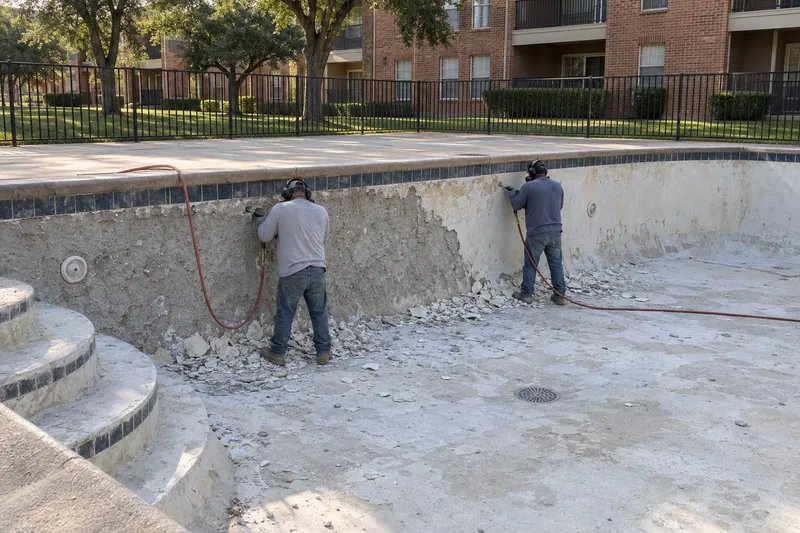
Hollow or delaminated plaster is sounded out and cut away, and drain covers are checked for cracks, damage or an expired design life while the pool is empty.
Apply and fill
The finish goes on, then the fill runs straight through, because a pause in it can leave a discolored ring, the National Plasterers Council says.
Balance and reopen
Once the pool reopens, its water must meet the City’s pH and chlorine rules.
Call or request a free estimate any time, 24/7.
(469) 526-3886Plan a commercial pool resurfacing in Lewisville
Reach Flower Mound Pool Resurfacing by phone or form at any hour. Tell us the kind of property, how many pools and spas it has, and when they can close.